
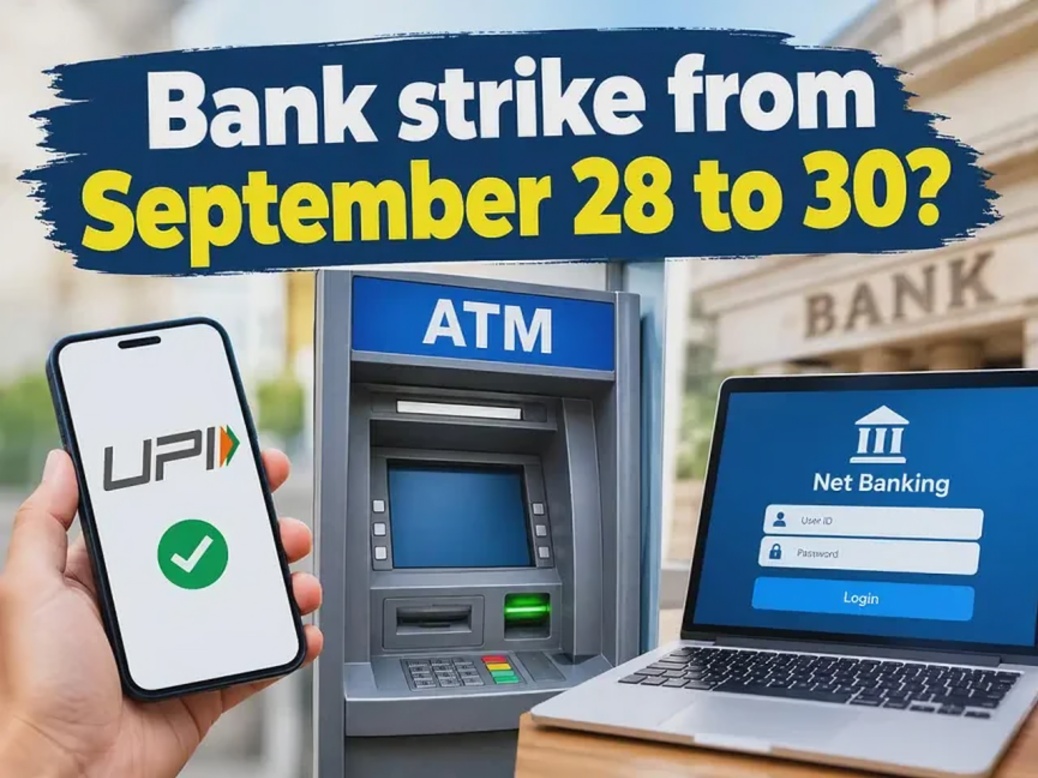
Bank customers across India are likely to face disruptions in branch-based banking services from September 28 to September 30, 2026, as the United Forum of Bank Unions has decided to proceed with a three-day nationwide strike.
The proposed strike is being organised by bank unions mainly over their demand for a five-day working week in the banking sector. The unions have maintained their decision to proceed with the strike after discussions and a conciliation meeting failed to resolve the outstanding issue. The government and bank managements have appealed for continued discussions and uninterrupted banking services.
With the strike dates approaching, banks have started informing customers about possible disruptions. State Bank of India, Bank of Baroda and Canara Bank are among the banks that have advised customers to complete important branch-related work before September 28.
Customers who need to visit a branch for documentation, transactions or other services that require employee assistance may therefore want to complete those activities before the strike begins. Banks have indicated that branch operations could be affected depending on employee participation in the strike.
State Bank of India has specifically advised customers to complete important banking transactions before the strike period. The bank has also asked customers to make use of alternative banking channels, including ATMs and Automated Deposit and Withdrawal Machines for cash requirements.
Customers can also use Customer Service Points for eligible services. Internet banking, mobile banking, YONO and UPI have been highlighted as alternative channels for routine banking requirements.
The important point for customers is that the proposed strike does not necessarily mean that every banking service will stop. Branch operations are expected to be the area most directly affected by employee participation. Digital and self-service banking facilities may continue to be available, although individual services can depend on the bank and the nature of the transaction.
UPI is expected to remain an important option for customers during the strike period. People who normally use UPI for payments, money transfers and other routine transactions can continue to use the service where it is available through their respective banks and payment applications.
Internet banking and mobile banking are also expected to provide alternatives for customers who need to transfer funds, check account information or complete other eligible digital transactions.
Customers who require cash can use ATMs where services are available. Banks have advised customers to plan their cash requirements instead of waiting until the strike period. ATM availability can vary depending on location and cash replenishment, so customers with specific cash requirements may prefer to plan in advance.
The timing of the strike is also significant. September 26 and September 27, 2026, fall on Saturday and Sunday, immediately before the proposed three-day strike. September 30 is also the half-yearly closing date for banks. As a result, customers who depend on branch services could experience a longer period of limited access around the end of the month. However, this does not mean that all bank branches will necessarily remain closed continuously for five days.
The Ministry of Finance has also highlighted the importance of maintaining essential banking services during the strike period. According to the ministry, the proposed strike from September 28 to September 30 comes at a time when banks are approaching their half-yearly closing activities. The government has said that measures are being considered to reduce disruption to customers, businesses and other banking operations.
The United Forum of Bank Unions has continued to press for the implementation of a five-day banking week. The government has stated that the Performance Linked Incentive issue has already been kept in abeyance, while the remaining major issue concerns the five-day working week. The unions have maintained that the unresolved issue is the reason for continuing their strike programme.
For customers, the immediate priority is to identify whether any pending banking work requires a physical branch visit. If a transaction involves documentation, verification, account-related assistance or another service that cannot be completed through digital channels, customers should consider completing it before September 28.
For routine transactions, customers can use UPI, mobile banking and internet banking where available. ATMs and other self-service facilities can be used for eligible cash-related requirements. Customer Service Points and business correspondents may also provide selected services depending on the bank.
Customers should also avoid assuming that every digital service will operate in exactly the same way throughout the strike. Bank-specific advisories should be followed, particularly for transactions that are time-sensitive or require employee intervention.
The proposed three-day strike is currently scheduled for September 28, September 29 and September 30, 2026. The government has urged bank employees to continue discussions rather than proceed with the strike, while the unions have said they will go ahead with the planned action.
The government has also stated that an indefinite strike has been proposed from October 26 if the five-day working week issue remains unresolved. This is a separate future action and is subject to developments in discussions between the unions, government and banking management.
For now, bank customers should plan their branch-related requirements ahead of September 28. Using digital banking, UPI and ATMs for eligible routine services can help reduce dependence on branch operations during the proposed strike period.