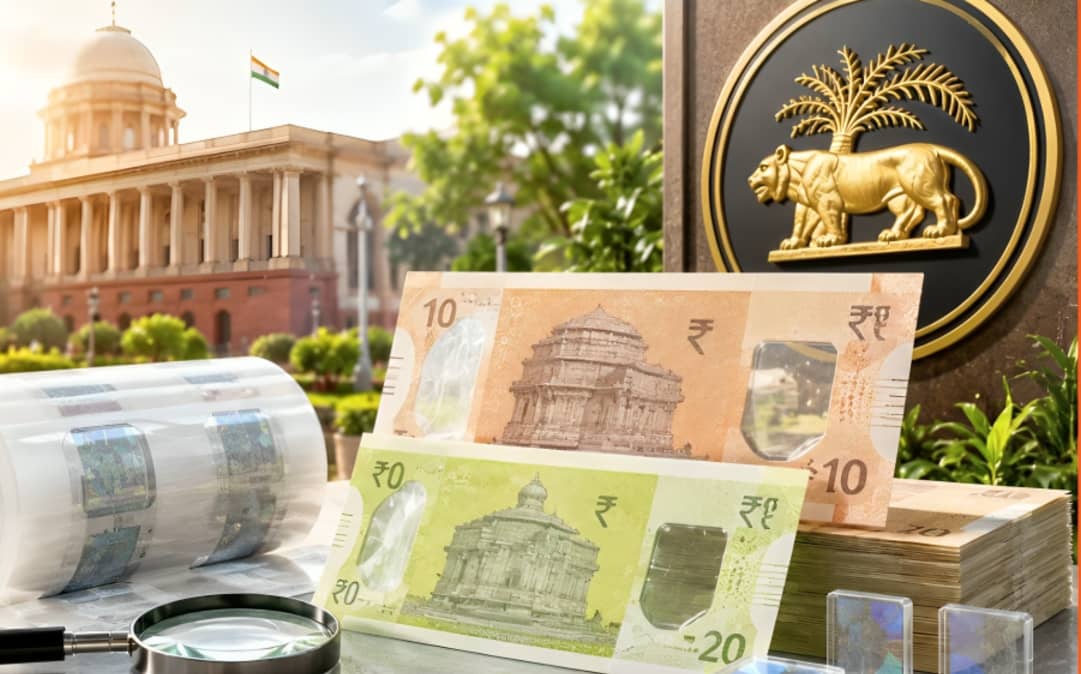

The Central Government has approved the Reserve Bank of India proposal to conduct field trials of polymer banknotes in Rs 10 and Rs 20 denominations. The move marks another step towards evaluating whether polymer can be used more widely for India's currency system.
Under the approved proposal, the RBI will conduct field trials involving one billion pieces of Rs 10 polymer banknotes and one billion pieces of Rs 20 polymer banknotes. The proposed trials are intended to assess how the notes perform under real world conditions before any decision is taken on regular issuance.
The proposal was sent by the RBI to the government under Section 25 of the Reserve Bank of India Act, 1934. The government has approved the proposal, allowing the central bank to proceed with the field trial process. Regular issuance of polymer banknotes in these denominations will depend on the successful completion of the trials.
Polymer banknotes are made from a durable plastic based material rather than conventional cotton based paper. One of the main reasons for considering polymer currency is its expected durability. Such notes can generally withstand repeated handling, moisture and everyday wear better than traditional paper banknotes.
The longer life of polymer notes could potentially reduce the frequency with which damaged currency needs to be replaced. This could have implications for the cost of printing, transporting, processing and disposing of worn out banknotes.
Security is another important consideration. Polymer banknotes can incorporate security features such as transparent sections and other specialised elements that may make counterfeiting more difficult. However, the effectiveness and suitability of such features will be assessed as part of the Indian field trials.
The field trial will also allow the RBI to study how the notes perform in India's diverse climate and usage conditions. Currency notes are handled extensively by members of the public, businesses, banks, ATMs and cash management systems. Their performance under these conditions will be important in determining whether polymer notes are suitable for wider circulation.
The government approval does not mean that existing paper Rs 10 and Rs 20 notes will immediately disappear from circulation. The current proposal is for field testing, and any future transition would depend on the results of the trials and subsequent decisions by the authorities.
The RBI has begun the procurement process required for the trial. Reports indicate that the procurement process is currently underway, meaning the exact timing of the field rollout depends on the completion of procurement and related preparations.
The proposal has attracted attention because India has considered polymer currency at various points in the past. Earlier trials and discussions have examined whether polymer notes could offer advantages over conventional paper currency, particularly in terms of durability and security.
Several countries around the world already use polymer banknotes for selected denominations or entire currency series. Their experience has provided central banks with information about the advantages and challenges associated with the material.
For India, however, the scale of the currency system makes any change a significant undertaking. Millions of notes are produced, distributed and handled across the country every day. A move towards polymer currency would therefore require careful testing of printing technology, banking equipment, cash handling systems and public acceptance.
The Rs 10 and Rs 20 denominations have been selected for the proposed field trials. These denominations are widely used for everyday transactions, making them useful for evaluating how polymer notes perform under frequent handling.
The trial process can also help authorities understand how consumers respond to the new material. Factors such as ease of handling, folding, identification and compatibility with cash counting and sorting machines could all be evaluated.
Another important consideration is the overall cost. Although polymer notes can have a longer usable life, their production may involve different manufacturing and processing requirements compared with traditional banknotes. Authorities will therefore need to assess the total cost over the life of the currency.
Environmental considerations may also form part of the broader assessment. A longer lasting banknote could reduce the number of notes that need to be replaced, but the production and disposal of polymer material also require appropriate systems.
The RBI is expected to assess the results of the field trials before making any recommendation regarding regular circulation. If the trials demonstrate that polymer notes are durable, secure and economically practical, the central bank could consider wider issuance in the future.
Until then, the existing paper currency system will continue to operate. The approval should therefore be viewed as a testing and evaluation exercise rather than an immediate change to the notes used by the public.
The proposed introduction of polymer Rs 10 and Rs 20 notes represents an effort to explore new approaches to currency management in India. The RBI will have to consider durability, security, production costs, public convenience and the operational requirements of banks before taking any further decision.
The government has approved the initial proposal, and the field trial process is now the next important stage. The outcome of these trials will determine whether polymer banknotes move from testing to regular circulation.
For consumers, there is no immediate requirement to exchange existing Rs 10 or Rs 20 notes. Current notes will continue to be part of the currency system unless the RBI announces any future change.
The development is therefore best understood as a pilot initiative aimed at evaluating a possible new type of Indian currency. The RBI's procurement and field testing process will provide more clarity on the practical performance and future of polymer banknotes in India.