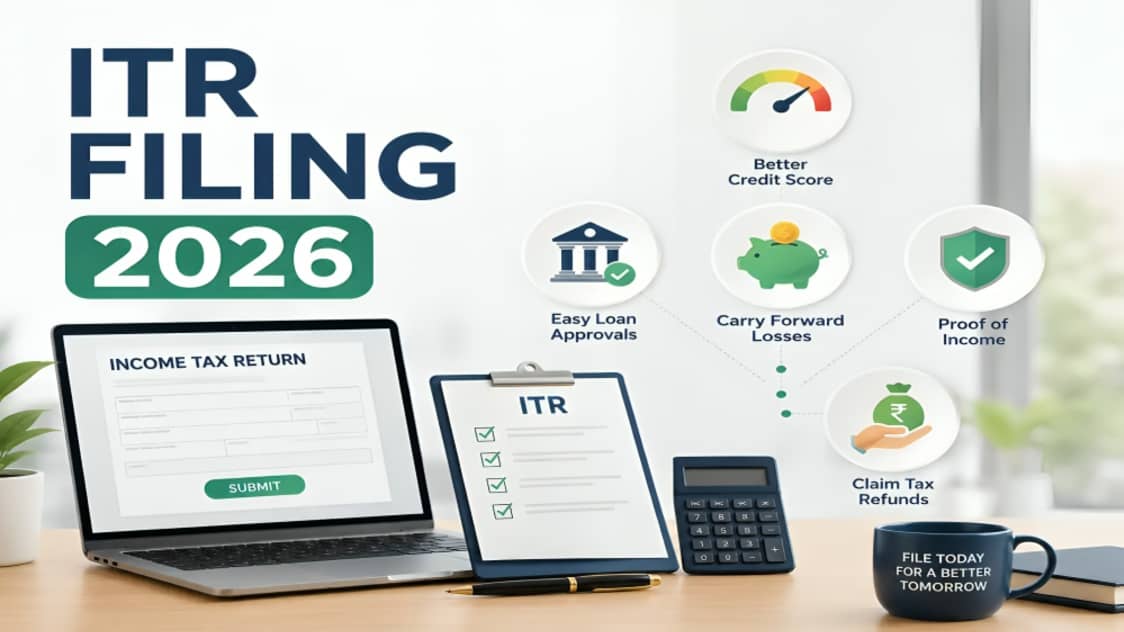

Taxpayers engaged in Futures and Options trading should be aware that the tax treatment of derivative transactions differs from that of investments in equity shares. For Income Tax Return filing in 2026, individuals and businesses involved in Futures and Options trading are generally required to report such income under the head of business or profession, rather than as capital gains, subject to the provisions of the Income Tax Act and the facts of each case.
Unlike investors who purchase and sell equity shares for investment purposes, Futures and Options traders participate in derivative contracts traded on recognized stock exchanges. Since these transactions are generally considered business activities, the resulting profits or losses are normally taxed as business income.
One of the most important aspects of filing returns for Futures and Options trading is selecting the appropriate Income Tax Return form. Taxpayers reporting business income are generally required to file forms applicable to business or professional income, depending on their nature of income and eligibility under the Income Tax Department's rules.
Another important requirement is the calculation of turnover. In Futures and Options trading, turnover is not simply the total value of all contracts traded. Instead, turnover is generally computed according to guidance issued by the Institute of Chartered Accountants of India and applicable tax provisions, taking into account absolute profits and losses from derivative transactions and other prescribed adjustments where applicable.
Correct turnover calculation is important because it determines whether a taxpayer may be subject to tax audit requirements. Under the Income Tax Act, businesses crossing specified turnover limits or failing to satisfy certain presumptive taxation conditions may be required to undergo a tax audit by a qualified Chartered Accountant before filing their returns.
Tax audit provisions depend on several factors, including turnover, cash transactions, accounting methods, and declared profits. Taxpayers should carefully examine the applicable provisions for the relevant assessment year or consult a qualified tax professional to determine whether a tax audit is mandatory.
Futures and Options traders should also maintain proper books of account and preserve trading statements, broker contract notes, profit and loss reports, bank records, and other supporting documents. These records help ensure accurate reporting and may be required in the event of any verification by the Income Tax Department.
Another important feature of taxation for derivative traders is the treatment of losses. Business losses arising from eligible Futures and Options transactions may generally be adjusted against certain categories of business income, subject to the provisions of the Income Tax Act. Unabsorbed eligible losses may also be carried forward for adjustment in future years if the return is filed within the prescribed due date and other legal conditions are satisfied.
Timely filing of Income Tax Returns is essential for taxpayers wishing to preserve the benefit of carrying forward eligible business losses. Missing statutory deadlines may result in the loss of certain tax benefits available under the law.
Tax experts also advise traders to reconcile broker statements with Annual Information Statement data, Tax Deducted at Source information where applicable, and other financial records before submitting their returns. Proper reconciliation helps reduce the possibility of reporting errors or receiving notices from the tax authorities.
With increasing participation in derivative trading among retail investors, tax compliance has become more important than ever. Understanding the distinction between business income and capital gains is essential for accurate tax reporting and avoiding potential penalties arising from incorrect classification.
Taxpayers should carefully review the latest instructions issued by the Income Tax Department for the relevant assessment year and ensure that all disclosures are complete and accurate. Where the tax position is uncertain, obtaining advice from a Chartered Accountant or qualified tax professional is recommended.
By selecting the correct Income Tax Return form, maintaining proper records, calculating turnover accurately, and complying with tax audit and loss adjustment rules where applicable, Futures and Options traders can fulfil their tax obligations while minimizing the risk of future compliance issues.