
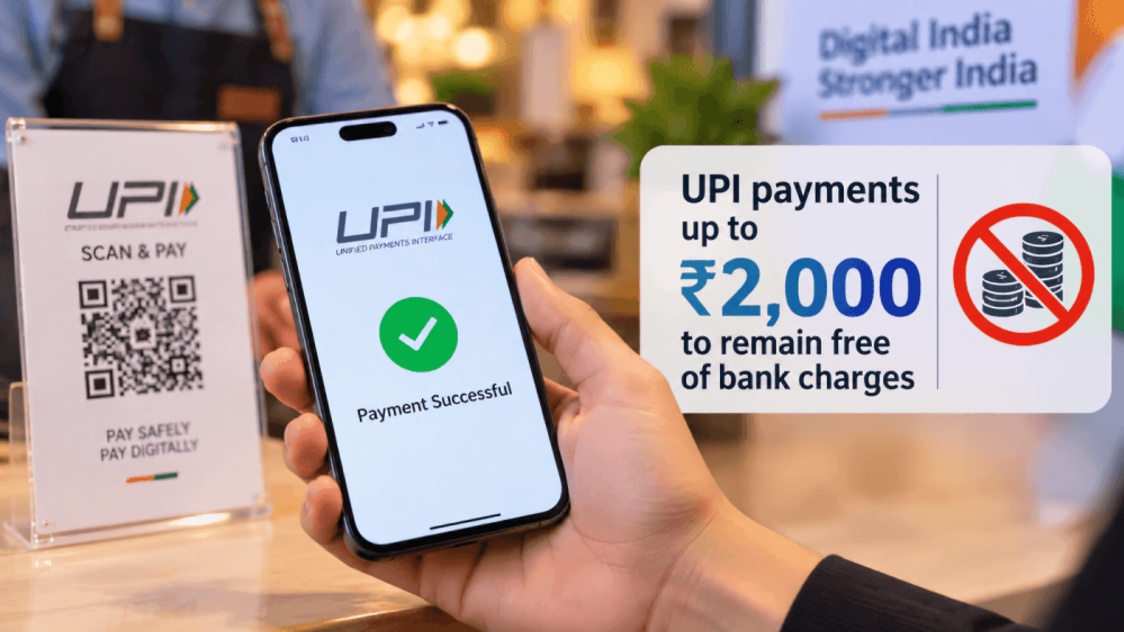
The Central government has issued a new notification clarifying that Unified Payments Interface transactions of up to Rs 2,000 will remain protected from direct and indirect charges. The decision provides statutory protection for smaller UPI payments and comes amid recent discussions about whether charges could eventually be introduced for higher-value transactions.
The Ministry of Finance issued the notification under Section 10A of the Payment and Settlement Systems Act, 2007. Under the notification, UPI transactions up to Rs 2,000 and payments made using RuPay-powered debit cards have been specified as electronic modes of payment on which banks and system providers cannot impose direct or indirect charges.
For ordinary UPI users, the immediate impact is straightforward. If a person makes a UPI payment of Rs 500, Rs 1,000, Rs 1,500 or Rs 2,000, the transaction remains protected from charges under the newly notified framework.
The notification also covers the person receiving the payment. Banks and system providers are prohibited from imposing a direct or indirect charge on either the person making or receiving a payment through the specified electronic modes. This provides protection for both sides of eligible transactions.
RuPay debit card payments have also been included in the government notification. This means payments made through RuPay-powered debit cards are covered by the no-charge provision specified by the government.
The latest move comes after growing discussion about the future of the Merchant Discount Rate, commonly known as MDR, on UPI transactions. MDR is a fee associated with processing certain digital payments and is generally linked to the merchant side of a transaction rather than being a direct fee charged to the consumer.
For several years, UPI has operated without a conventional MDR on most transactions. The government and the payments ecosystem have instead used other mechanisms to support the cost of maintaining and expanding the digital payments infrastructure.
The latest notification does not announce an MDR rate for UPI payments above Rs 2,000. This distinction is important for consumers. The government has protected payments up to the specified threshold, but it has not automatically introduced a fee on every UPI payment above that amount.
For example, a person paying Rs 5,000 or Rs 10,000 through UPI is not automatically required to pay a government-mandated consumer transaction fee simply because the payment exceeds Rs 2,000. Any future change to charges on larger transactions would depend on further policy or regulatory decisions.
The notification is therefore better understood as defining the category of digital payments that will remain legally protected from charges under the amended framework. It does not by itself establish a new fee for higher-value transactions.
The move is significant because UPI has become a central part of India's digital payments ecosystem. Millions of consumers use UPI every day for purchases, bill payments, money transfers and other financial transactions.
According to government data, UPI processed 2,366 crore transactions worth Rs 29.9 lakh crore in July 2026 alone. The government has described UPI as the world's largest real-time payment system by transaction volume and has continued to support its expansion.
The scale of UPI means that even a small change in the payment-cost structure could have implications for banks, payment companies, merchants and consumers. This is why the recent clarification has attracted significant attention from the digital payments industry.
Another important issue is the difference between consumer charges and merchant-side charges. Government statements have indicated that consumers are not intended to face transaction fees, while any future MDR could apply to a limited category of merchant transactions above a specified threshold.
This distinction means that consumers should not interpret the new Rs 2,000 threshold as a direct announcement that UPI will become chargeable for individuals. The current notification specifically protects transactions up to Rs 2,000.
The possibility of charges on higher-value merchant transactions has nevertheless become an important subject of discussion. Industry participants have argued that some form of MDR could provide banks and payment service providers with an additional revenue stream to support the cost of operating the payments ecosystem.
At the same time, policymakers need to consider the impact of any potential charges on merchants. If payment processing costs increase, businesses could face higher operating expenses. The effect could vary depending on the size and type of merchant and the structure of any future MDR.
The government has therefore maintained a distinction between protecting small-value digital payments and considering the economics of larger transactions.
Data on transaction volumes also helps explain why the Rs 2,000 threshold is important. Recent reports indicate that transactions above Rs 2,000 account for a relatively small share of UPI transactions by volume, although they represent a much larger share of the overall value processed through the system.
This means that protecting transactions up to Rs 2,000 covers a large portion of everyday UPI usage. Small purchases at shops, restaurants, local businesses and other establishments can continue to be processed without the direct or indirect charges prohibited by the notification.
For users, there is therefore no immediate need to change how they use UPI for ordinary low-value payments. The notification preserves the no-charge protection for transactions within the Rs 2,000 limit.
For merchants, however, the discussion around higher-value payments will remain important. Businesses that regularly receive larger UPI payments will be watching for any further announcements regarding MDR, eligibility and payment-processing costs.
Banks and payment service providers will also be closely monitoring the policy developments. UPI has generated enormous transaction volumes, but maintaining the infrastructure requires investment in technology, cybersecurity, payment processing and customer support.
The government has previously provided financial support to encourage low-value digital payments. The broader objective has been to promote digital transactions and ensure that payment services remain accessible to consumers and merchants.
The latest notification fits into that broader policy approach by protecting smaller UPI transactions from charges while leaving room for further policy decisions concerning larger transactions.
It is also important to distinguish UPI transactions from other forms of digital payment. The notification specifically identifies UPI transactions up to Rs 2,000 and RuPay-powered debit card payments for the no-charge protection. Other payment methods can have their own fee structures and regulations.
For consumers, the key takeaway is that the Rs 2,000 threshold is currently a protection limit, not a mandatory spending limit. Users can continue making UPI payments above Rs 2,000, and there is currently no automatically applicable government consumer fee simply because a payment exceeds the threshold.
The policy could evolve if the government or relevant authorities later announce rules concerning larger transactions. Until such an announcement is made, users should not assume that every payment above Rs 2,000 will attract a charge.
The new notification is therefore likely to remain an important development in India's digital payments policy. It provides clarity for smaller UPI transactions while leaving the question of potential charges on larger transactions open for further consideration.
For now, consumers making UPI payments up to Rs 2,000 can continue to use the service without concern about direct or indirect charges covered by the notification. RuPay debit card users also continue to receive the specified no-charge protection.
The larger question is how India's payment ecosystem will eventually balance consumer convenience, merchant costs and the financial sustainability of payment infrastructure. Any future decision on charges for higher-value UPI transactions will be closely watched by the entire digital payments industry.