
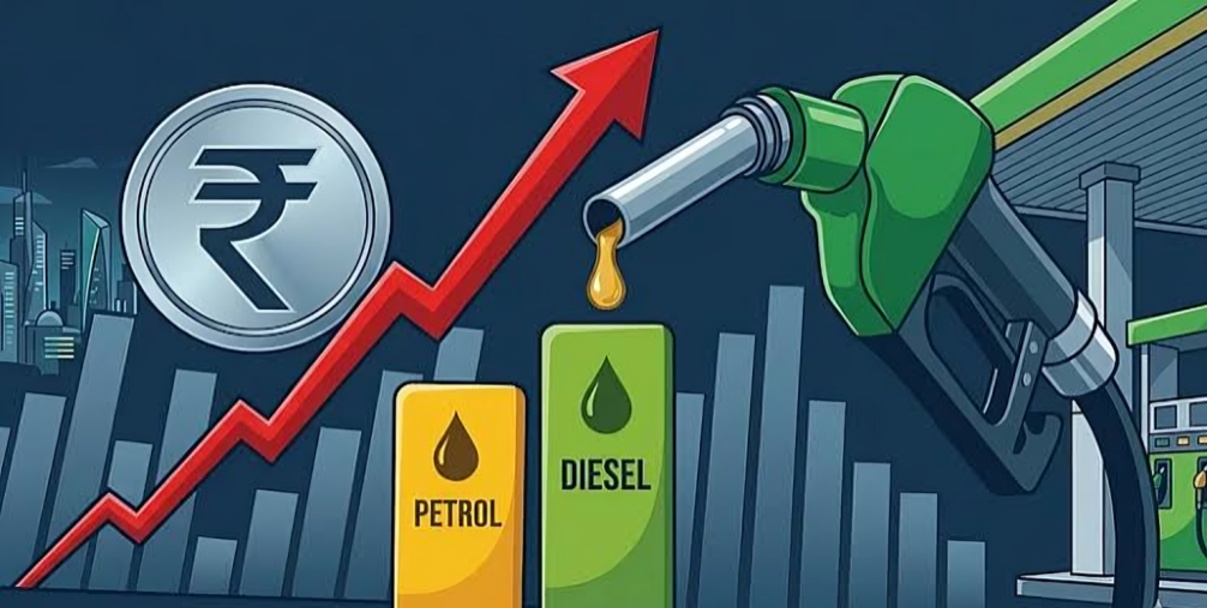
Crude oil prices have once again crossed the psychologically important 100 dollar per barrel mark, creating fresh concerns over fuel prices, inflation and household expenses in India.
Brent crude, the international benchmark, settled at 101.21 dollars a barrel on September 9 after rising sharply amid escalating tensions in the Middle East. The price had touched an intraday high of 101.58 dollars. The latest increase has renewed concerns about the impact of higher global energy costs on countries such as India that depend heavily on imported crude oil.
The immediate question for Indian consumers is whether higher crude prices will translate into higher petrol and diesel prices. The answer is not necessarily immediate. Domestic fuel prices depend on several factors, including international crude prices, the exchange rate, refining costs, freight and insurance expenses, taxes and the pricing decisions of oil marketing companies.
Indian oil marketing companies are already facing pressure on their fuel marketing margins. Recent reports indicate that the Indian crude basket has moved above 100 dollars a barrel, while the margins on petrol and diesel have come under pressure. This means prolonged high crude prices could make it more difficult for oil companies to maintain existing retail prices without absorbing larger losses.
The situation is particularly important for India because crude oil is a major import for the country. When international oil prices rise, the cost of importing crude can increase substantially. A weaker Indian rupee against the US dollar can add another layer of pressure because crude oil is traded internationally in dollars.
If high crude prices continue for an extended period, the impact could gradually spread beyond petrol and diesel. Transportation is one of the first areas likely to feel the pressure because road transport depends heavily on diesel and petrol. Higher transportation costs can increase the expenses involved in moving food, consumer goods and industrial products across the country.
This can eventually affect household budgets. Even when consumers do not directly purchase large quantities of fuel, higher transportation and logistics costs can contribute to increased prices for vegetables, groceries, manufactured goods and other essential products.
LPG is another important area for households. Cooking gas prices are influenced by international energy prices and government policy. IndianOil's official price information currently lists the non-subsidised 14.2 kg Indane LPG cylinder at 942 rupees in Delhi, 968 rupees in Kolkata, 941.50 rupees in Mumbai and 957.50 rupees in Chennai. These prices can change based on government decisions and market conditions.
However, consumers should not assume that a crude oil price above 100 dollars automatically means an immediate increase in LPG or petrol prices. The government and oil marketing companies can use different measures to manage the impact of global price movements. IndianOil previously stated in May 2026 that retail prices of petrol, diesel and domestic LPG had remained unchanged despite an increase in international fuel prices.
CNG prices could also face indirect pressure, although the relationship between crude oil and CNG prices is different from that of petrol and diesel. CNG prices are influenced by domestic and imported natural gas costs, distribution expenses, taxes and local pricing decisions. Therefore, an increase in crude oil prices does not automatically result in an equivalent increase in CNG prices.
The biggest concern at present is whether crude prices remain above 100 dollars for a prolonged period. A short-term spike may not necessarily result in an immediate change in retail fuel prices. However, if international prices remain elevated because of prolonged supply disruptions, oil companies could face increasing pressure.
The recent rise in crude prices has been linked to growing concerns about oil supply disruptions in the Middle East. The Strait of Hormuz is particularly important to global energy markets because a substantial share of international oil and gas supplies has historically moved through the waterway. Recent attacks and disruptions have increased concerns about the reliability of energy shipments from the region.
For India, sustained disruption could increase the import bill and place additional pressure on inflation and the rupee. Higher energy costs can also affect industries that depend on fuel and transportation, potentially increasing production and distribution expenses.
Consumers therefore need to distinguish between the possibility of higher fuel prices and an officially announced price increase. At present, crude oil crossing 100 dollars is a significant warning signal, but it does not by itself confirm an immediate petrol, diesel, LPG or CNG price hike.
The key factors to watch in the coming days will be international crude prices, the Indian crude basket, the rupee-dollar exchange rate, global supply disruptions and the pricing decisions of Indian oil marketing companies.
If crude prices remain elevated, the pressure on fuel costs and the wider economy could increase. If geopolitical tensions ease and global oil supplies recover, prices could move lower and reduce some of that pressure.
For households, the latest development is therefore a reason to monitor fuel prices and monthly expenses rather than assume that a price hike is certain. The longer crude remains above 100 dollars a barrel, the greater the potential pressure on India's fuel costs, transportation expenses and overall inflation.