
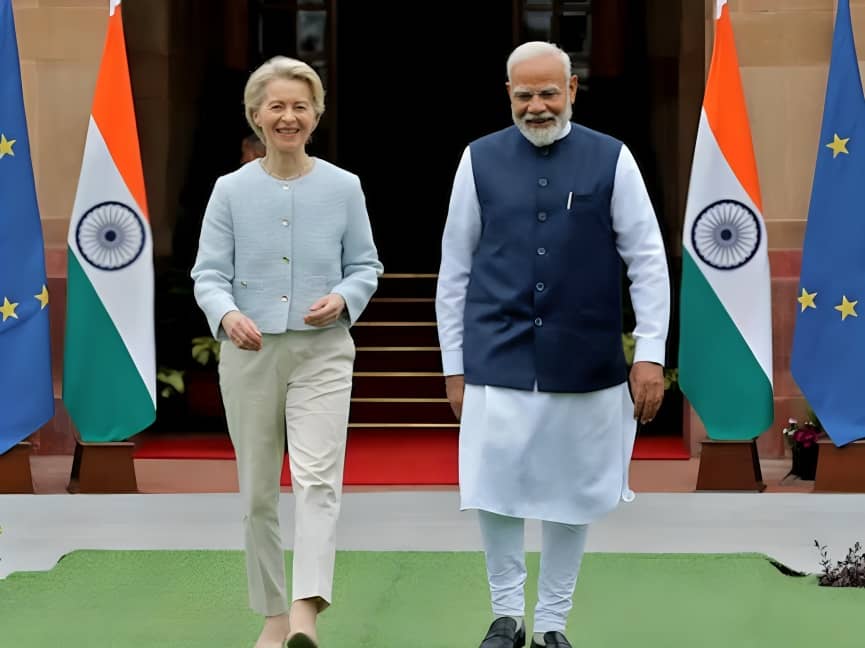

India and the European Union have formally concluded a landmark Free Trade Agreement that is expected to significantly reshape trade relations between the two economies. Prime Minister Narendra Modi announced the development on January 27, calling it one of the most important trade agreements signed by India in recent years. He said the deal represents a major step forward in India’s engagement with global markets.
According to the Prime Minister, the India–EU FTA will lead to the reduction or elimination of tariffs on approximately 96.6 percent of Indian goods exported to European markets. This move is expected to boost Indian exports across multiple sectors, including manufacturing, textiles, pharmaceuticals, engineering goods, and processed food products.
Speaking during a virtual address at the Indian Energy Week, Prime Minister Modi highlighted the scale of the agreement. He noted that India and the European Union together account for around 25 percent of global gross domestic product and nearly one third of total global trade. He described the agreement as an example of strong economic coordination between two major global economies.
The agreement has been described by policymakers and analysts as a transformational deal due to its wide coverage and long term impact. For Indian exporters, lower tariffs are expected to improve competitiveness in European markets, making Indian products more affordable and attractive to consumers across EU member states. Small and medium enterprises are also expected to benefit as improved market access could help them expand their international footprint.
For Indian consumers, the FTA could gradually lead to greater availability of high quality European goods at competitive prices. Sectors such as automobiles, renewable energy equipment, advanced machinery and luxury goods may see increased imports as trade barriers are lowered over time.
The deal is also expected to strengthen investment flows between India and Europe. With clearer trade rules and reduced tariff uncertainty, European companies may increase investments in India, particularly in manufacturing, clean energy, digital infrastructure and advanced technology sectors. At the same time, Indian companies are likely to explore expansion opportunities in Europe with greater confidence.
Prime Minister Modi said the agreement opens up significant opportunities for India’s 140 crore citizens as well as for European economies. He added that the FTA aligns with India’s long term vision of becoming a global manufacturing and export hub while maintaining balanced trade relationships.
While the agreement marks a major milestone, experts note that its real impact will depend on effective implementation and coordination between regulatory authorities on both sides. Businesses will also need time to adapt to new trade rules, standards and compliance requirements.
Overall, the India–EU Free Trade Agreement is being seen as a strategic move that strengthens economic ties, promotes growth and positions India more firmly within global value chains. As the agreement comes into force, its benefits are expected to unfold gradually, shaping trade and investment patterns in the years ahead.


