
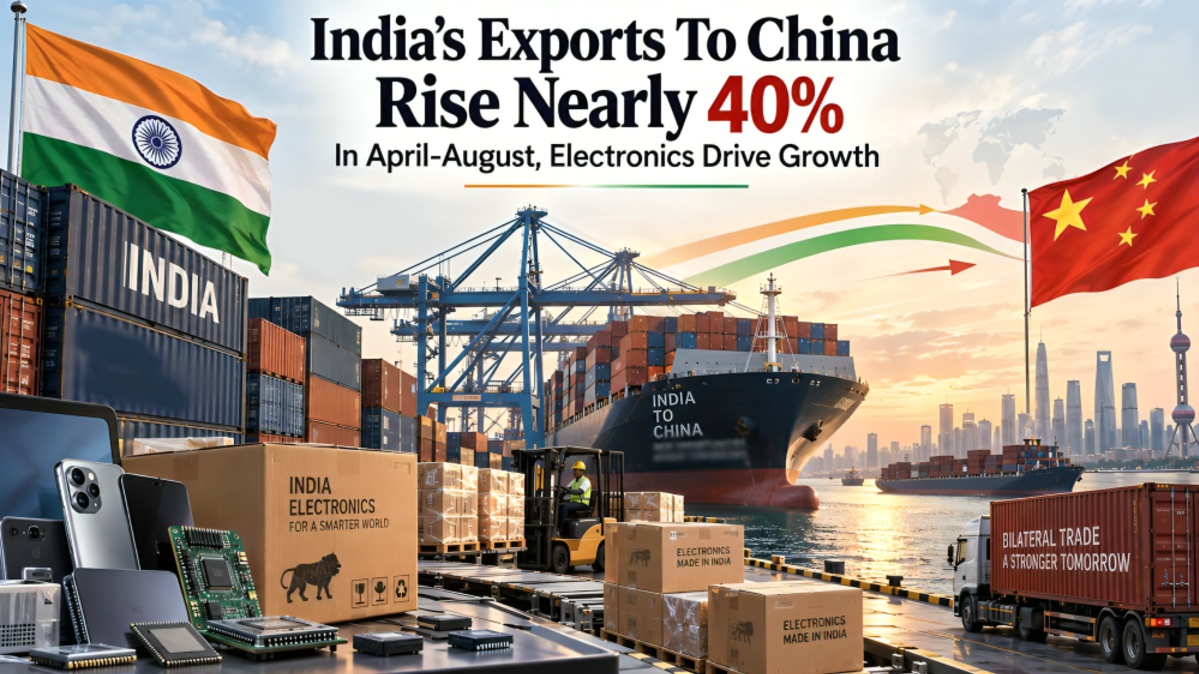
India’s exports to China have recorded a sharp increase during the first five months of the current financial year, with electronics and engineering products emerging as important contributors to the growth. Government trade data shows that India’s merchandise exports to China increased by 38.71 percent year on year during April to August 2026, reaching approximately 9.61 billion dollars compared with 6.93 billion dollars during the corresponding period of the previous year.
The increase marks a notable change in India’s export pattern to China, where manufactured goods and electronic products have historically faced strong competition. The latest growth comes as Indian manufacturers expand their production capabilities and seek a larger role in global supply chains.
Electronics have been one of the most visible areas of growth. According to the government data cited in recent reports, electronics exports to China increased by more than 15 percent during April to August compared with the same period a year earlier. Engineering goods also recorded strong growth, increasing by about 21 percent during the period.
Industry representatives have linked part of the electronics growth to increasing global demand for equipment and components associated with artificial intelligence and data centres. The rapid expansion of AI infrastructure globally has created additional demand for electronic equipment, components and related manufacturing capabilities.
Rajoo Goel, secretary general of the Electronic Industries Association of India, said the increase was partly connected to pressure on suppliers to meet demand for high-end equipment required for AI-related products and the expansion of data centres.
India’s electronics manufacturing base has also expanded significantly in recent years. Products such as printed circuit board assemblies, smartphones, display modules and telecommunications equipment have contributed to the increase in electronics exports to China.
In the financial year ended March 2026, India’s electronics exports to China had already increased substantially. Recent reports citing government data said electronics shipments to China tripled to about 3.18 billion dollars during that financial year. Printed circuit board assemblies, smartphones, display modules and telecom equipment were among the products contributing to the increase.
Printed circuit board assemblies have emerged as a particularly notable part of the export story. Business Standard reported earlier this year that India’s PCBA exports to China increased more than 40 times in FY26 to approximately 1.5 billion dollars. Around 80 percent of India’s total PCBA exports went to China during that year.
The growth in engineering exports is another important development. Machinery and parts, automobile components and hand tools are among the engineering products being shipped from India to China. The increase suggests that Indian manufacturers are gradually participating in more industrial supply chains rather than relying primarily on traditional commodity exports.
Government data cited by the Times of India showed that engineering goods accounted for 20.73 percent of the growth in exports to China during April to August. Electronic goods contributed 15.4 percent, while petroleum products, organic and inorganic chemicals and iron ore also contributed to the overall increase.
The rise in exports comes at a time when India and China are also seeking to improve their economic relationship after a period of strained bilateral ties. Changes in global trade conditions and shifts in international supply chains have encouraged companies to reassess manufacturing and sourcing locations.
For India, the increase provides evidence of expanding manufacturing capacity and greater participation in international supply chains. Industry representatives have said that the next challenge is to maintain the momentum and expand exports beyond relatively simple assemblies into components, sub-assemblies and higher-value finished products.
Pankaj Mohindroo, chairman of the Indian Cellular and Electronics Association, said the increase indicates that Indian manufacturing is gaining credibility in global value chains. The comments underline the importance of converting the recent rise in shipments into sustained export growth.
However, the latest figures should also be viewed in the context of the overall India China trade relationship. Despite the strong percentage increase, China remains a relatively small destination for Indian exports. China accounted for about 4.4 percent of India’s exports in the financial year ended March 2026, while the United States remained India's largest export market.
At the same time, India continues to import considerably more goods from China than it exports to its neighbour. According to the Indian Embassy in Beijing, India’s exports to China reached 19.47 billion dollars in FY2025-26, while imports from China stood at 131.63 billion dollars. This resulted in a trade deficit of approximately 112.16 billion dollars.
The Department of Commerce’s trade portal also lists China among India’s leading trading partners. The latest government figures show exports of 19.47 billion dollars and imports of 131.62 billion dollars for FY2025-26, highlighting the continuing size of the bilateral trade imbalance.
This means that the recent export increase, while significant in percentage terms, has not materially changed the overall trade balance between the two countries. India’s imports from China remain several times larger than its exports.
Another important factor is the relatively low base from which some of the recent export growth has occurred. Analysts and industry participants have noted that the percentage increase should therefore be interpreted alongside the absolute value of shipments.
The changing composition of exports is nevertheless significant. A larger share of electronics, engineering products and manufactured goods could help India diversify its export basket and reduce dependence on traditional commodities.
The expansion of AI and data centre infrastructure could provide another source of demand for Indian electronics manufacturers. If Indian companies can increase production of components and equipment required by global technology supply chains, exports to China and other markets could potentially expand further.
The government’s manufacturing policies and incentives for electronics components are also aimed at developing domestic capabilities. Earlier government-supported projects under the electronics component manufacturing programme have targeted areas such as printed circuit boards, copper-clad laminates and other components.
For Indian exporters, maintaining quality, competitive pricing and reliable supply will remain important as they seek to deepen their presence in the Chinese market. China itself has a large and highly developed manufacturing ecosystem, making the increase in Indian shipments notable but also highlighting the competitive nature of the market.
The latest figures therefore show two developments occurring simultaneously. India’s exports to China are growing rapidly in percentage terms, particularly in electronics and engineering products. At the same time, the overall bilateral trade relationship continues to be heavily weighted toward Chinese exports to India.
The April to August data will be closely watched as the financial year progresses. Continued growth in electronics, engineering goods and other manufactured products could determine whether the recent increase represents a temporary rise or a broader shift in India’s export relationship with China.
For now, government data shows a substantial increase in India’s shipments to China, with exports rising nearly 40 percent during the first five months of FY2026-27. Electronics, engineering goods and demand linked to AI and data centre expansion have emerged as important factors behind the increase.