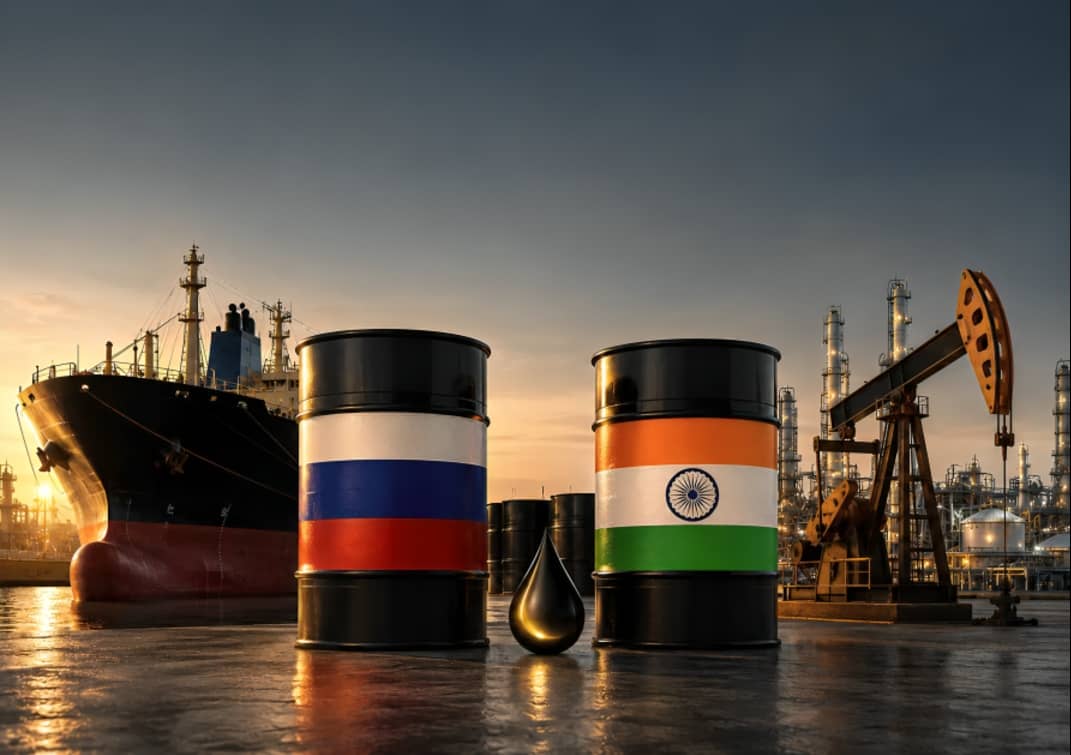
Russia continued to be India’s largest supplier of crude oil in August 2026, even as the volume of Russian crude arriving in the country declined significantly from the previous month. At the same time, the United States strengthened its position in India’s energy market by becoming the largest supplier of both liquefied petroleum gas and liquefied natural gas.
The latest figures from maritime intelligence and research firm Kpler show that India imported approximately 2.1 million barrels of crude oil per day from Russia during August. Russian supplies accounted for about 45 percent of India’s total crude imports during the month. Although the share remained substantial, the volume was considerably lower than the record level recorded in July.
India’s overall crude oil imports were estimated at around 4.6 million barrels per day in August, compared with more than 5 million barrels per day in July. The decline came after Indian refiners increased purchases in previous months as they prepared for possible supply disruptions linked to the geopolitical situation in West Asia.
The reduction in Russian crude imports does not necessarily indicate that India is moving away from Russian oil. Analysts have attributed the August decline to several factors, including lower Russian export availability, stronger competition from Chinese refiners, scheduled maintenance at some Indian refineries and changes in global shipping conditions.
According to provisional Kpler data reported by The Indian Express, Russian crude imports fell to around 2.08 million barrels per day in August from 2.82 million barrels per day in July. This represented a monthly decline of approximately 26.3 percent. Russia’s share of India’s crude import basket consequently fell from around 55.9 percent in July to approximately 45 percent in August.
Despite the decline, Russia remained comfortably ahead of other major crude suppliers. The United Arab Emirates and Saudi Arabia were among India’s other significant sources, while Venezuela also increased its contribution to the Indian crude basket.
The changing crude import pattern comes at a time when international energy markets are facing significant geopolitical and logistical challenges. Shipping risks, changes in Russian export availability and competition from other major buyers have affected the flow and pricing of crude oil.
India has increasingly relied on a diversified procurement strategy to reduce the risks associated with dependence on any single region. Russian crude continues to form a major part of this strategy, while supplies from the Middle East, Latin America and other producing regions have also become important.
The energy supply shift is particularly visible in the LPG market. The United States emerged as India’s largest supplier of LPG in August, accounting for approximately 51 percent of the country’s total LPG imports, according to Kpler data. India imported around 1.1 million tonnes of LPG during the month, of which approximately 0.6 million tonnes came from the US.
US LPG supplies were lower than the approximately 0.9 million tonnes imported from the US in July. However, the United States still maintained its position as the largest supplier because supplies from traditional West Asian sources were affected by disruptions and changing shipping conditions.
The UAE and Algeria were among the other important LPG suppliers to India during August. The increased role of the United States reflects the ability of Indian importers to source cargoes from geographically distant markets when supplies from closer regions become less reliable.
The same trend was visible in the LNG market. The United States supplied approximately 0.8 million tonnes of the 2.2 million tonnes of LNG imported by India in August. This gave the US a share of around 38 percent of India’s LNG imports during the month. Oman and Nigeria were among the other major LNG suppliers.
The growing importance of US energy supplies represents another aspect of the changing India US energy relationship. While Russia continues to dominate India’s crude oil imports, the United States has become increasingly important in the supply of gas based energy products.
India’s energy requirements are large and continue to grow as industrial activity, transportation, electricity generation and household consumption increase. The country imports a significant portion of its crude oil and natural gas requirements, making the stability of international energy supply chains important for the domestic economy.
The diversification of suppliers provides India with greater flexibility when global markets face disruptions. However, it can also increase costs. Longer voyages from the United States and other distant suppliers can result in higher freight, insurance and transportation expenses compared with cargoes sourced from nearby Gulf producers.
Experts have pointed out that the changing LPG supply pattern could therefore carry additional costs for Indian buyers. Longer shipping routes and elevated insurance expenses can increase the overall landed cost of imported energy products.
The situation also demonstrates how geopolitical developments can alter global energy trade routes. Disruptions affecting the Strait of Hormuz and other important shipping corridors have encouraged major energy-consuming countries to seek alternative suppliers. India has responded by increasing its procurement options across different regions.
For crude oil, Russia remains a central part of India’s supply strategy. However, the August figures show that its share can fluctuate depending on export availability, shipping conditions, refinery requirements and competition from other countries.
Chinese demand has also become an important factor in the market for Russian crude. Stronger competition from Chinese refiners for available Russian cargoes could affect the amount of crude available to Indian buyers. At the same time, restrictions and risks affecting Russian shipping routes have increased logistical challenges.
The decline in Russian imports also contributed to the reduction in India’s overall crude purchases during August. However, analysts have indicated that the fall should not automatically be interpreted as a structural shift away from Russian crude. Instead, it reflects a combination of temporary and market related factors.
India’s purchases from Venezuela also increased during August, reaching their highest monthly level since 2020, according to The Indian Express. This provides another example of how Indian refiners have expanded their sourcing options as global energy conditions have changed.
The diversification strategy is also evident in India’s approach to LPG and LNG. The United States has become an important source for both products, while Oman, Nigeria, the UAE and Algeria continue to contribute to India’s energy supply.
The latest data therefore shows a distinct division in India’s energy import structure. Russia continues to dominate crude oil supplies, while the United States has established a leading position in LPG and LNG. This does not necessarily mean that India is choosing one supplier over another. Instead, it indicates that Indian energy companies are sourcing different products from different markets based on availability, pricing, transportation conditions and supply security.
For consumers and the wider economy, the cost of imported energy remains an important consideration. India’s dependence on overseas supplies means that changes in international commodity prices, shipping costs, insurance premiums and geopolitical risks can influence the domestic energy market.
The August figures also highlight the importance of maintaining multiple supply options. By sourcing crude oil and gas from a broad group of countries, India can reduce the impact of disruptions affecting any single supplier or region.
Russia’s continued position as India’s largest crude supplier shows that Russian oil remains strategically important to Indian refiners. At the same time, the United States becoming the largest supplier of LPG and LNG demonstrates how quickly energy trade patterns can change when geopolitical conditions and supply availability shift.
Going forward, India’s energy import strategy is likely to remain focused on balancing cost, reliability and supply security. Russian crude is expected to remain an important part of the crude basket, while US LPG and LNG supplies provide additional alternatives to traditional sources.
The August data ultimately points to a more diversified energy import structure for India. Russia remains the leading crude supplier, but the United States has gained a strong position in gas related imports. With global energy markets continuing to face geopolitical and logistical uncertainty, India’s ability to source supplies from multiple regions will remain an important part of its energy security strategy.