
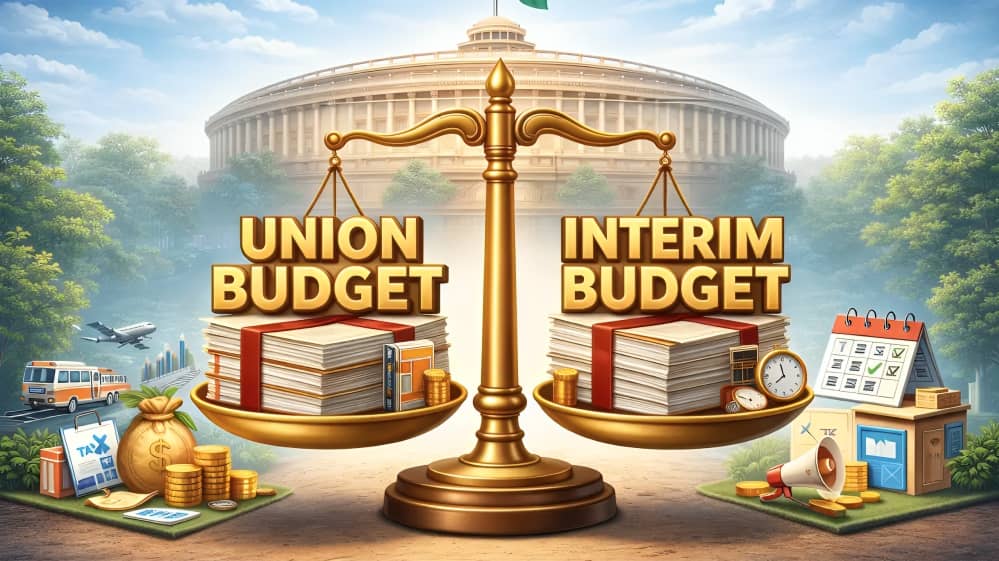
The Union Budget is one of the most important annual financial documents presented by the Government of India. It lays out a comprehensive plan for revenue generation, expenditure allocation, taxation policies, and sector specific spending for the upcoming financial year. However, during certain years, particularly when general elections are approaching, the government presents an Interim Budget instead of a full Union Budget. As attention turns to Union Budget 2026, understanding the differences between the two becomes essential.
A Union Budget is a detailed financial statement that reflects the government’s economic vision and policy direction for the year. It includes proposals related to direct and indirect taxes, government spending on sectors such as infrastructure, health, education, defence, and welfare schemes, as well as measures aimed at boosting economic growth and managing fiscal deficits. The Union Budget also outlines borrowing plans and estimates of revenue from various sources.
In contrast, an Interim Budget is a stopgap arrangement. It is presented when the ruling government is nearing the end of its term and does not have the political mandate to introduce major policy changes. The primary objective of an Interim Budget is to seek parliamentary approval for essential government expenditure until a new government is formed and presents a full budget.
One of the key differences lies in policy announcements. A full Union Budget may introduce significant reforms, new schemes, or changes in tax structures. An Interim Budget, by convention, avoids major policy decisions and focuses on maintaining continuity. However, it can include routine expenditure allocations and, in some cases, limited welfare announcements.
Another major distinction is the time horizon. A Union Budget covers the entire financial year, while an Interim Budget typically provides for a few months of government spending. This is achieved through a Vote on Account, which allows the government to withdraw funds from the Consolidated Fund of India to meet necessary expenses such as salaries, pensions, and ongoing projects.
Despite being temporary, an Interim Budget is still a constitutional requirement and must be approved by Parliament. It ensures that government operations continue smoothly during the transition period between administrations.
From an economic perspective, markets and investors tend to react more strongly to a full Union Budget due to its long term policy implications. Interim Budgets usually generate limited market movement, as they are not expected to introduce structural changes.
Union Budget 2026 is particularly significant as it will outline the government’s financial priorities for the year ahead, potentially addressing growth, inflation management, fiscal consolidation, and public investment. Unlike an Interim Budget, it will reflect a complete economic strategy rather than a provisional arrangement.
In summary, while both budgets serve essential roles, the Union Budget represents a full expression of government policy and economic planning, whereas the Interim Budget functions as a temporary financial bridge during periods of political transition.


