
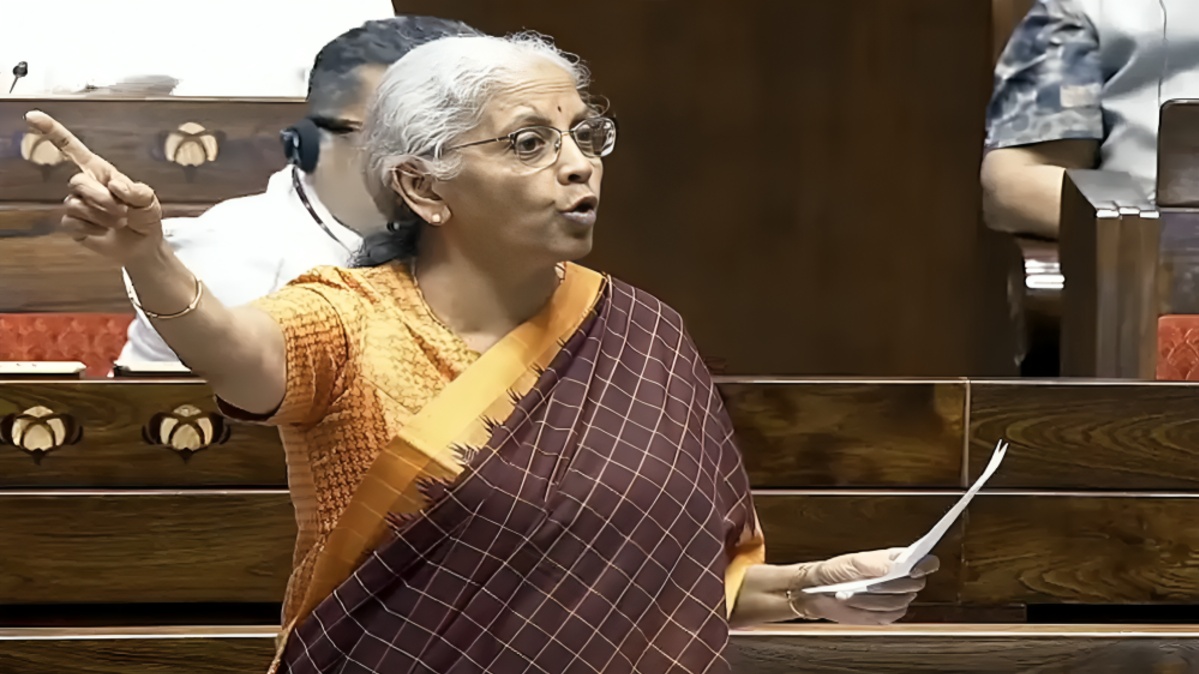
Union Finance Minister Nirmala Sitharaman has clarified that consumers will not have to bear the Merchant Discount Rate introduced for selected Unified Payments Interface transactions. Her statement comes after concerns and discussions over the new UPI payment framework, which introduces MDR on certain higher value merchant transactions from October 15, 2026.
Sitharaman said MDR is a charge within the payment ecosystem and will not be passed on to UPI users. She also clarified that the charge is neither a tax nor a cess and that the money collected through MDR will not be deposited into the Consolidated Fund of India. According to her explanation, the charge is intended to support payment service providers and improve the infrastructure and services associated with the digital payments system.
The new framework was introduced by the National Payments Corporation of India and will take effect from October 15. Under the framework, a 0.4 percent MDR will apply to specified person to merchant UPI transactions above Rs 2,000. For transactions of Rs 75,000 and above, the MDR will be capped at Rs 300 per transaction. The charge is distributed among participants in the payment ecosystem, including banks, payment service providers and UPI application providers.
An important part of the framework is that person to person UPI transactions will remain completely free, irrespective of the amount transferred. This means that individuals sending money to another individual through UPI will not be required to pay MDR.
Payments made to merchants up to Rs 2,000 will also remain free of MDR. The government has said that small merchants covered under the zero MDR framework will continue to receive payments without this charge. Small merchants receiving up to Rs 1 lakh per month through UPI QR payments under the specified category will remain exempt from MDR.
The government has estimated that approximately 96 percent of person to merchant UPI transactions will remain unaffected by the new framework. According to the Finance Ministry, MDR will apply only to specified merchant transactions above the Rs 2,000 threshold and transactions outside the zero MDR provisions for small merchants.
The new framework also includes different rates for certain categories of transactions. Payments above Rs 2,000 in specified essential sectors such as railways, telecommunications, insurance, fuel and agricultural inputs will attract a flat MDR of Rs 5 per transaction. Certain capital market transactions, including payments relating to mutual funds, securities and stockbrokers, will attract a concessional MDR of 0.02 percent, subject to a maximum of Rs 300.
The government has also instructed banks to ensure that MDR is not passed on to customers. UPI application providers have been prohibited from imposing platform fees or hidden charges on individuals for UPI transactions. The Finance Ministry has stated that individuals will continue to have free access to UPI without monthly usage quotas or additional charges imposed on them.
The issue of who ultimately bears the cost has nevertheless generated discussion because MDR is a payment processing charge associated with merchant transactions. While the government's stated framework requires merchants and payment ecosystem participants to bear the MDR rather than consumers, the economic impact on businesses remains a subject of discussion.
The government has said that the purpose of introducing MDR is to support the long term sustainability of the UPI ecosystem. The payments network requires continued investment in technology, cybersecurity, fraud prevention, reliability and customer service as transaction volumes increase. The new MDR framework is intended to create a source of revenue for participants involved in processing UPI payments while maintaining free access for consumers.
Sitharaman's clarification was made amid public discussion about the proposed changes to UPI charges. She said the public should be aware of the distinction between MDR and a government tax. According to her, MDR is a charge between operators in the payment ecosystem and is not a tax collected by the government.
The new rules therefore create a distinction between the cost of processing certain merchant payments and the amount paid by UPI users. Consumers will continue to make person to person transfers without charges, while merchant payments up to Rs 2,000 will remain free. Eligible small merchants will also continue under zero MDR provisions.
The new framework is scheduled to come into effect on October 15, 2026. The government has said that banks and payment aggregators will be monitored to ensure that MDR charges are not transferred to consumers. This monitoring is intended to ensure that the framework operates according to the announced rules.
For UPI users, the key point is that the introduction of MDR does not mean that individuals will suddenly be charged for using UPI. The charge applies only to specified merchant transactions that meet the conditions of the new framework. Person to person payments remain free, and payments to merchants up to Rs 2,000 also remain outside MDR.
The changes mark a significant development in India's digital payments system, which has operated with widespread zero cost UPI transactions for several years. The government and payment authorities have presented the new framework as a measure to support the financial and technological sustainability of the payments ecosystem while protecting consumers and small merchants from additional payment charges.