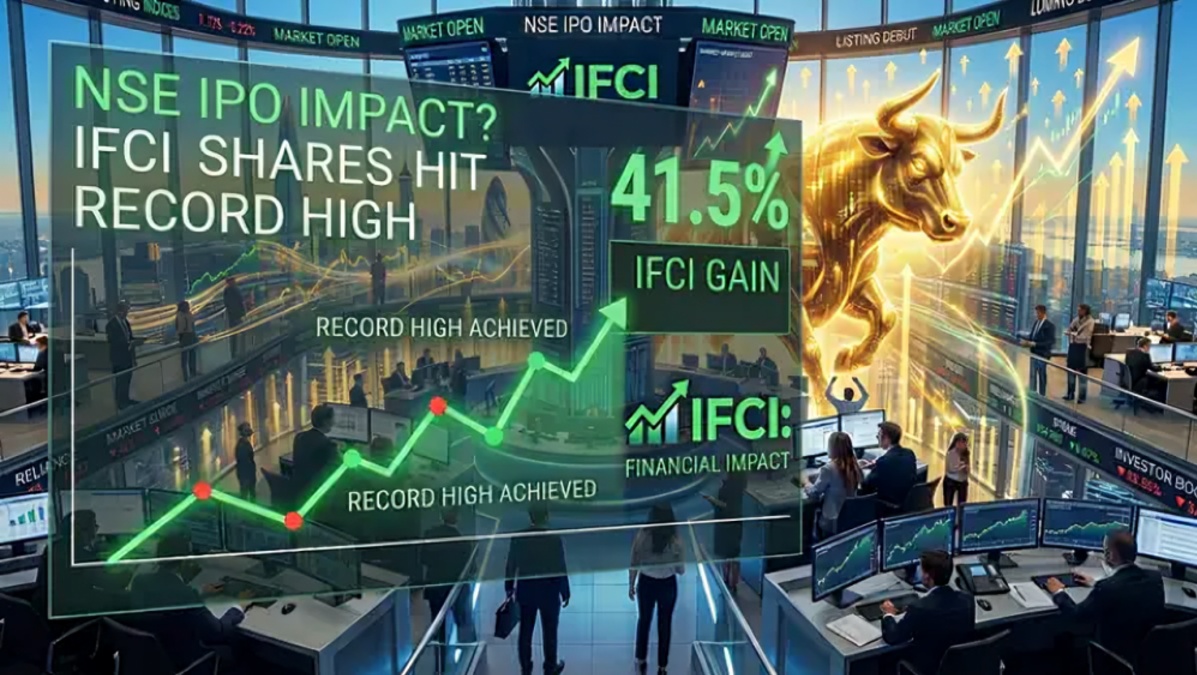
IFCI shares have come into focus as the National Stock Exchange moves closer to its long-awaited initial public offering. The proposed NSE IPO has generated renewed interest in companies that hold direct or indirect exposure to the exchange, including IFCI. However, the relationship between IFCI and NSE is indirect and needs to be understood carefully before assessing the potential value for shareholders.
IFCI does not directly own the NSE stake. Its exposure comes through Stock Holding Corporation of India Limited, commonly known as SHCIL. IFCI holds a controlling 52.8 percent stake in SHCIL, while SHCIL owns approximately 4.4 percent of NSE. This ownership structure means that any change in the market value of NSE could have an indirect impact on the value attributed to IFCI through its holding in SHCIL.
The proposed NSE IPO has become a major event for India's capital markets. NSE has received regulatory approval to proceed with its public offering, and reports indicate that the exchange is targeting a listing in the week beginning September 21, 2026. The proposed issue is expected to be an offer for sale, meaning existing shareholders will sell shares rather than NSE raising fresh capital through the issue.
The IPO is expected to involve around 14.89 crore shares, representing approximately 6 percent of NSE's equity. Reports have indicated that the offering could value NSE at around Rs 47 billion dollars, while the unlisted market valuation has been higher. The final IPO price band and valuation, however, remain important factors that investors will need to monitor.
For IFCI investors, the significance of the NSE IPO comes from price discovery. NSE has remained an unlisted company for years, making it more difficult for investors to determine the precise market value of its shares. The IPO and subsequent listing could establish a transparent market price for NSE shares.
That market price could make SHCIL's 4.4 percent NSE investment easier to value. Since IFCI owns a controlling interest in SHCIL, investors could then use the publicly available NSE valuation as one component when assessing the underlying value of IFCI.
For example, if NSE were eventually valued at Rs 5 lakh crore, SHCIL's 4.4 percent holding would have an illustrative gross value of around Rs 22,000 crore. Applying IFCI's 52.8 percent ownership in SHCIL would produce an indirect economic exposure of roughly Rs 11,600 crore.
However, this calculation is only an illustration and should not be interpreted as the amount of cash available to IFCI. The NSE shares are owned by SHCIL, not directly by IFCI. There can also be differences between the economic value of a subsidiary's assets and the value ultimately reflected in the parent company's share price.
This distinction is particularly important because the NSE IPO is structured as an offer for sale. Existing shareholders are expected to sell part of their holdings. Therefore, investors should examine how much of SHCIL's NSE stake is actually sold and how the proceeds are ultimately handled. A rise in NSE's valuation does not automatically mean that IFCI will receive an equivalent amount of cash.
The potential value unlocking nevertheless helps explain why IFCI shares have attracted increased market attention. Reports in recent days have shown sharp movements in IFCI shares as investors reacted to developments surrounding the NSE IPO. On September 2, IFCI shares touched an intraday high of Rs 99.49, while more recent reports also highlighted continued investor interest following regulatory progress on the NSE listing.
The market response indicates that investors are already attempting to assign greater value to IFCI's indirect exposure to NSE. This also means that investors need to consider how much of the expected value unlocking may already be reflected in IFCI's current share price.
The NSE IPO is therefore not simply a story about a potential asset becoming valuable. It is also a question of valuation. If NSE's final IPO valuation is higher than market expectations, companies with exposure to the exchange could potentially receive further attention. If the final valuation is lower than expected, some of the optimism already built into related stocks could weaken.
IFCI investors should also keep track of SHCIL's position. The exact number of NSE shares sold by SHCIL, if any, will be important in determining how much of the investment is monetised and how much remains on its books. The treatment of any proceeds could also influence how investors assess the value of IFCI.
Another important factor is IFCI's core business performance. The company should not be valued solely on the basis of its indirect NSE exposure. Its operating income, profitability, assets, liabilities, investments and subsidiary performance remain important considerations.
The broader market environment will also influence the NSE listing. NSE is one of India's most important financial-market institutions and operates the benchmark Nifty 50 index. It is also a major global derivatives exchange. The exchange's proposed public listing is therefore expected to attract significant interest from institutional and retail investors.
The IPO also marks an important stage in NSE's long-running journey toward becoming a listed company. The process had faced regulatory and legal hurdles for several years. Recent regulatory developments and the resolution of key legal issues have helped clear obstacles that had delayed the listing process.
For IFCI shareholders, the key issue is how much of the value associated with SHCIL's NSE investment is eventually recognised by the market. A listed NSE share price could provide a clearer reference point, potentially reducing some of the uncertainty surrounding the valuation of the underlying asset.
However, investors should avoid treating the indirect NSE exposure as guaranteed profit. NSE's final IPO valuation, listing price, SHCIL's stake-sale decisions, IFCI's financial performance and the market's valuation of IFCI itself will all determine the eventual impact.
The NSE IPO could therefore act as a potential value-discovery catalyst for IFCI rather than an automatic source of cash. Investors will be watching the IPO price band, final issue structure, SHCIL's participation and NSE's market capitalisation after listing.
Ultimately, the investment case for IFCI needs to be assessed on a broader basis. Its indirect exposure to NSE through SHCIL is an important asset, but it represents only one component of the company's overall valuation. The upcoming NSE listing could make that asset more visible and easier to value, potentially drawing further attention to IFCI.
As the NSE IPO moves toward the market, IFCI is likely to remain one of the stocks investors monitor for potential indirect value unlocking. The extent of that benefit, however, will depend on the final NSE valuation and how the market prices IFCI after taking its wider financial position into account.