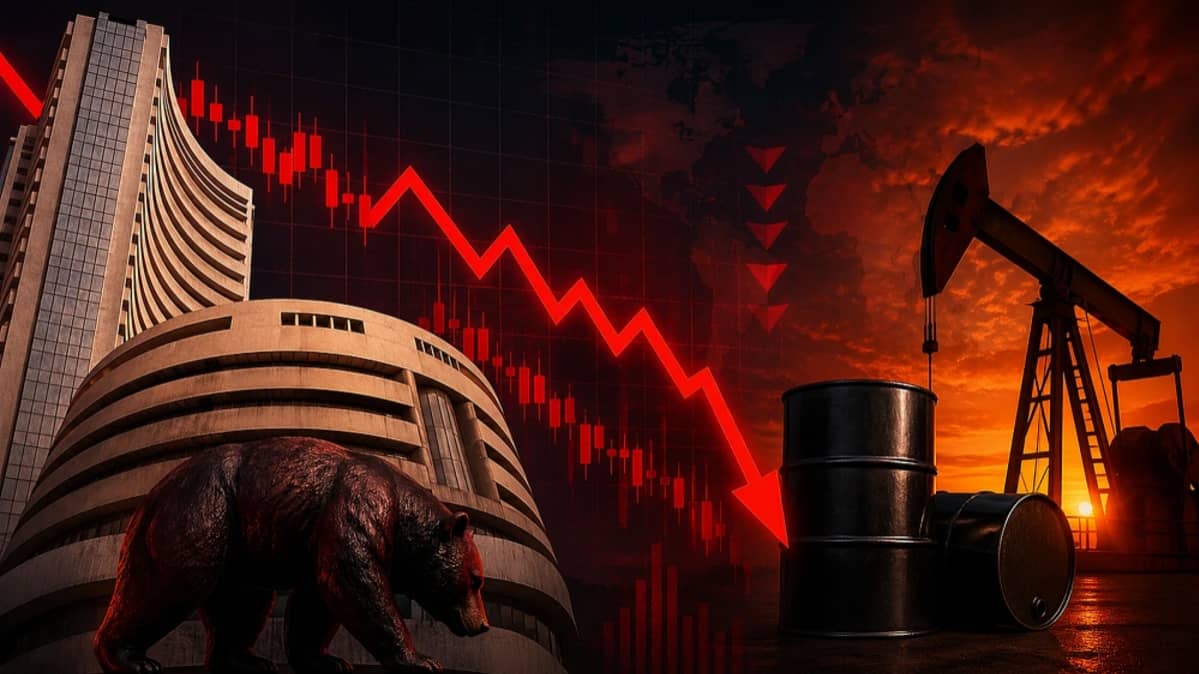
The Indian stock market witnessed a sharp decline on Monday, September 28, 2026, as investors reacted to rising crude oil prices, renewed uncertainty surrounding US Iran tensions and weak global market sentiment. The benchmark BSE Sensex fell more than 1,000 points during trading, while the Nifty 50 dropped below the 22,850 level.
The sharp decline pushed the Sensex close to its lowest level in around six months. The selloff also resulted in a substantial decline in the overall market value of companies listed on the Bombay Stock Exchange. Reports indicated that nearly Rs 6 lakh crore was wiped out from the combined market capitalisation of BSE listed companies during the sharp fall.
Rising Crude Oil Prices
One of the major factors behind the market decline was the sharp increase in crude oil prices. Brent crude futures moved above 106 dollars a barrel as concerns over oil supplies increased amid continuing tensions involving the United States and Iran.
India is particularly sensitive to movements in international crude oil prices because the country imports a significant portion of its crude requirements. A sustained increase in oil prices can raise India's import bill and put pressure on inflation, the rupee and corporate profit margins.
Reuters reported that Brent crude futures rose to around 106.7 dollars a barrel on Monday following uncertainty over the US Iran situation and concerns surrounding oil shipments through the Strait of Hormuz.
The increase in oil prices has therefore become an important concern for Indian investors. Higher fuel and transportation costs can affect several sectors, while companies that depend heavily on energy and imported raw materials could face increased operating expenses.
US Iran Tensions Affect Investor Sentiment
Geopolitical uncertainty was another important factor behind the market decline. Continuing tensions between the United States and Iran have increased concerns about the stability of global energy supplies.
Investors are closely monitoring developments related to the Strait of Hormuz, one of the world's important routes for oil shipments. Any significant disruption to oil flows through the region could further increase crude prices and create additional pressure on countries that depend on imported energy.
Reports said that the latest rise in oil prices followed a deadlock in US Iran peace discussions. The uncertainty has encouraged investors to reduce exposure to riskier assets and adopt a more cautious approach.
Sensex and Nifty Under Pressure
During Monday's trading session, the Sensex declined by more than 1,000 points. At around 12:18 PM, the index was trading at 72,936.39, down 959 points or 1.30 percent, according to a Times of India market update. The Nifty 50 was at 22,833.75, down 307 points or 1.33 percent at the same time.
Earlier in the session, the Sensex had also crossed the 1,000 point decline mark. The Nifty remained below the important 23,000 level, reflecting the broad weakness across Indian equities.
The decline was broad based, with all 30 Sensex companies trading in negative territory during the reported morning session. Financial stocks were among those facing significant selling pressure.
Higher US Bond Yields Add to Pressure
Rising US Treasury yields also contributed to the negative sentiment in Indian equities. Higher bond yields can influence global investment flows because investors may reassess the attractiveness of emerging market assets when returns on US government securities increase.
The combination of higher US yields, elevated crude prices and geopolitical uncertainty has created a challenging environment for emerging market stocks.
Investors are also monitoring currency movements because a weaker Indian rupee can increase the domestic cost of imported crude oil and other commodities.
Foreign Investor Selling
Foreign portfolio investor activity has also remained an important factor for the Indian market. Data cited in market reports showed that foreign investors sold Indian equities worth around Rs 3,694 crore on September 25.
Continued foreign selling can add pressure to benchmark indices, particularly when global investors are reducing risk because of geopolitical uncertainty, higher US yields and concerns about emerging market currencies.
The selling pressure from foreign investors has occurred alongside broader concerns about the Indian market after a prolonged period of weakness.
Impact on Investor Wealth
The sharp fall in benchmark indices resulted in a significant decline in the total market value of BSE listed companies. Reports estimated that nearly Rs 6 lakh crore in market capitalisation was erased during the selloff.
This does not mean that investors collectively withdrew Rs 6 lakh crore in cash. The figure represents the decline in the market value of listed companies as share prices fell.
Such large changes in market capitalisation are common during periods of intense selling when investors react quickly to developments affecting the global economy, commodity prices and geopolitical conditions.
Why Crude Oil Matters for India
Crude oil prices have a direct and indirect impact on the Indian economy. Since India imports much of its crude oil requirement, higher international prices increase the country's import expenditure.
Expensive crude can also affect transportation costs and increase expenses for businesses that depend on fuel and petroleum based products. If higher costs continue for an extended period, they can create additional inflationary pressure.
For companies, higher energy and transportation expenses can affect profit margins if the increased costs cannot be passed on to customers.
This is why movements in crude oil prices are closely watched by equity investors, policymakers and businesses.
Global Markets Also Remain Under Pressure
The weakness in Indian equities is part of a broader risk off environment. Asian markets also faced pressure as investors assessed the impact of higher oil prices and geopolitical uncertainty.
The situation highlights how developments outside India can have a significant impact on domestic financial markets. Oil prices, US interest rates, global bond yields, currency movements and geopolitical developments can influence foreign investment flows into Indian equities.
What Investors Will Watch Next
Investors are likely to closely monitor crude oil prices and developments surrounding the United States and Iran. Any improvement in geopolitical conditions could influence oil prices and market sentiment, while further escalation could increase concerns over energy supplies.
The movement of the Indian rupee against the US dollar will also remain important. A weaker rupee combined with expensive crude could increase concerns about India's import bill and inflation.
Foreign investor flows, US Treasury yields and global equity market trends will also be important indicators for the Indian market in the coming sessions.
The latest decline demonstrates the sensitivity of Indian equities to global developments. While the immediate market movement has been driven by oil prices and geopolitical uncertainty, the longer term direction will depend on how these factors evolve and how investors assess their impact on India's economic growth and corporate earnings.
For investors, the sharp fall in the Sensex and Nifty reflects heightened market volatility rather than a change in the value of every individual company. Market conditions can change quickly as new information emerges, particularly during periods of geopolitical uncertainty.