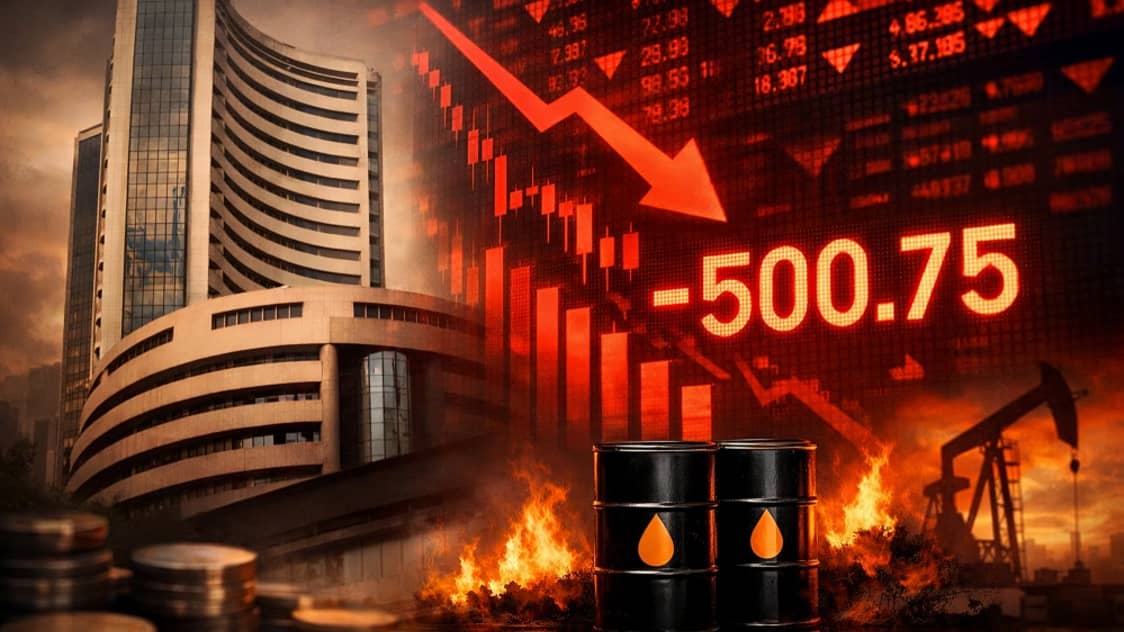
Indian equity markets witnessed a sharp decline on Thursday, October 8, 2026, as investors reacted to tighter monetary policy, rising crude oil prices, continued foreign investor selling and weak global market sentiment. The benchmark Sensex fell more than 1,000 points during intraday trading, while the Nifty 50 declined more than 1.5 percent at one stage.
The selloff came a day after the Reserve Bank of India raised its benchmark repo rate by 25 basis points to 5.5 percent. The rate increase was the first such hike by the central bank in nearly four years. The RBI also changed its policy stance from neutral to calibrated tightening, signalling that monetary policy could remain focused on inflation risks and financial stability.
The change in the RBI policy stance was closely watched by investors because higher interest rates can influence borrowing costs, corporate financing conditions and equity valuations. Market participants were already dealing with concerns over elevated global bond yields and a weaker rupee. The combination of these factors contributed to increased selling pressure in domestic equities.
The Sensex opened at 72,668 on Thursday and later fell to an intraday low of around 71,551, according to market reports. At one stage, the index was down more than 1,000 points. The Nifty 50 also came under strong pressure and fell below the 22,300 level during the session.
Rising crude oil prices were another major factor affecting market sentiment. Brent crude moved above 100 dollars a barrel and reached around 102 to 104 dollars during the session, depending on the point of trading. Concerns over supplies from the Middle East and disruptions involving shipping routes contributed to the increase in oil prices.
Higher crude prices are particularly important for India because the country depends significantly on imported oil. A sustained increase in crude prices can raise import costs and place pressure on the current account balance and the Indian rupee. It can also contribute to inflationary pressures across the economy.
The rupee has already been under pressure. On October 7, the Indian currency fell to around 96.8450 against the US dollar, approaching its record low of 96.96. Foreign capital outflows, elevated oil prices and a stronger US dollar have been among the factors affecting the currency.
Foreign institutional investor selling also remained a concern for the domestic market. Foreign investors sold Indian equities worth around Rs 6,121 crore on October 7, according to market data. This followed substantial foreign selling during previous sessions. At the same time, domestic institutional investors continued to provide some support by purchasing equities.
The broad nature of Thursday’s decline showed that selling was not limited to a single sector. Business Standard reported that the majority of Nifty 50 stocks were trading lower during the session, while most major sectoral indices also remained under pressure. Small cap and mid cap stocks were also affected.
Global market conditions added another layer of pressure. Asian markets including Japan and Hong Kong were trading lower, while South Korea’s benchmark also recorded a significant decline. Rising US Treasury yields contributed to concerns that global financial conditions could remain tight for longer. Higher bond yields can make fixed income assets relatively more attractive compared with riskier assets such as equities.
The Indian market is also entering an important period because the September quarter corporate earnings season is beginning. Tata Consultancy Services was scheduled to announce its quarterly results on Thursday. Investors are expected to closely monitor corporate earnings and management commentary for signs of how companies are dealing with higher input costs, interest rates and changing global demand conditions.
Despite the broad market weakness, the information technology sector showed relative strength during early trading. The IT index gained around 1.8 percent in the morning session, supported by gains in major technology stocks. Tata Consultancy Services was among the stocks showing strength ahead of its quarterly results.
Several individual stocks, however, witnessed significant declines. Digital payment companies came under pressure after reports that the proposed merchant fee rollout could be delayed. Paytm and One Mobikwik fell sharply, while Pine Labs also declined. ITC also recorded a significant fall following block deals involving the company’s shares.
The market decline also reflects concerns about valuations. Higher interest rates can affect the valuation of stocks because future corporate earnings become less attractive when the cost of money increases. Investors may therefore become more selective and shift towards companies and sectors that are better positioned to handle higher financing costs.
Market analysts are now closely watching the RBI’s future policy decisions, crude oil movements, foreign fund flows, currency movements and upcoming corporate earnings. Any sustained improvement in these areas could influence investor sentiment, while continued pressure could keep the market volatile.
The RBI’s decision to move towards calibrated tightening has become particularly important because it indicates that inflation remains a significant consideration for monetary policy. Governor Sanjay Malhotra has indicated that near term rate cuts are not being considered, while future policy moves will depend on economic and inflation developments.
The sharp fall in the Sensex and Nifty does not necessarily represent a single factor driven market movement. Instead, several domestic and international developments have combined to create a challenging environment for investors. Higher crude prices, tighter monetary policy, foreign selling, currency weakness and uncertain global conditions are currently influencing market behaviour.
For retail investors, market experts generally advise focusing on individual company fundamentals and maintaining a long term investment perspective rather than reacting solely to a single day’s movement. Market volatility can increase when multiple economic and geopolitical factors change at the same time.
As trading continues, investors will be watching whether the major indices can stabilise after the sharp decline. The upcoming corporate earnings season, movements in crude oil prices, foreign investment flows and signals from central banks are expected to remain important factors for Indian equities.
The October 8 selloff therefore marks another challenging session for Dalal Street after the market had already experienced pressure in recent weeks. With the RBI adopting a tighter policy stance and global markets facing uncertainty, investors are likely to remain focused on economic data, corporate earnings and international developments before taking further positions.