
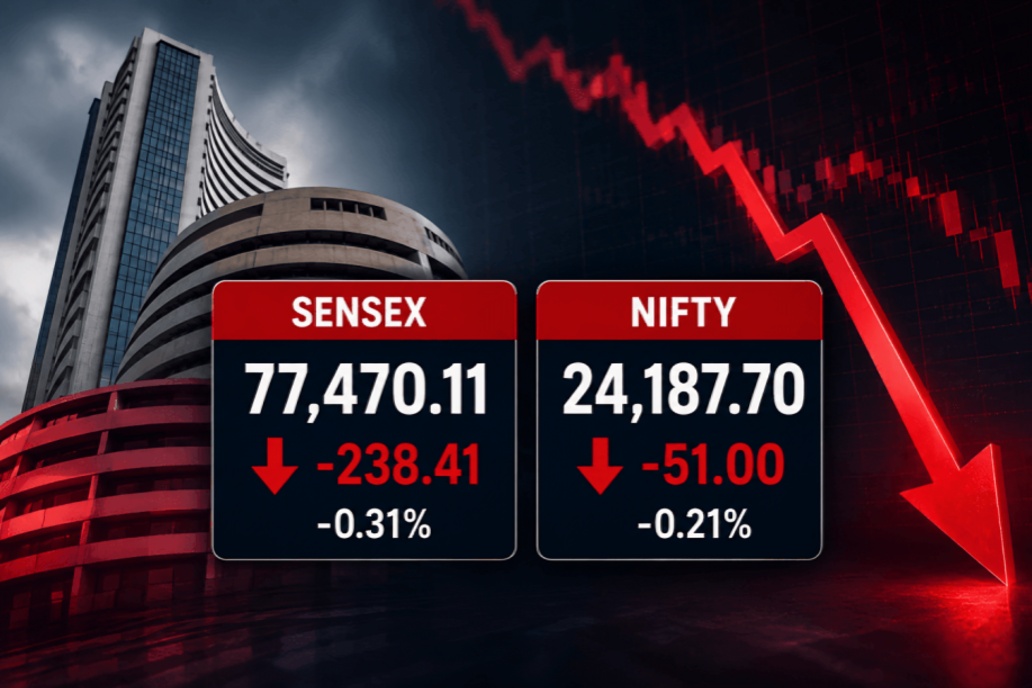
Indian equity markets came under renewed selling pressure on Tuesday, September 8, 2026, as investors remained cautious amid rising crude oil prices, geopolitical uncertainty and concerns about the global interest-rate outlook.
The BSE Sensex ended the session at 75,577.58, down 555.23 points, or 0.73 percent. The Nifty 50 also declined, falling 0.61 percent to close at 23,635.10. The decline extended the recent weakness in the domestic market, with both benchmark indices having fallen over the previous several sessions.
Banking and energy stocks were among the major contributors to the market decline. ICICI Bank fell around 2 percent during the session and was among the notable laggards. Reliance Industries also declined and added to the pressure on the benchmark indices because of its significant weight in the Nifty and Sensex. Other financial stocks also faced selling pressure as investors reduced exposure to risk-sensitive sectors.
One of the biggest concerns for investors was the sharp rise in crude oil prices. Brent crude moved close to the 100 dollar per barrel level, increasing worries about the impact of expensive energy on inflation and India's import bill. India remains heavily dependent on imported crude oil, making global oil prices an important factor for the country's inflation, currency and corporate earnings outlook.
The latest rise in oil prices was linked to escalating geopolitical tensions in the Middle East. According to Reuters, Brent crude rose to around 98.4 dollars a barrel after attacks on Saudi energy facilities by Houthi forces. The increase in oil prices raised concerns that persistent inflationary pressure could complicate the global monetary policy outlook.
Higher crude prices can affect the Indian economy through several channels. An increase in the cost of imported oil can put pressure on the trade balance and the Indian rupee. It can also increase transportation and production costs for businesses. If companies are unable to pass those higher costs to consumers, profit margins could come under pressure.
The market was also influenced by expectations surrounding US monetary policy. Investors are closely watching the Federal Reserve because higher energy prices could make it more difficult for central banks to reduce interest rates. Any expectation of higher US interest rates can affect global capital flows and increase volatility in emerging markets such as India.
For Indian equities, the interest-rate outlook is particularly important because foreign institutional investors closely monitor global bond yields and returns available in developed markets. If US yields rise, some investors may reduce exposure to emerging-market assets or become more selective in allocating capital.
Banking stocks also remained under pressure during Tuesday's session. ICICI Bank was among the significant losers, declining about 2 percent. Weakness in major private-sector banks can have a considerable impact on the benchmark indices because of their large index weightings.
Reliance Industries was another important stock to watch. The company is one of the largest constituents of India's benchmark indices, so movements in its share price can influence the overall direction of the Sensex and Nifty. Its decline therefore contributed to the broader market weakness.
Despite the weakness in the headline indices, the market did not experience uniform selling across all segments. Reuters reported that mid-cap and small-cap indices posted modest gains of around 0.2 percent. Defence stocks also performed relatively well after the government approved defence procurement proposals worth approximately Rs 1.1 lakh crore.
The continued strength of India's IPO market is another factor investors are monitoring. A busy primary market can attract significant capital from institutional and retail investors. However, strong IPO activity does not necessarily indicate weakness in the secondary market. Investors may evaluate individual IPO valuations and compare them with existing listed companies before committing funds.
The market's recent decline therefore needs to be viewed in the context of several overlapping factors rather than a single trigger. Rising crude prices, geopolitical tensions, expectations surrounding US monetary policy, global market weakness and domestic stock-specific movements all contributed to the cautious sentiment.
The newly introduced Closing Auction Session on the NSE was another factor that attracted attention during Tuesday's trading. Reuters reported that the mechanism contributed to volatility around the closing period, particularly during the weekly derivatives expiry. The new system has created challenges for some systematic trading strategies because of limited participation and potential price differences during the closing process.
The rupee also remained under pressure as investors assessed the implications of higher crude prices. A weaker rupee can make imported commodities more expensive, adding to concerns about inflation. At the same time, exporters and companies with significant overseas revenue may receive some benefit from currency depreciation, although the impact varies across sectors.
For investors, the immediate focus is likely to remain on crude oil prices, developments in the Middle East, global interest-rate expectations and foreign fund flows. Any moderation in oil prices could provide some relief to Indian equities, while another sharp rise could increase concerns about inflation and corporate costs.
The recent market decline also highlights the importance of avoiding decisions based solely on daily index movements. Individual companies can perform differently depending on their earnings, valuations, business outlook and exposure to global factors. Investors are therefore likely to continue focusing on company-specific fundamentals in addition to broader economic developments.
The September 8 session was another reminder that Indian equities remain sensitive to global developments. The Sensex has moved significantly lower over the recent trading sessions, while the Nifty has also struggled to sustain higher levels. Reuters reported that both indices had declined about 2.2 percent over the previous seven sessions before Tuesday's close.
Going forward, market direction will depend on whether crude oil prices stabilise and whether geopolitical tensions ease. Investors will also monitor signals from the US Federal Reserve and other major central banks for clues about future interest rates.
For Indian markets, lower crude prices and stable global interest rates would generally provide a more supportive environment. However, sustained high oil prices combined with tighter global monetary conditions could continue to create volatility.
Overall, the September 8 decline reflects a combination of external and domestic pressures. The Sensex lost more than 555 points, while the Nifty slipped below the 23,650 level. Major stocks including ICICI Bank and Reliance Industries added to the selling pressure, while rising crude prices and geopolitical uncertainty remained the dominant concerns for investors.
Investors should therefore closely monitor global oil prices, currency movements, foreign institutional activity, interest-rate expectations and upcoming corporate developments before drawing conclusions about the broader market trend.