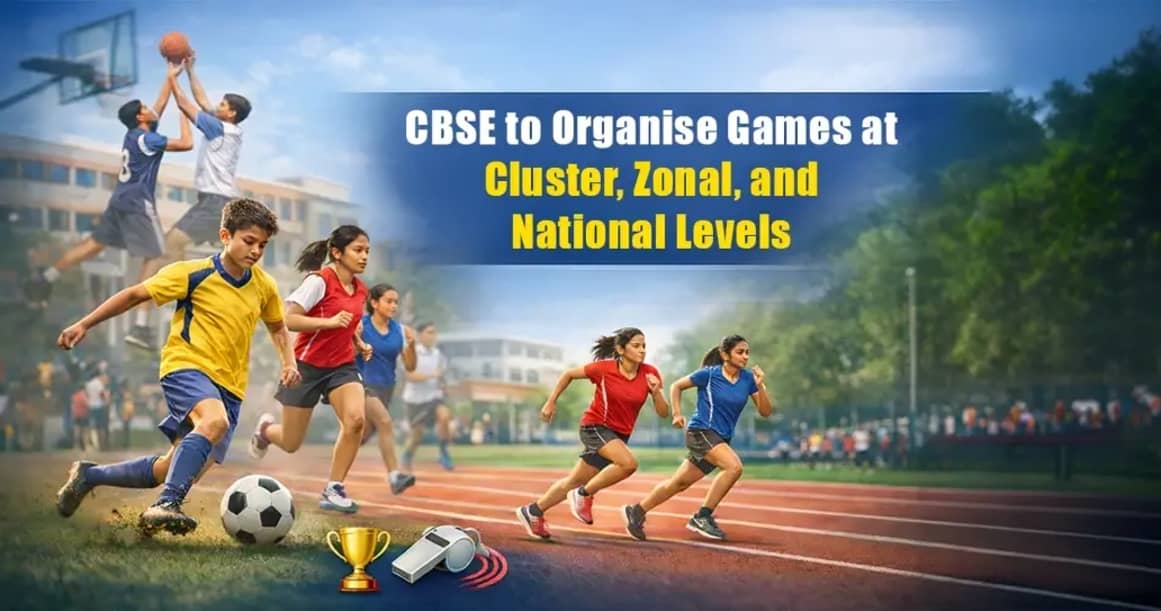
The Central Board of Secondary Education has outlined its sports competition guidelines for the 2026-27 academic session, providing schools and students with details on eligibility, age criteria, participation procedures, organisation and funding.
The guidelines are intended to create a standard framework for CBSE affiliated schools participating in sports competitions during the academic year. They cover several aspects of school level sporting events, including student eligibility, age groups, participation requirements, responsibilities of organising institutions and procedures for addressing disputes.
Sports competitions organised under the CBSE framework provide students with opportunities to participate in athletics and other sporting disciplines while representing their schools at different levels.
One of the important areas covered by the guidelines is the age eligibility of participating students. Students must meet the prescribed age requirements for the particular competition and category in which they seek to participate.
Schools are expected to verify the age and eligibility details of students before submitting entries. Accurate documentation is important because eligibility disputes can arise if the information submitted by a school does not match the official records.
Students and schools should therefore carefully check the applicable age criteria before registering for a competition.
The guidelines also provide a framework for participation at different levels. Students may progress through the relevant stages depending on the structure of the competition and their performance.
Participation requirements can differ according to the sport and competition category. Schools should therefore refer to the specific instructions applicable to each sporting discipline.
Organising schools also have responsibilities under the CBSE sports framework. They are expected to make appropriate arrangements for conducting competitions and follow the prescribed procedures.
These responsibilities may include venue arrangements, scheduling, participant management, officials, documentation and other operational requirements necessary for conducting the events smoothly.
The funding process is another important aspect addressed in the guidelines. Organising schools may receive financial support or follow prescribed procedures for managing expenses associated with CBSE sports competitions.
The funding provisions are intended to support the organisation of events while maintaining transparency and accountability in the use of available resources.
Schools involved in organising competitions should maintain proper records of expenditure and follow the applicable financial instructions.
The guidelines also address procedures for challenging or raising objections against competition results. This is important because disputes can occasionally arise regarding scoring, eligibility, officiating or other aspects of a sporting event.
Students and schools that believe there has been an error or irregularity can use the prescribed process to raise their concerns. However, challenges must be submitted according to the rules and within the applicable time limits.
The availability of a formal process helps ensure that disputes are addressed systematically rather than through informal complaints.
Coaches and school sports officials also have an important role in ensuring compliance. They should familiarise themselves with the competition rules and communicate eligibility requirements to participating students.
Schools should verify all necessary documents before sending students to competitions. This can help avoid last minute problems related to age, identity or eligibility.
Students participating in CBSE sports events should also understand that meeting the basic eligibility requirements does not automatically guarantee participation in every stage. Selection and progression depend on the rules applicable to the particular competition.
The guidelines are particularly relevant for schools planning their sports calendars for the 2026-27 academic year. Early preparation can help schools complete registration and documentation requirements within the prescribed timelines.
Sports participation is an important part of school education because it provides students with opportunities to develop physical fitness, discipline, teamwork and competitive skills.
CBSE sports competitions also give talented students opportunities to compete against participants from schools across different regions.
A standardised competition framework can help ensure that students from different schools are assessed under consistent procedures.
The age criteria are particularly important because sports competitions often involve students from different age groups. Correct classification helps maintain fairness and ensures that participants compete against students in the appropriate category.
Schools should therefore ensure that the age details submitted for students are accurate and supported by valid records.
The funding provisions are also significant for organising schools because hosting sporting events involves expenditure on venues, equipment, officials and other arrangements.
Clear financial procedures can help schools understand how expenses are handled and what documentation may be required.
The guidelines also place importance on following competition procedures when raising objections. Schools and participants should avoid relying on informal claims and instead use the official process prescribed by CBSE.
Any challenge to a result should be supported by relevant information and submitted through the appropriate channel.
For the 2026-27 academic session, schools are expected to review the updated sports guidelines before registering students for competitions.
Teachers, sports coordinators and coaches should ensure that participating students understand the eligibility requirements and competition rules.
Parents and students can also check with their respective schools for sport specific information, schedules and documentation requirements.
The guidelines may vary depending on the particular sporting discipline, so participants should not assume that rules applicable to one sport automatically apply to another.
The CBSE framework is designed to provide a structured approach to school sports competitions while ensuring that students receive fair opportunities to participate.
The 2026-27 guidelines cover key areas including age eligibility, participation levels, responsibilities of organising schools, financial arrangements and mechanisms for addressing disputes.
Schools should follow the official CBSE instructions and verify all requirements before submitting student entries.
For students, understanding the rules in advance can help prevent avoidable eligibility issues and ensure a smoother competition experience.
Overall, the CBSE sports guidelines for 2026-27 provide schools with a framework for conducting and participating in sports competitions. The focus on eligibility, age verification, organisational responsibilities, funding and result related complaints is intended to promote transparency and consistency.
Schools, students and coaches should carefully review the applicable official instructions and complete all required procedures within the prescribed timelines before participating in CBSE sports competitions during the 2026-27 academic session.