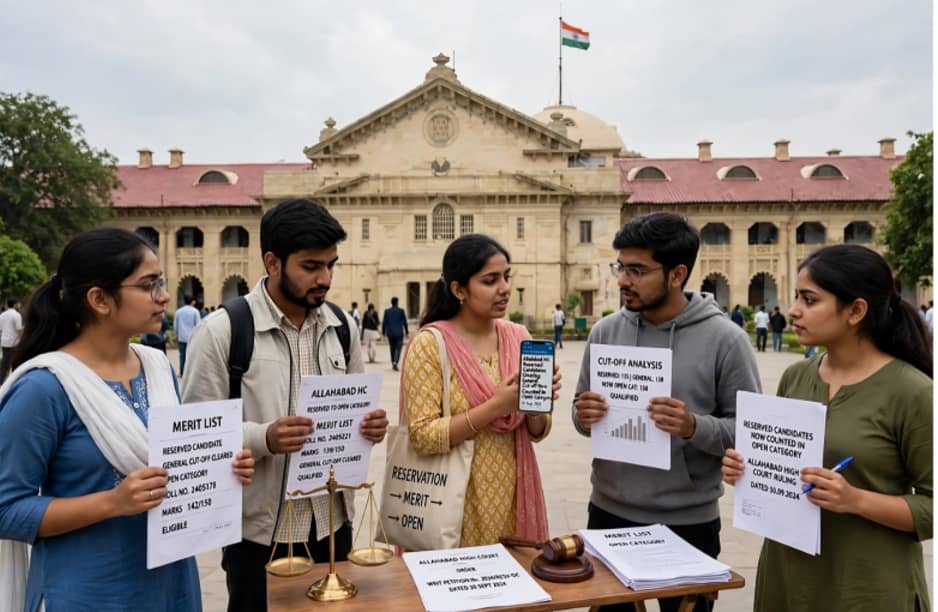
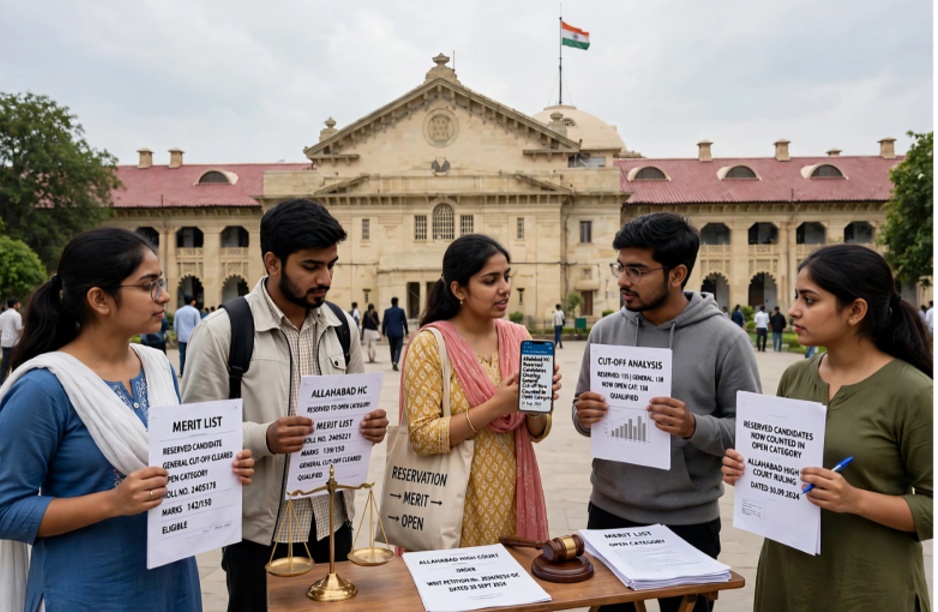
The Lucknow bench of the Allahabad High Court has ruled that meritorious candidates belonging to reserved categories must be considered under the unreserved or open category at the screening stage itself when they secure marks above the prescribed unreserved category cut off without taking any relaxation or concession in the qualifying standard.
The judgment was delivered in connection with recruitment for the post of Swasthya Shiksha Adhikari through the Uttar Pradesh Public Service Commission. A division bench comprising Justice Rajan Roy and Justice Manjive Shukla allowed a special appeal filed by Bhavna Yadav and other petitioners.
The case arose from a UPPSC recruitment advertisement issued on December 22, 2025. The advertisement contained a condition stating that reserved category candidates could be adjusted against unreserved vacancies only at the stage of final selection, subject to the condition that they had not received any concession in the qualifying standard during the screening examination.
The petitioners challenged this condition as well as an office memorandum issued by the Uttar Pradesh government. Their contention was that candidates who qualify on their own merit by crossing the unreserved cut off should not be restricted to reserved category vacancies until the final stage of recruitment.
The High Court examined the role of the screening examination in the particular recruitment process. The bench noted that the screening test was not merely an initial qualifying exercise or a simple method of shortlisting candidates.
Under the recruitment advertisement, 75 percent of the marks used for preparing the final merit list come from the screening examination, while the remaining 25 percent come from the interview. Because screening examination marks have such a substantial impact on the final merit list, the court held that the examination forms an integral part of the final selection process.
This aspect was important to the court's consideration of how reserved category candidates should be treated during the recruitment process. The court held that where a reserved category candidate crosses the unreserved category cut off without taking any relaxation or concession in the qualifying standard, the candidate should be treated as an open category candidate from the screening stage itself.
The ruling does not mean that every reserved category candidate automatically moves to the open category. The condition concerning the absence of relaxation or concession is significant. The candidate must have qualified against the unreserved standard without relying on a relaxation that enabled the candidate to meet the qualifying requirement.
The court considered Section 3(6) of the Uttar Pradesh Public Services Reservation for Scheduled Castes, Scheduled Tribes and Other Backward Classes Act, 1994. According to the court's interpretation, the provision does not impose a restriction that a meritorious reserved category candidate can be adjusted against an unreserved vacancy only at the final selection stage.
The bench therefore set aside the relevant condition contained in the recruitment advertisement. It also held that the January 9, 2020 office memorandum would not apply to the recruitment in question.
The court's ruling is particularly relevant to recruitment examinations that have multiple stages. In such examinations, the role of the preliminary or screening test can differ depending on the applicable recruitment rules. In the present case, the screening marks were directly incorporated into the final merit calculation, which led the court to treat the screening examination as an integral part of the selection process.
The High Court has also directed the UPPSC to review the applicability of the relevant office memorandum within three months. The Uttar Pradesh government has separately been directed to formulate and clarify its policy on the issue within the same three month period.
The decision could have implications for the way recruitment authorities frame rules concerning reserved category candidates and open category vacancies. However, the practical application of the judgment will depend on the specific recruitment rules, examination structure and applicable reservation provisions in each recruitment process.
The distinction between an open category vacancy and a reserved category vacancy is important in this context. An open category vacancy is not necessarily restricted to candidates belonging to the unreserved social category. Candidates from reserved communities can also compete for open vacancies when they meet the applicable open category standard on their own merit, subject to the rules governing relaxation and concessions.
The Supreme Court has also addressed this broader issue in recent judgments. In a December 2025 case concerning Rajasthan High Court recruitment, the Supreme Court upheld the principle that reserved category candidates who score above the open category cut off without availing relaxation or concession cannot be excluded from consideration for open category vacancies.
At the same time, the Supreme Court has distinguished situations in which a candidate has used a relaxation at an earlier stage of an examination. A January 2026 Supreme Court ruling concerning a Karnataka recruitment dispute addressed the effect of relaxation at the preliminary stage and held that such relaxation can prevent a reserved category candidate from later claiming an unreserved vacancy.
This distinction is important for candidates because simply obtaining a higher score at a later stage does not necessarily determine eligibility for an open category vacancy if a candidate previously relied on a qualifying relaxation. The applicable recruitment rules and the specific facts of each selection process therefore remain important.
The Allahabad High Court's latest ruling is focused on the UPPSC recruitment for Swasthya Shiksha Adhikari. The court did not issue a general direction that overrides every recruitment rule across India. Instead, it interpreted the Uttar Pradesh reservation law and the conditions governing the recruitment before it.
The judgment also highlights the importance of understanding how screening examinations are structured. In some recruitment examinations, a screening test may only determine which candidates can proceed to a later stage, with its marks not being included in the final merit calculation. In the UPPSC recruitment considered by the court, however, 75 percent of the final merit came from screening marks.
The court therefore concluded that the screening examination could not be treated as a stage entirely separate from final selection. This reasoning formed an important part of the decision concerning the timing of consideration for open category vacancies.
Following the judgment, the UPPSC has been given three months to review the applicability of the relevant office memorandum. The state government has also been asked to clarify its policy within three months.
For candidates preparing for government recruitment examinations in Uttar Pradesh, the development highlights the importance of checking the exact recruitment notification, reservation provisions, qualifying standards and rules relating to relaxation before applying or challenging a selection process.
The judgment also provides a distinction between merit based consideration and selection based on a relaxed qualifying standard. Candidates who clear the unreserved cut off without using a relaxation are treated differently from candidates who require a relaxation to qualify at an earlier stage.
The Allahabad High Court's decision therefore addresses when a meritorious reserved category candidate should be considered against an open vacancy in the specific recruitment process. It also establishes that where screening marks contribute substantially to final merit, the screening stage can form an integral part of the final selection process.
The state government's policy clarification and the UPPSC's review, both directed to be completed within three months, are expected to provide further clarity on how the relevant rules will be applied in the recruitment process concerned.