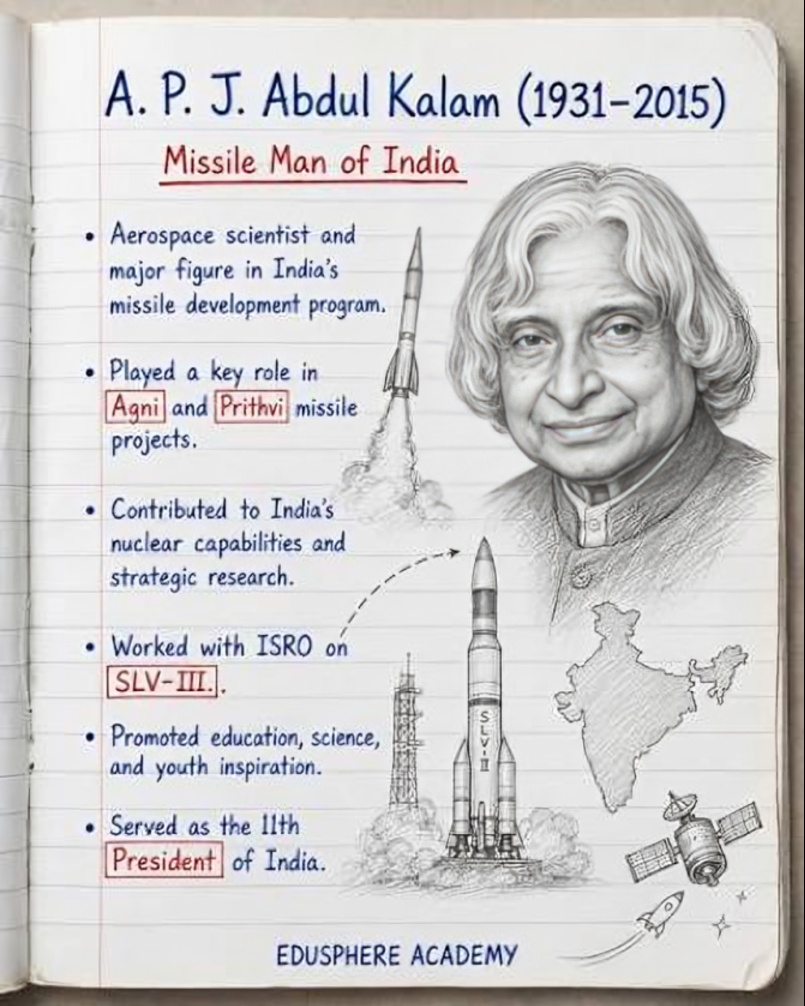
Dr. A.P.J. Abdul Kalam, fondly remembered as the Missile Man of India and the People's President, continues to inspire millions through his extraordinary life dedicated to education, science and national development. On his death anniversary, people across the country pay tribute to his contributions as a scientist, teacher, author and visionary leader whose legacy remains deeply connected to India's progress.
Born on October 15, 1931, in Rameswaram, Tamil Nadu, Abdul Kalam grew up in a humble family. Despite financial challenges, he remained committed to education from an early age. He completed his schooling at Schwartz Higher Secondary School in Ramanathapuram, where his teachers recognized his curiosity and passion for learning.
Kalam pursued a degree in Physics from St. Joseph's College, Tiruchirappalli, graduating in 1954. Although he initially studied science, his interest gradually shifted toward engineering and aviation. He later enrolled at the Madras Institute of Technology (MIT), Chennai, where he studied Aeronautical Engineering. His years at MIT played a crucial role in shaping his future career as an aerospace scientist.
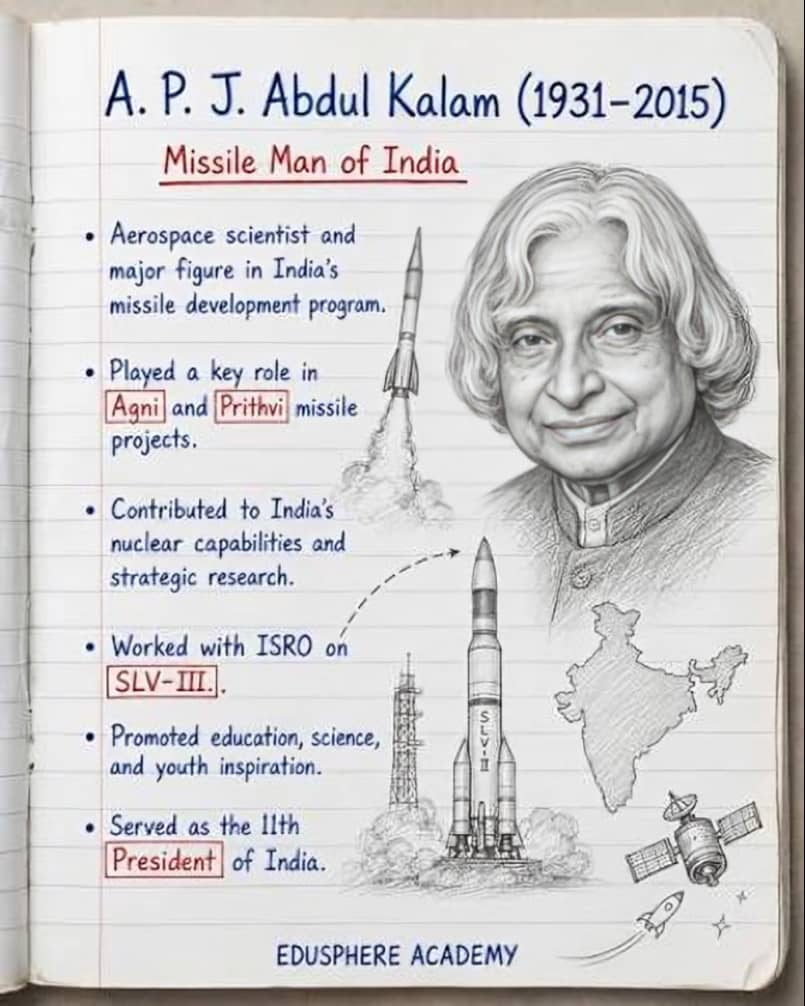
After completing his engineering education, Kalam joined the Defence Research and Development Organisation (DRDO) in 1958. Soon after, he became associated with the Indian Space Research Organisation (ISRO), where he played a significant role in India's early space programme. One of his major achievements was serving as the Project Director for the Satellite Launch Vehicle 3 (SLV-3), which successfully placed the Rohini satellite into orbit in 1980, marking a milestone in India's space capabilities.
Kalam later returned to DRDO and led several strategic defence programmes. He played a central role in the Integrated Guided Missile Development Programme, contributing to the development of missile systems including Agni and Prithvi. These achievements earned him the title Missile Man of India and established him as one of the country's leading scientists.
His contributions to science and technology were recognised with several prestigious civilian honours, including the Padma Bhushan, Padma Vibhushan and Bharat Ratna, India's highest civilian award.
In 2002, Dr. Kalam was elected as the 11th President of India, serving until 2007. During his presidency, he became widely known as the People's President because of his accessibility, humility and constant engagement with students and young people. Rather than limiting himself to ceremonial responsibilities, he travelled extensively across the country, encouraging students to dream big, pursue knowledge and contribute to national development.
Even after completing his presidential term, Kalam devoted much of his time to teaching, writing and mentoring students. He served as a visiting professor at several educational institutions and delivered lectures on innovation, leadership, science and nation-building. His books, including Wings of Fire, Ignited Minds, India 2020 and My Journey, continue to inspire readers across generations.
Dr. Kalam strongly believed that education was the most powerful tool for transforming society. He consistently encouraged young people to develop scientific thinking, creativity, integrity and a sense of responsibility toward the nation. His famous message, "Dream, dream, dream. Dreams transform into thoughts and thoughts result in action," continues to motivate students across India.
On July 27, 2015, Dr. Kalam passed away while delivering a lecture at the Indian Institute of Management Shillong, reflecting his lifelong dedication to education until his final moments.
Today, his educational journey stands as a powerful example of how determination, knowledge and hard work can overcome adversity. His life continues to inspire students, educators, scientists and leaders, ensuring that his vision for a developed and knowledge-driven India remains relevant for future generations.