
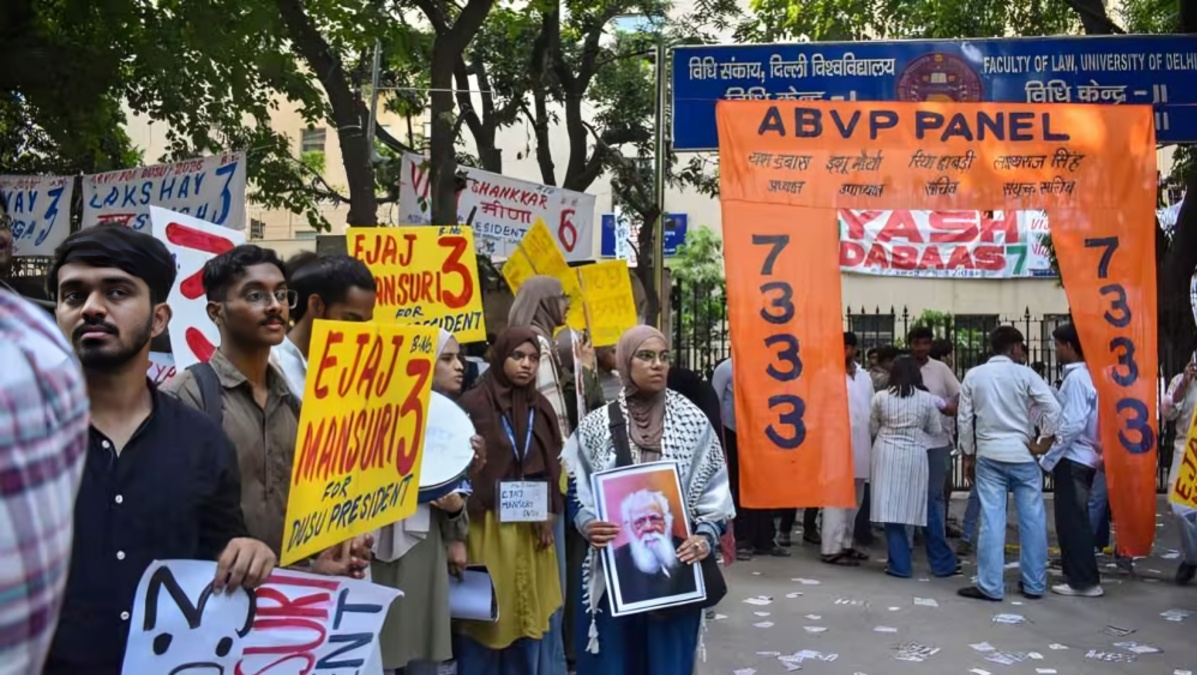
The Delhi University Students Union election for the 2026 academic year is taking place on September 18, with students voting across Delhi University colleges and departments to elect representatives for the four central posts. The election is being conducted amid increased attention on campus security, campaign rules and compliance with directions issued by the Delhi High Court.
The four central positions being contested are president, vice president, secretary and joint secretary. Major student organisations, including the Akhil Bharatiya Vidyarthi Parishad and the National Students Union of India, have fielded candidates for the election. Other student groups are also contesting the central panel.
The voting process is being conducted in two sessions. Students attending morning and day classes can vote during the first session, while students attending evening classes can vote during the second session. Reports have placed the number of eligible voters at more than 1.5 lakh, although other reports have cited a larger figure for the wider university student population. The exact turnout will become clearer after polling concludes and official figures are released.
The 2026 election has attracted considerable attention because of the direct contest between ABVP and NSUI. The ABVP has fielded Yash Dabas for president, Ishu Maurya for vice president, Riya Chhawadi for secretary and Lakshya Raj Singh for joint secretary. The organisation is contesting all four central posts.
NSUI has also fielded a full panel for the central positions. Other organisations, including the AISA SFI alliance, are participating in the election. An Aam Aadmi Party student wing, the Association of Students for Alternative Politics, has also fielded Ashmit Kumar as a presidential candidate. The presidential contest therefore includes candidates beyond the two major student organisations.
The election campaign has focused on a range of student concerns. Accommodation, hostel availability, campus infrastructure, student safety, fees and placement opportunities have emerged as some of the issues discussed during the campaign. Students have also raised concerns about affordable and safe accommodation, particularly following the recent Satya Niketan building collapse that resulted in the deaths of seven people, including Delhi University students.
The ABVP has highlighted hostels, safety and placements in its election manifesto. Other student organisations have also presented their respective priorities and proposals to voters. The issues raised during the campaign reflect concerns about both academic life and the wider living conditions of students studying in Delhi.
Security arrangements have been strengthened for polling day. Delhi Police has deployed personnel across university areas, while North Campus has been divided into multiple zones and sectors for security management. Authorities have also taken steps to monitor campaign-related activities and maintain order around polling locations.
The election is taking place under heightened judicial scrutiny. The Delhi High Court has recently examined allegations relating to campaign violations, violence, vandalism, vehicle cavalcades and the presence of outsiders during the election period. The court has also questioned Delhi University and the Delhi Police about enforcement of election rules.
On September 18, the Delhi High Court directed that victory processions should not be held after the election results are announced. The restriction covers roads, university campuses and hostels. The court also directed Delhi Police to enforce the order and warned that violations could result in criminal and other legal consequences, including contempt proceedings.
The High Court has also issued notices to 140 student candidates in connection with alleged violations of election norms and previous court directions. The notices concern allegations and do not by themselves establish that every candidate was responsible for a violation. The concerned parties will have an opportunity to respond before the court.
The court's intervention has added another layer to the 2026 DUSU election process. Candidates and their supporters are required to comply with the applicable election rules and judicial directions as polling concludes and counting begins.
Vote counting is scheduled for September 19 at the University Sports Stadium. The counting process will determine the winners of the four central DUSU positions. Until the counting is completed and official results are announced, claims about which organisation has won the central panel should not be treated as confirmed results.
The reference to an ABVP clean sweep in five Delhi University colleges belongs to an earlier DUSU election result and should not be used as the 2026 result. In the 2024 college-level elections, ABVP was reported to have secured all positions in five colleges, while NSUI won all positions in two colleges. That historical result is separate from the 2026 election currently underway.
For the 2026 election, the final outcome will depend on votes cast on September 18 and counted on September 19. The central panel results will provide the official picture of the new DUSU leadership.
Students and readers following the election should therefore distinguish between campaign claims, early trends and confirmed results. A candidate or organisation leading at an individual college does not necessarily establish the final outcome for the DUSU central panel.
The 2026 election is also being conducted against the background of continuing discussion about student representation, campus facilities and election regulations. The results are expected to indicate how students have voted on the competing candidates and the issues highlighted during the campaign.
Once counting is completed, the official results will establish who has been elected president, vice president, secretary and joint secretary. Until then, reports should describe the election as an ongoing process rather than announcing an unconfirmed winner.
The immediate timeline is therefore straightforward. Polling is taking place on September 18, counting is scheduled for September 19, and the results will determine the next DUSU central panel. Candidates and supporters must also follow the Delhi High Court's directions concerning post-result victory processions.