
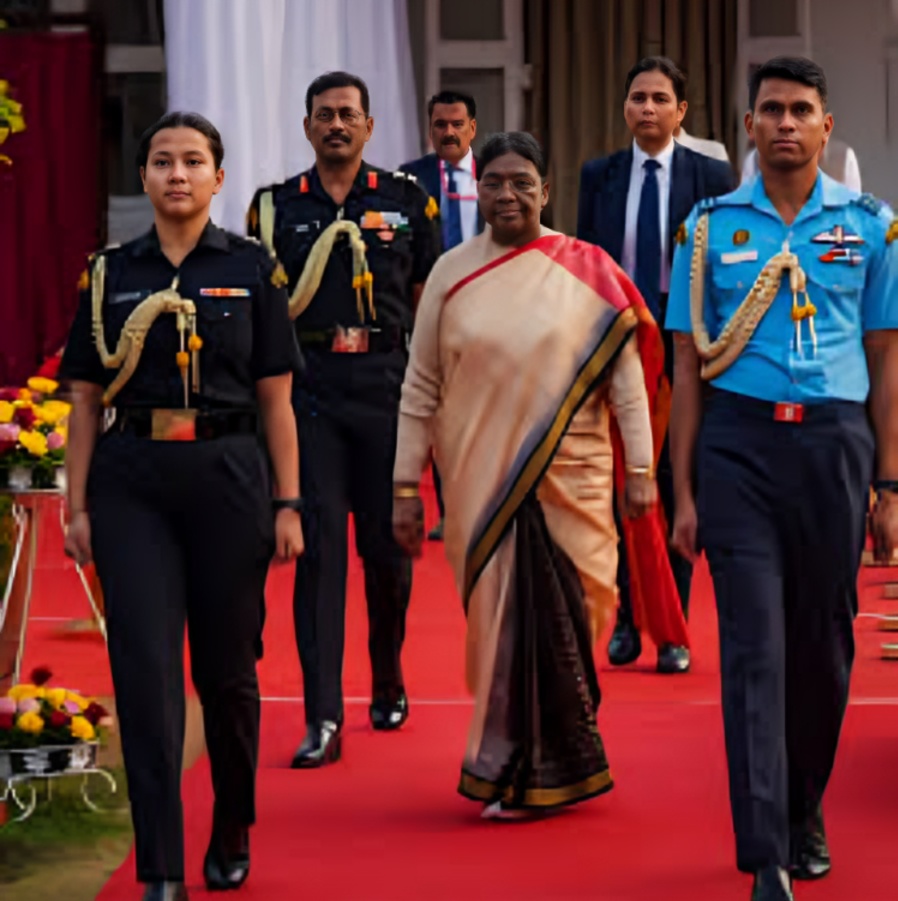
Major Navya Shekhawat has achieved a significant milestone in the history of the Indian Armed Forces after becoming the first woman officer from the Indian Army to serve as Aide-de-Camp to President Droupadi Murmu.
Her appointment at Rashtrapati Bhavan represents an important development in the increasing participation of women in senior and prestigious roles within the armed forces. Major Shekhawat is serving as an ADC to the President, a position that involves assisting the head of state during official engagements, ceremonies and other important programmes.
While Major Shekhawat is the first woman from the Indian Army to hold the President’s ADC position, she is the second woman officer overall to serve in this role. Lieutenant Commander Yashasvi Solanki of the Indian Navy became the first woman officer to serve as an ADC to the President in 2025. Major Shekhawat’s appointment therefore marks the entry of the Indian Army’s first woman officer into this prestigious presidential role.
Major Shekhawat’s journey into the Indian Army began through the Combined Defence Services examination conducted by the Union Public Service Commission. After securing a place through the relevant selection process, she underwent military training at the Officers Training Academy in Chennai.
She was subsequently commissioned into the Army Service Corps. The Army Service Corps plays an important role in supporting the operational requirements of the Indian Army through logistics, transportation and supply-related functions.
According to reports, Major Shekhawat joined the Army in 2021 and reached the rank of Major within a few years. Her appointment as the President’s ADC has brought wider attention to her military career and professional journey.
The role of an Aide-de-Camp is much more than simply accompanying a senior constitutional authority during public appearances. An ADC is part of the official support structure around the President and is involved in coordinating official engagements, maintaining military protocol and assisting during ceremonies and important events.
The President of India is the Supreme Commander of the Armed Forces. As a result, the ADC role carries considerable ceremonial and professional significance for an officer selected for the position.
ADC officers can be seen accompanying the President during official ceremonies at Rashtrapati Bhavan, state visits, military functions, investiture ceremonies and other important engagements. Their responsibilities require discipline, professionalism, attention to protocol and the ability to coordinate with different officials and organisations.
Major Shekhawat’s appointment is also significant in the broader context of women's representation in the Indian military. Over the past several years, women officers have taken on increasingly diverse responsibilities across the Army, Navy and Air Force.
The appointment of women to traditionally male-dominated military positions has become an important part of the armed forces’ evolving personnel structure. Women officers are now serving in a growing range of operational, technical, administrative and leadership roles.
Major Shekhawat’s appointment adds another example of this changing landscape. Her selection for the President’s ADC position demonstrates that women officers are increasingly being considered for highly visible and prestigious assignments based on their professional qualifications and military service.
The significance of the appointment also extends beyond the individual officer. For young women considering a career in the armed forces, such appointments can serve as an example of the opportunities available through military service.
Major Shekhawat’s journey from clearing the CDS examination and completing military training to serving at Rashtrapati Bhavan highlights the career path available to officers who enter the armed forces through competitive selection and professional training.
Her appointment also comes after the historic appointment of Lieutenant Commander Yashasvi Solanki, who became the first woman officer overall to serve as the President’s ADC in 2025. The subsequent appointment of a woman Army officer indicates the continuing expansion of women's representation in the President’s military staff.
The development has attracted attention because the President’s ADC position is closely associated with military protocol and official engagements. Officers serving in this role are expected to maintain high standards of discipline and professionalism while representing their respective services.
Major Shekhawat’s appointment also highlights the importance of the Army Service Corps, whose personnel support the wider military through essential logistics and supply functions. Her career demonstrates that officers from support services can also move into highly visible ceremonial and institutional assignments.
For the Indian Army, the appointment is another notable step in the continuing integration of women officers into a broader range of responsibilities. It also reflects the changing profile of military leadership and representation in the country.
Major Navya Shekhawat’s appointment as the first woman Army officer to serve as the President’s ADC is therefore both a personal career milestone and a significant development for women in the Indian Armed Forces. As she takes on responsibilities at Rashtrapati Bhavan, her appointment is likely to remain an important reference point in the evolving story of women's participation in India's defence services.