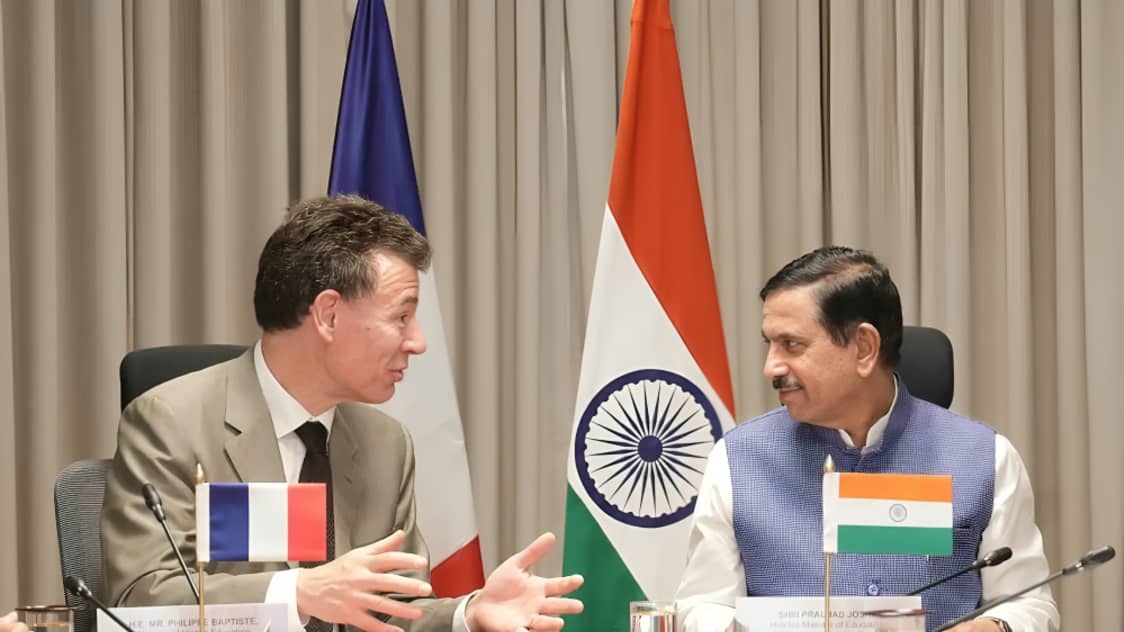
Union Education Minister Pralhad Joshi interacted with students during his visit to the Indian Institute of Technology Madras on October 8, 2026. The interaction focused on students’ experiences, aspirations and ideas for India’s future, highlighting the importance of direct engagement between policymakers and young people in higher education.
Joshi shared details of his visit through social media and said he interacted with students during a morning walk across the IIT Madras campus. According to his account, the discussions included the students’ experiences and their vision for the country. He described their enthusiasm, ideas and energy as a reflection of the significant potential of India’s youth.
The interaction comes at a time when innovation, entrepreneurship, research and emerging technologies are becoming increasingly important areas of focus in Indian higher education. Institutions such as IIT Madras play an important role in developing technical talent while also supporting research, startups and industry collaboration.
IIT Madras has established itself as an important centre for technology and entrepreneurship. The institute’s broader innovation ecosystem includes research activities, startup development and initiatives designed to connect students and researchers with emerging fields. Recent information from IIT Madras shows that the institution has been expanding programmes intended to provide students with early exposure to new academic and career opportunities.
One such initiative is the IIT Madras School Connect programme, which is designed to introduce school students to a range of academic disciplines and future career pathways. The October 2026 programme expanded its coverage to include Class IX students along with Classes X, XI and XII. The initiative offers courses in areas including data science and artificial intelligence, aerospace, cybersecurity, electronic systems, chemical engineering, product design, economics and finance, mathematics and computing and engineering biological systems.
The expansion reflects the growing emphasis on giving students exposure to emerging fields before they make important academic and career decisions. Such programmes can help students understand the changing requirements of the job market and identify areas of interest at an earlier stage.
Innovation and entrepreneurship were also central themes in recent remarks by Joshi at other educational institutions. In September, he called on young innovators to identify practical problems faced by ordinary people and develop affordable solutions. He also highlighted the role of mentoring, incubation and industry support in helping promising ideas move from prototypes towards wider adoption.
The emphasis on innovation is particularly relevant for IIT Madras, which has a strong connection with India's technology and startup ecosystem. The institute has supported a large number of startups and research projects, while its academic programmes cover traditional engineering disciplines as well as newer areas of technology.
The role of Indian Knowledge Systems is another part of the broader discussion around the future of education. The Indian Knowledge Systems Division under the Ministry of Education promotes interdisciplinary research into India's traditional knowledge and its possible applications in areas including agriculture, basic sciences, engineering and technology, architecture, management and economics.
At IIT Madras, Indian Knowledge Systems has also received attention through institutional initiatives. The institute has previously developed an IKS research corridor aimed at encouraging interdisciplinary work involving areas such as humanities and social sciences, civil engineering, materials engineering and computer science. This approach seeks to connect traditional knowledge with contemporary academic research.
The discussion around Indian Knowledge Systems forms part of a larger effort to broaden the scope of higher education. While modern technology and scientific research remain essential, policymakers and educational institutions are also examining how India's historical knowledge traditions can be studied, documented and evaluated through contemporary academic methods.
For students, the changing education landscape means that technical qualifications are increasingly being combined with research experience, entrepreneurship, communication skills and interdisciplinary learning. Future employment opportunities are also expected to be influenced by developments in artificial intelligence, digital technologies, cybersecurity, advanced manufacturing, climate technology and other emerging sectors.
IIT Madras has been expanding its educational initiatives in response to these changes. Its School Connect programme, for example, offers students exposure to 17 future focused disciplines. The courses are designed to help students explore subjects before making decisions about higher education and career pathways.
The institute's approach also reflects a broader shift in education from conventional classroom learning towards experiential and interdisciplinary learning. Students are increasingly being encouraged to work on practical problems, participate in research, explore entrepreneurship and develop skills that can be applied beyond academic examinations.
The interaction between Joshi and IIT Madras students therefore comes against a wider national focus on preparing young people for a changing economy. Direct conversations with students can provide policymakers with insights into their aspirations, challenges and expectations from the education system.
The minister's comments about the enthusiasm and ideas of the students also underline the importance of youth participation in India's development. India has a large young population, and educational institutions are expected to play a major role in preparing this workforce for future economic and technological requirements.
At the same time, future ready education involves more than introducing new technology into classrooms. It also requires strong research infrastructure, access to quality faculty, opportunities for innovation and entrepreneurship, industry partnerships and programmes that encourage students to explore different career possibilities.
IIT Madras has continued to build programmes that connect students with emerging disciplines and research opportunities. The institute's School Connect initiative has already reached more than 1.75 lakh students through partnerships with thousands of schools and aims to expand its reach further.
The growing focus on innovation also creates opportunities for students to address real world challenges. Recent initiatives supported by the Education Ministry have encouraged young people to work on practical solutions in areas relevant to everyday life. Such efforts can help bridge the gap between academic ideas and their potential applications in society.
For higher education institutions, the challenge will be to balance academic foundations with rapidly changing technological requirements. Students will need strong fundamentals while also developing the ability to learn new technologies and adapt to changing professional environments.
The interaction at IIT Madras highlighted this broader connection between education, innovation and national development. While the campus meeting was informal, it provided an opportunity for the Education Minister to hear directly from students and understand their aspirations for the country's future.
Overall, Pralhad Joshi's interaction with IIT Madras students reflects the growing importance of student engagement in discussions about India's education and development priorities. Innovation, entrepreneurship, Indian Knowledge Systems, research and emerging technologies are increasingly becoming part of the conversation about how India's higher education system can prepare young people for future opportunities.