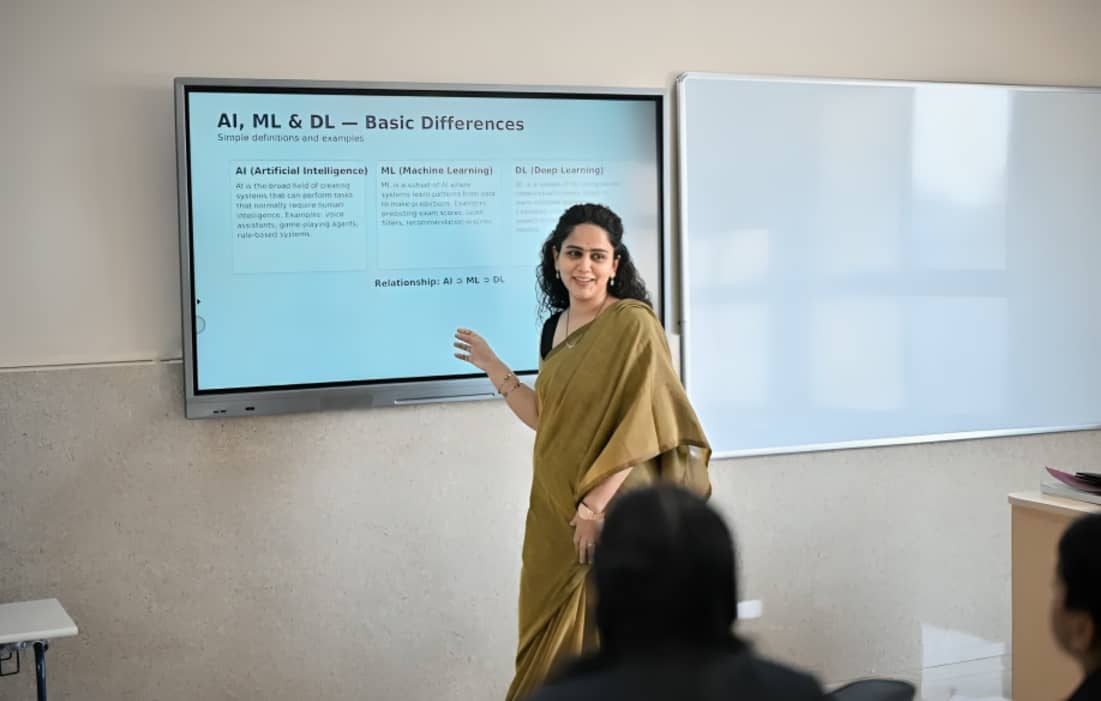

Punjab has become the first state in India to introduce Artificial Intelligence as a mainstream subject across all school grades from Class 1 to Class 12. The initiative marks a significant step in integrating emerging technologies into school education and aims to equip students with digital skills that are expected to play an increasingly important role in future careers.
The programme will be implemented through the Sarbat.AI initiative and is expected to benefit more than 3.15 million students studying in government schools across the state. The initiative reflects Punjab's effort to prepare students for a technology driven economy by introducing AI education at an early stage of learning.
According to the state government, the curriculum has been designed to provide age appropriate learning experiences. Younger students will be introduced to the basic concepts of artificial intelligence, computational thinking, logical reasoning, and responsible use of technology through simple and engaging activities. As students progress to higher classes, the curriculum will gradually expand to include practical applications of AI, problem solving techniques, data literacy, coding, machine learning concepts, and ethical use of artificial intelligence.
The introduction of Artificial Intelligence as a mainstream subject is expected to complement existing academic programmes rather than replace traditional subjects. Education officials believe that combining AI education with mathematics, science, social sciences, and language learning will help students develop interdisciplinary skills required in the modern workforce.
Artificial Intelligence has rapidly become one of the most influential technologies across industries including healthcare, finance, manufacturing, agriculture, transportation, education, and information technology. As AI applications continue to expand globally, educational institutions are increasingly introducing technology focused programmes to prepare students for future employment opportunities.
The Punjab initiative also emphasizes responsible and ethical use of artificial intelligence. Students will be encouraged to understand not only how AI systems work but also the importance of privacy, fairness, transparency, digital safety, and responsible decision making while using technology.
Teacher training forms an important part of the implementation strategy. Educators are expected to receive professional development and instructional support to effectively deliver AI related lessons in classrooms. Continuous training will help teachers remain updated with evolving technologies and modern teaching methodologies.
Education experts have welcomed the growing focus on digital literacy, noting that early exposure to emerging technologies can help students develop analytical thinking, creativity, innovation, and problem solving abilities. They believe that introducing AI concepts during school education can better prepare students for higher education and future careers in technology driven sectors.
The initiative is also expected to encourage greater interest in science, technology, engineering, and mathematics education. Students who develop a strong understanding of computational thinking and digital technologies during their school years may find it easier to pursue advanced studies in engineering, computer science, robotics, data science, and related disciplines.
Industry leaders have consistently highlighted the growing demand for professionals with skills in artificial intelligence, data analytics, cybersecurity, cloud computing, and software development. By introducing AI education from the primary level, Punjab aims to strengthen long term workforce readiness and improve digital competencies among students.
The Sarbat.AI programme represents a broader effort to modernize school education through technology enabled learning. In addition to classroom instruction, the initiative may encourage project based learning, collaborative activities, and practical applications that help students understand how artificial intelligence can be used to solve real world problems.
As technology continues to reshape economies worldwide, education systems are increasingly adapting to ensure students develop the knowledge and skills required for the future. Punjab's decision to introduce Artificial Intelligence as a mainstream subject from Classes 1 to 12 represents an important milestone in Indian school education and may serve as a model for other states exploring similar educational reforms.
By integrating AI education across all grade levels, the state aims to build a generation of digitally skilled learners who are better prepared to participate in an increasingly technology driven world while understanding both the opportunities and responsibilities associated with artificial intelligence.