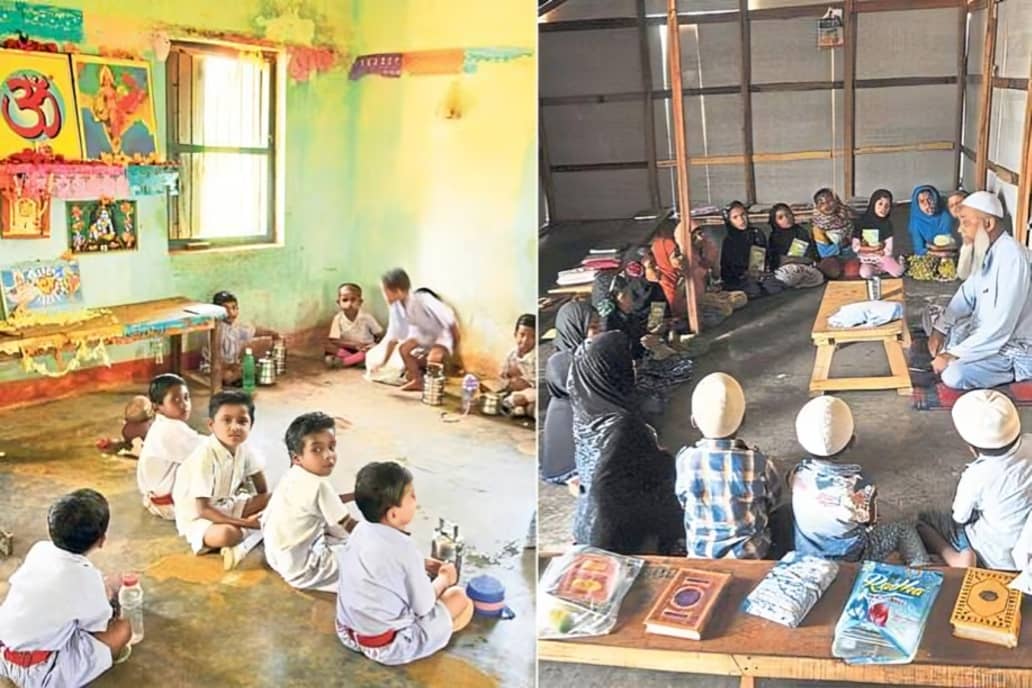

The Supreme Court has declined to entertain a public interest litigation seeking greater regulation and supervision of institutions that provide religious education to children below the age of 14. The petition was filed by BJP leader and advocate Ashwini Kumar Upadhyay, who sought directions relating to the registration, recognition and monitoring of such institutions.
The petition raised concerns about institutions allegedly operating without adequate state supervision. Upadhyay argued that children could be vulnerable to ideological influence and alleged that some institutions were being used for radicalisation under the guise of religious instruction. These allegations were presented as the petitioner's concerns and were not established as findings by the Supreme Court.
The case was considered by a bench comprising Justice Dipankar Datta and Justice Satish Chandra Sharma. During the proceedings, the Court did not enter into the merits of the allegations raised in the petition.
Instead, the Court directed the petitioner to await a decision on a representation that had already been submitted to the Union Ministry of Education. This means that the Supreme Court's decision did not amount to a judicial finding that the allegations were either proved or disproved.
The issue concerns the regulation of educational institutions that provide religious instruction to children. The petitioner had sought a framework under which such institutions would be registered, recognised and monitored by the authorities.
According to the petitioner's submissions, thousands of institutions were allegedly functioning without adequate supervision. The petition argued that stronger monitoring was necessary to protect children and address concerns relating to education, national integration and public safety.
The Supreme Court's approach keeps the matter within the administrative and policy framework for the time being. By asking the petitioner to await the government's response to the existing representation, the Court has not issued the broad regulatory directions sought in the petition.
The case also highlights the distinction between religious instruction and formal educational regulation. Institutions providing education to children can be subject to different legal and regulatory frameworks depending on their nature, recognition and the laws applicable to them.
The petition sought a uniform approach to registration and supervision of institutions providing religious education to children below 14 years of age. Such a framework, if considered by the government, would involve questions relating to education policy, constitutional rights, child welfare and institutional autonomy.
The matter has attracted attention because it touches upon sensitive issues involving religion, education and the rights of children. Any future policy decision would therefore need to take into account the existing constitutional and statutory framework.
The Supreme Court's decision should not be interpreted as an endorsement of the allegations made in the petition. The Court's refusal to entertain the plea at this stage was accompanied by a direction to await the government's consideration of the representation.
The development follows an earlier proceeding involving a similar petition by Upadhyay. In that matter too, the Supreme Court had declined to intervene under Article 32 and had given the petitioner liberty to approach the jurisdictional High Court. The Court had clarified that it had not expressed an opinion on the merits of the matter.
The latest proceedings therefore form part of a continuing legal and policy discussion over the regulation of religious educational institutions.
For the government, the representation before the Union Ministry of Education could become the next important step. The ministry may examine the issues raised and determine whether any administrative or policy action is required.
For institutions providing religious education, any future regulatory framework could have implications for registration, recognition, curriculum, supervision and compliance requirements. However, no such new framework has been ordered by the Supreme Court through the present proceedings.
The case also raises broader questions about balancing child protection with constitutional freedoms. Regulation of educational institutions must operate within the legal framework governing religious freedom, educational rights and the interests of children.
Until the government takes a decision on the representation, the specific regulatory measures sought by the petitioner remain unresolved.
It is also important to distinguish between allegations made in a legal petition and findings established by a court. In this case, the concerns regarding alleged radicalisation were raised by the petitioner, while the Supreme Court did not make a finding confirming those allegations.
The Court's decision therefore leaves the broader policy questions open. The Union Ministry of Education's response, if any, could determine whether the issue moves forward through an administrative or policy process.
For now, the immediate outcome is that the Supreme Court has not granted the directions sought in the PIL. The petitioner has been asked to await the government's consideration of the representation already submitted.
The development is likely to remain relevant in discussions surrounding religious education, child welfare and regulatory oversight in India. Any future action will depend on the response of the competent authorities and, if necessary, further proceedings before the appropriate court.
The Supreme Court's order provides clarity on one important point: the Court has not ruled on the truth or otherwise of the allegations concerning radicalisation. It has instead left the issue for consideration through the appropriate administrative and legal channels.