
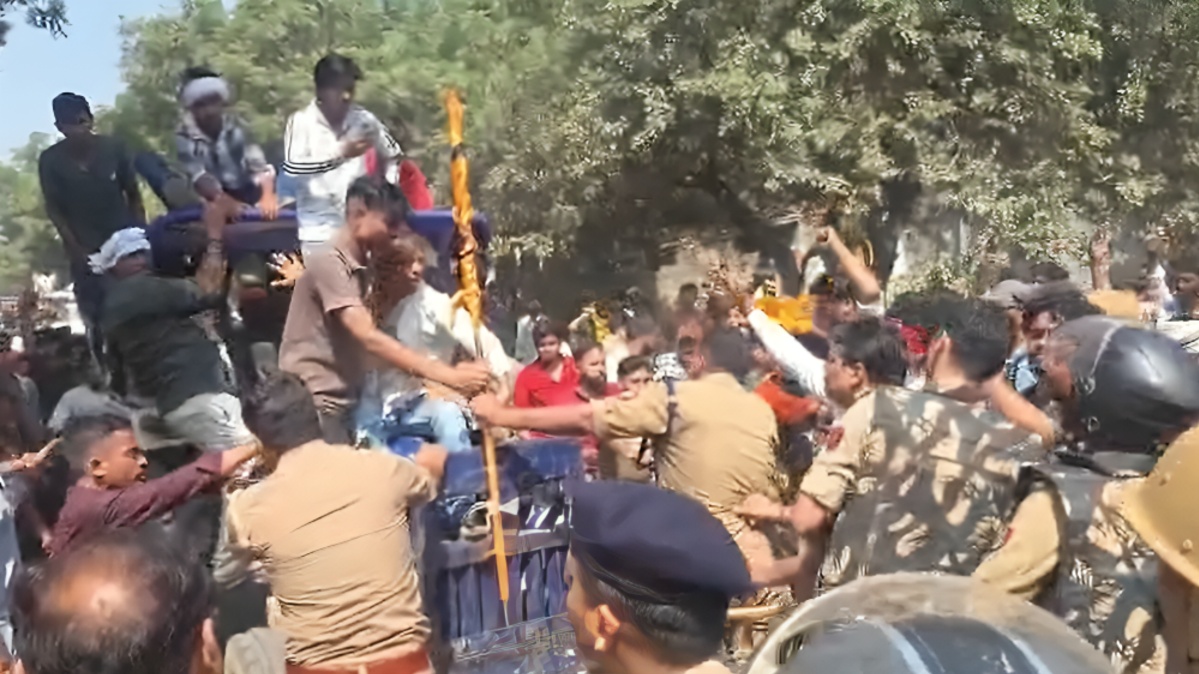
UGC Equity Regulations Protest in Agra
Hundreds of protesters gathered in Agra on Sunday, September 20, to oppose the University Grants Commission Promotion of Equity in Higher Education Institutions Regulations, 2026. The protesters demanded withdrawal of the regulations and raised concerns about provisions that they allege could be misused against students belonging to the general category.
The demonstration took place in the Khandauli area of Agra, where protesters reportedly gathered near the Mudi or Mudi Chauraha intersection. According to police and media reports, the group included people who arrived on foot as well as participants travelling in tractors.
The protesters had planned to march towards the Agra district headquarters. Police personnel attempted to stop the march by placing barricades in the area. Reports said a confrontation and heated exchange took place between protesters and police when the group attempted to move forward.
After the protesters moved past the barricades, some of them reached the Yamuna Expressway. Reports from PTI and Times of India said protesters briefly disrupted traffic on the expressway. Some demonstrators reportedly lay down on the road, while others climbed onto trucks, affecting the movement of vehicles.
Police officials subsequently intervened and persuaded the protesters to clear the road. Traffic movement resumed after the protesters moved away from the expressway.
There is some difference in the accounts regarding the extent of the disruption. Reports from PTI and Times of India described a brief traffic disruption on the Yamuna Expressway. An Agra Police statement cited by Hindustan Times, however, said police prevented a significant blockade and that only a few individuals attempted to access the expressway before being persuaded to leave. The police also said the situation remained under control.
The protest was organised against the UGC Promotion of Equity in Higher Education Institutions Regulations, 2026. The regulations were notified by the University Grants Commission in January 2026 and were intended to establish a framework for preventing discrimination and promoting equity in higher education institutions.
The 2026 regulations included provisions concerning institutional mechanisms for dealing with discrimination complaints. Among the measures were equity committees, equal opportunity mechanisms and grievance redressal arrangements in higher education institutions.
The regulations became controversial after petitions were filed before the Supreme Court challenging aspects of the framework. Petitioners raised concerns about the way certain forms of caste-based discrimination were defined and argued that the provisions could leave members of the general category without adequate protection in some circumstances.
The Supreme Court considered the challenges in January 2026. On January 29, the Court directed that the 2026 UGC regulations be kept in abeyance while the legal issues were examined. The Court also directed that the earlier 2012 UGC regulations would continue to remain in force until further orders.
The Supreme Court's interim order did not finally decide the constitutional validity of the 2026 regulations. Instead, the Court placed their implementation on hold while the legal challenge continued.
The Court raised questions concerning provisions of the 2026 regulations, including the definition of caste-based discrimination and other aspects of the framework. The legal proceedings therefore became an important part of the continuing debate over how discrimination and equity should be addressed in higher education institutions.
The Centre later told the Supreme Court in August 2026 that the 2026 regulations were under reconsideration. The matter remains part of the broader legal process concerning the proposed framework.
Against this background, the Agra demonstration has become another public expression of opposition to the 2026 regulations. The protesters have demanded that the framework be withdrawn rather than implemented in its present form.
According to reports, protesters alleged that some provisions could be misused against general category students and said the regulations did not provide adequate safeguards against false complaints. These are the concerns raised by the protesting groups and should be distinguished from the Supreme Court's legal assessment of the regulations.
The protest also involved a demand for government attention to the concerns raised by the participants. UGC Mukti Morcha president Dharmendra Singh Chauhan said the group wanted the government to reconsider the provisions and said the protest would continue through what he described as democratic and peaceful means.
Police officials said a memorandum had been received from the protesters. Additional Deputy Commissioner of Police Himanshu Gaurav said that no one had been detained at the time of his statement and that the protesters were returning after the demonstration.
The Agra incident comes amid continued public discussion surrounding the UGC's 2026 equity framework. The regulations were originally presented as a mechanism to strengthen institutional measures against discrimination in universities and colleges. Their implementation was subsequently halted by the Supreme Court pending further consideration.
The debate involves several separate questions. One concerns the need for effective mechanisms to prevent discrimination in higher education. Another concerns the wording and scope of the 2026 regulations and whether their provisions provide adequate safeguards for all categories of students.
The Supreme Court's interim intervention has kept the 2026 regulations from taking effect while the earlier 2012 framework continues to operate. This means that higher education institutions are currently governed by the earlier regulatory framework rather than the implementation of the 2026 regulations.
The legal status of the 2026 regulations is therefore important when reporting protests against them. The regulations have not simply been implemented and subsequently withdrawn by the government. They were notified in January, placed in abeyance by the Supreme Court on January 29, and later became the subject of further legal proceedings and government reconsideration.
For students, teachers and higher education institutions, the outcome of the legal process could determine whether the 2026 framework is implemented in its current form, modified or replaced. Until further directions are issued, the Supreme Court's January order keeping the 2026 regulations in abeyance remains an important part of the situation.
The Agra protest also highlights the continuing public response to the regulations. While protesters are demanding complete withdrawal, the government and the courts are dealing with the issue through the ongoing legal and regulatory process.
The Yamuna Expressway episode was eventually brought under control after police intervention. Traffic resumed after protesters cleared the route. The incident did not result in a prolonged closure of the expressway according to the available reports.
The latest developments show that the controversy surrounding the UGC Equity Regulations 2026 remains unresolved. The regulations continue to be in abeyance, the 2012 framework remains applicable under the Supreme Court's January order, and the Centre has indicated that the 2026 framework is under reconsideration.
For readers and students following the issue, it is important to distinguish between the protesters' allegations, the government's position and the Supreme Court's interim directions. The protest represents opposition to the proposed regulations, while the final legal and regulatory position will depend on subsequent proceedings and decisions.