
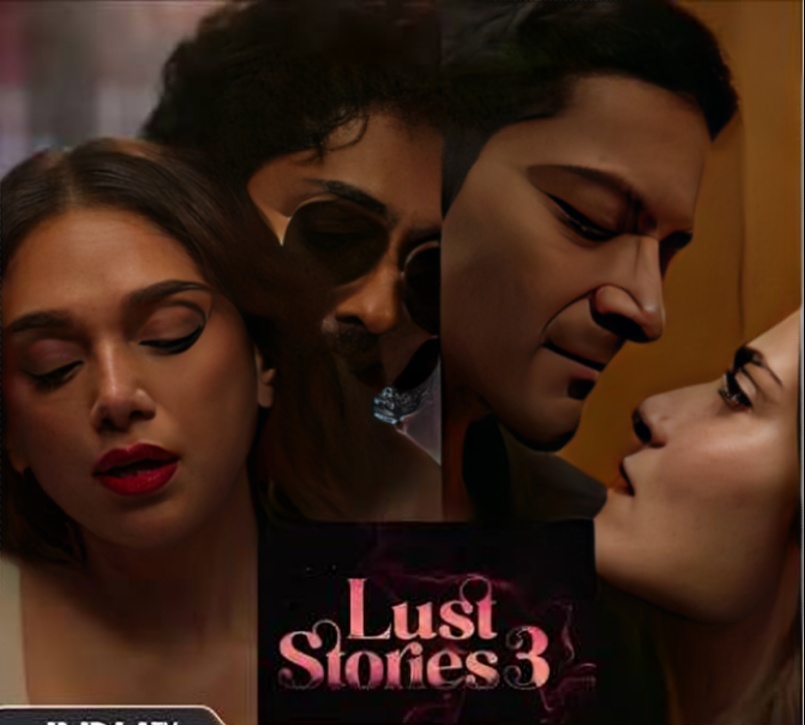
Lust Stories 3, the latest instalment of Netflix’s anthology franchise, began streaming on September 18, 2026. The film brings together four directors, Vikramaditya Motwane, Kiran Rao, Shakun Batra and Vishal Bhardwaj, who present separate stories examining desire, intimacy, relationships and the emotional complications that can arise between people.
The third instalment continues the format established by the earlier films, with each filmmaker approaching the central themes from a different perspective. Rather than connecting the four stories through a single narrative, the anthology allows each director to establish a separate setting, group of characters and tone. Netflix describes the new instalment as four emotionally distinct stories exploring love, lust, relationships and repressed desire.
The ensemble cast includes Konkona Sen Sharma, Radhika Apte, Vijay Varma, Gurfateh Pirzada, Sana Thampi, Ali Fazal, Radhika Madan, Aditi Rao Hydari and Siddharth. The four segments give the actors opportunities to explore different kinds of relationships and emotional conflicts.
Vikramaditya Motwane’s segment features Konkona Sen Sharma and Radhika Apte as two women dealing with dissatisfaction in their marriages. According to reviews, the story takes an unusual turn when the characters become interested in the idea of partner swapping after being influenced by a Korean drama. The segment combines comedy with an examination of friendship, marriage and female solidarity.
Kiran Rao’s story features Gurfateh Pirzada and Sana Thampi. Their characters come from different backgrounds and find themselves connected through circumstances involving work, loneliness and personal aspirations. The segment adds another perspective to the anthology by focusing on emotional and physical intimacy between people who are not necessarily looking for the same things from a relationship.
Shakun Batra’s segment takes a different approach to intimacy and relationships. The story centres on a couple whose relationship is affected by emotional and physical distance. Their difficulties become a way for the film to explore how people communicate their needs and how social expectations can influence relationships.
The fourth segment is directed by Vishal Bhardwaj and stars real-life couple Aditi Rao Hydari and Siddharth. Set in Hyderabad in the late 1980s, the story follows a literature teacher played by Aditi Rao Hydari and her husband, portrayed by Siddharth. Her character becomes interested in writing erotic literature, creating a story that combines desire, creativity and social attitudes toward women expressing their sexuality.
Aditi Rao Hydari’s performance has received particular attention from several reviewers. Scroll described her performance as one of the strongest aspects of the anthology, highlighting the character’s combination of hesitation, imagination and determination. The segment also uses its period setting to examine how women’s desires and creative expression were viewed in an earlier social environment.
Siddharth plays Aditi Rao Hydari’s husband in the Vishal Bhardwaj segment. Their real-life relationship has also generated interest around their casting, but the story itself focuses on the fictional relationship between their characters. The segment uses humour and period details to explore differences between the husband’s understanding of his wife and her own expectations.
The anthology does not treat desire in exactly the same way across its four segments. Each filmmaker brings a different tone and storytelling method to the subject. Some stories rely more heavily on comedy, while others focus on emotional distance, social expectations or the difficulties of communication within relationships.
This variety is one of the central features of Lust Stories 3. Moneycontrol described the anthology as four stories that approach sex, desire, loneliness and relationships from different perspectives. The review noted that the stories move between different locations and time periods while returning to recurring themes of loneliness, frustration and the need to feel desired.
The anthology also continues the franchise’s attempt to discuss sexuality and relationships through mainstream Hindi cinema. However, the new film does not necessarily approach every subject with the same level of seriousness. Several segments use humour to address situations that could otherwise become emotionally heavy.
The balance between humour and intimacy has produced different reactions from critics. Rediff described the anthology as lighter and more playful than deeply introspective, noting that the latest instalment does not spend as much time examining the emotional consequences of desire as the earlier films.
Other critics have been more critical of the overall writing. Mint argued that some of the segments suffer from weak writing and that the anthology does not consistently generate the intensity suggested by its title. The review was more positive about the Vishal Bhardwaj segment, particularly its period setting and performances.
NDTV offered a more positive assessment, describing the film as a weekend viewing option and highlighting its exploration of female desire and sexuality. The review also specifically noted the chemistry between Aditi Rao Hydari and Siddharth in Vishal Bhardwaj’s segment.
The differing reviews show that Lust Stories 3 has received a varied critical response rather than a single unanimous assessment. Some reviewers have appreciated the anthology’s willingness to experiment with tone and subject matter, while others have found certain stories less effective than others.
The film’s structure also means that audience reactions may differ depending on which segment connects with them most. Because each story has its own characters and narrative approach, viewers may respond differently to the comedy of one segment, the emotional conflict of another or the period setting of the final story.
The anthology format gives the four directors considerable freedom to explore the central theme without having to maintain one continuous storyline. This also allows the film to move between contemporary urban settings and the late 1980s Hyderabad setting of Bhardwaj’s segment.
The performances are an important part of that approach. Konkona Sen Sharma and Radhika Apte bring a different dynamic to Motwane’s story, while Gurfateh Pirzada and Sana Thampi represent a younger relationship in Rao’s segment. Ali Fazal and Radhika Madan appear in Batra’s story, while Aditi Rao Hydari and Siddharth headline Bhardwaj’s period narrative.
The film is produced by RSVP and Flying Unicorn Entertainment and is distributed globally through Netflix. The streaming platform announced the third instalment as part of the continuing Lust Stories franchise, which began in 2018 and returned with a second edition in 2023.
The first Lust Stories featured segments directed by Karan Johar, Zoya Akhtar, Anurag Kashyap and Dibakar Banerjee. The second instalment brought together Amit Ravindernath Sharma, Konkona Sen Sharma, R Balki and Sujoy Ghosh. The third edition changes the combination of filmmakers once again, bringing Motwane, Rao, Batra and Bhardwaj together.
Lust Stories 3 also continues the franchise’s focus on relationships rather than presenting desire simply as a romantic or physical subject. The four stories examine how people communicate, misunderstand one another and respond to social expectations surrounding relationships.
The Vishal Bhardwaj segment adds a historical dimension by placing its characters in Hyderabad in the late 1980s. The setting allows the story to examine how ideas about women, literature and sexuality were shaped by the social environment of that period.
The anthology also uses literature as part of its exploration of desire. Aditi Rao Hydari’s character becomes interested in writing after encountering erotic literature, creating a connection between imagination and personal expression. The story uses this idea to examine the gap between what people privately imagine and what society allows them to openly express.
Another recurring idea across the film is communication. Characters often struggle to express what they want directly, leading to misunderstandings and unusual decisions. This gives the stories their dramatic and comic situations while allowing the directors to examine relationships from different angles.
As an anthology, Lust Stories 3 does not attempt to deliver one uniform tone. Instead, it moves between comedy, relationship drama, social observation and period storytelling. This variation can be seen as both a feature of the format and a reason why the critical response has been mixed.
The current reviews particularly highlight Aditi Rao Hydari’s performance and the Vishal Bhardwaj segment, while responses to the other stories vary. Some critics have praised the freshness of the individual approaches, whereas others have found certain sections less convincing or less effective in sustaining their themes.
Lust Stories 3 is now streaming on Netflix from September 18, 2026. With four directors and a large ensemble cast, the anthology offers four separate interpretations of love, desire and relationships. Its reception so far suggests that viewers are likely to find significant differences in tone and execution between the individual segments.
For audiences familiar with the franchise, the third instalment continues the series’ interest in conversations about intimacy and relationships. For new viewers, the standalone structure of the four stories means that the film can be approached without needing to watch the earlier instalments.
Overall, Lust Stories 3 presents four different cinematic perspectives rather than one continuous relationship drama. The critical response has highlighted the performances, variety of settings and willingness to approach desire through comedy and social observation, while also pointing to uneven writing and differences in the effectiveness of individual segments.