
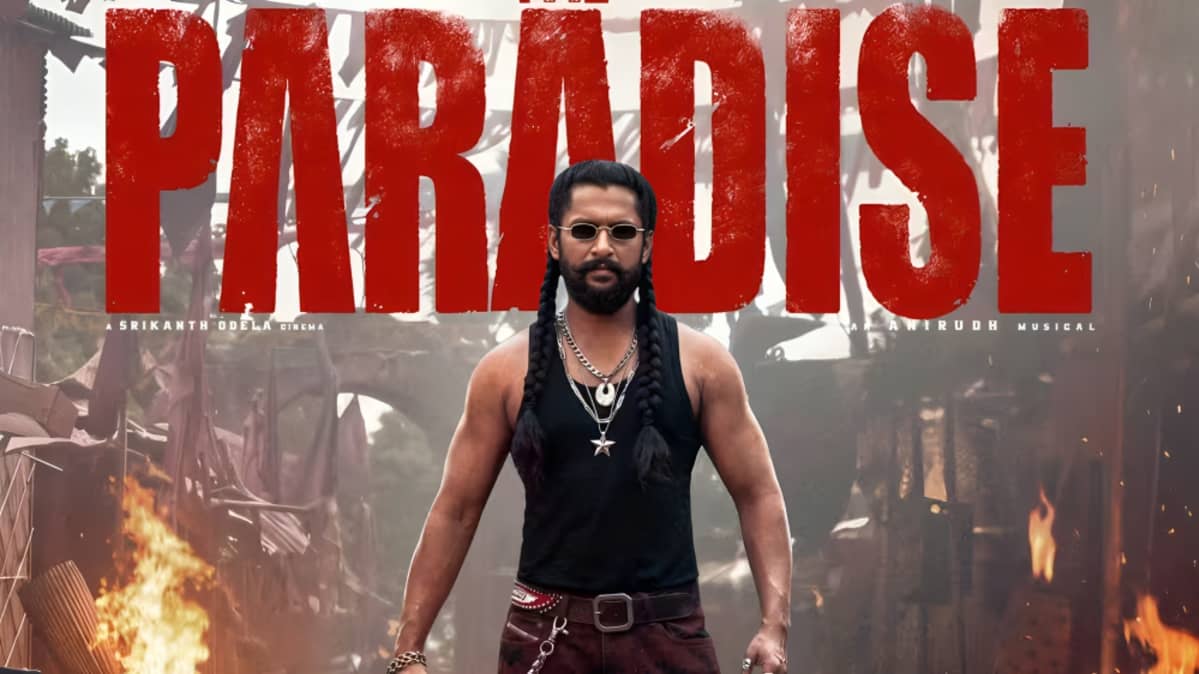
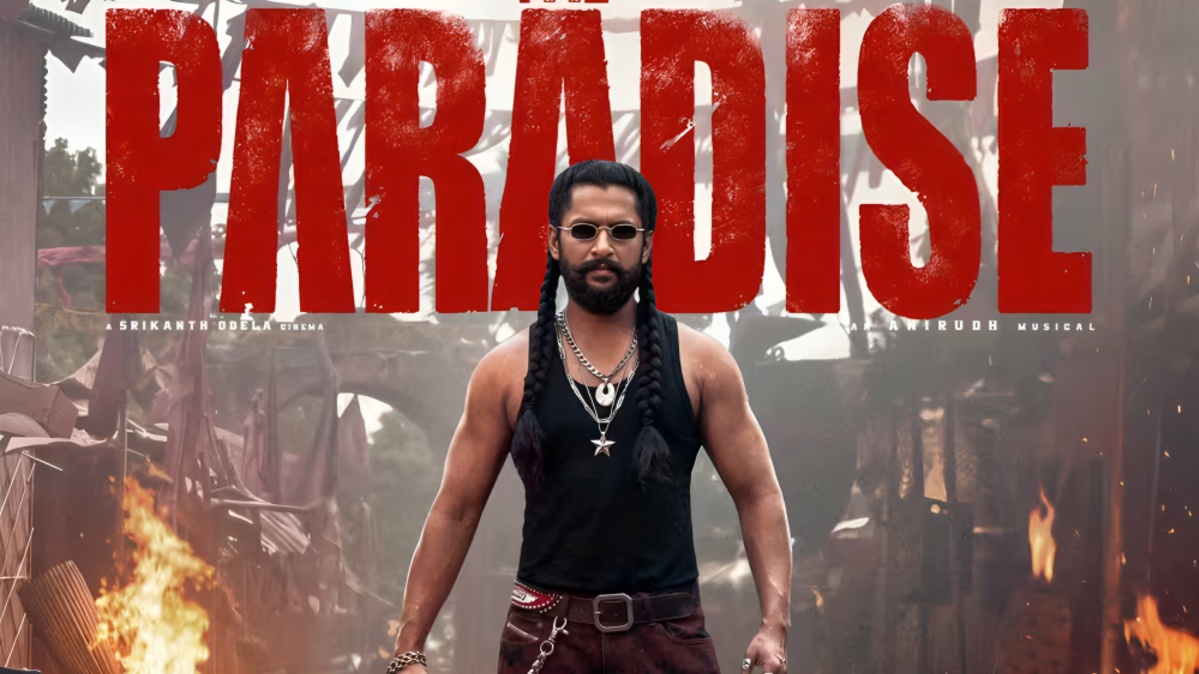
The Paradise is a Telugu period action drama directed by Srikanth Odela and headlined by Nani. The film arrived in theatres worldwide on September 24, 2026, marking the second collaboration between Nani and Odela after Dasara. Set in 1980s Secunderabad, the film combines social themes, action and family emotions while focusing on a marginalised community and its struggle for dignity and basic rights.
Nani plays Jadal, a character whose journey forms the centre of the story. Jadal belongs to a community that has faced discrimination and a lack of recognition. The narrative follows his experiences as he confronts an oppressive system and becomes involved in a wider struggle for identity, justice and freedom.
The period setting is an important part of The Paradise. The film uses 1980s Secunderabad as the backdrop for its characters and their conflicts. Rather than presenting the story only as a conventional action drama, director Srikanth Odela attempts to connect the action with themes of social inequality, oppression, resistance and family relationships.
Nani's performance is one of the most discussed aspects of the film. The actor appears in an intense and physically demanding role that is different from some of his more restrained performances. Recent reviews have acknowledged his commitment to the character, with The Indian Express describing his physical transformation and performance as key elements holding the film together.
The relationship between Jadal and his mother is another important emotional element. Sonali Kulkarni plays his mother, adding a family dimension to a story otherwise dominated by conflict and violence. Before the release, Nani described the film as more than an action drama and highlighted its mother and son relationship as an important part of the narrative.
The supporting cast includes Mohan Babu, Raghav Juyal, Kayadu Lohar and Sampoornesh Babu, along with Sonali Kulkarni. Raghav Juyal appears in a negative role, while Kayadu Lohar is part of the film’s central emotional and narrative structure. The ensemble is designed to support the larger conflict surrounding Jadal and his community.
The film also benefits from Anirudh Ravichander’s music. The music and background score contribute to the action-oriented atmosphere and help establish the intensity of several sequences. Early audience reactions have particularly mentioned the film’s music and selected action sequences, although responses to the overall screenplay and second half have been divided.
The Paradise has received mixed critical responses following its theatrical release. The Indian Express noted that Nani’s performance anchors the film but argued that the screenplay relies on familiar narrative elements. Its review also raised concerns about the film’s storytelling approach.
The Times of India similarly highlighted the film’s striking world and Nani’s contribution while observing that the narrative loses momentum in parts. The publication gave the film a 2.5 out of 5 critic rating, reflecting a response that recognised its visual and performance strengths while pointing to limitations in the storytelling.
India Today offered a more critical assessment of the film’s narrative structure. Its review argued that the movie struggles with cohesion and continuity and that its numerous ideas do not always come together into a strong central story. At the same time, the review acknowledged Nani’s performance and Anirudh Ravichander’s music as elements that provide some relief.
Audience reactions have also been varied. Early responses following paid premiere shows included praise for Nani’s performance, action sequences and music, while some viewers criticised the screenplay, editing and the second half. This has resulted in a divided early response rather than a uniform assessment of the film.
One of the film’s notable aspects is its attempt to combine a socially rooted story with a large scale action presentation. Jadal’s struggle is connected to the broader experiences of his community, giving the action sequences a social context. The film deals with questions of identity, discrimination, dignity and resistance while also exploring the personal relationship between Jadal and his mother.
The film received an A certificate from the Central Board of Film Certification ahead of its theatrical release. Reports stated that the final runtime was close to three hours. The Paradise was released in Telugu along with dubbed versions in other languages.
The Paradise also marks an important continuation of the creative partnership between Nani and Srikanth Odela. Their previous film Dasara was also rooted in a working class environment and featured an intense social setting. With The Paradise, the director has attempted to build another world around a marginalised community while giving Nani a physically demanding action role.
The film’s strengths largely depend on its performances, production scale, music and period setting. Nani brings intensity to Jadal, while Sonali Kulkarni provides an emotional dimension through the mother character. The supporting cast contributes to the wider conflict, although critics have differed on how effectively the individual characters are integrated into the main narrative.
The screenplay remains the main point of disagreement among reviews. Some critics have found the film’s ideas and individual sequences effective, while others have felt that too many themes and narrative elements weaken the overall story. The response to the second half has also been divided, with some viewers finding the pacing and storytelling less effective than the earlier portions.
Overall, The Paradise presents a socially rooted period action story with Nani at its centre. The film attempts to combine intense action with themes of oppression, identity, resistance and family. While Nani’s performance, the music and the film’s visual world have attracted attention, current reviews have also raised questions about the screenplay, narrative cohesion and second-half execution. The film therefore arrives as a large-scale action drama whose critical response remains mixed.