
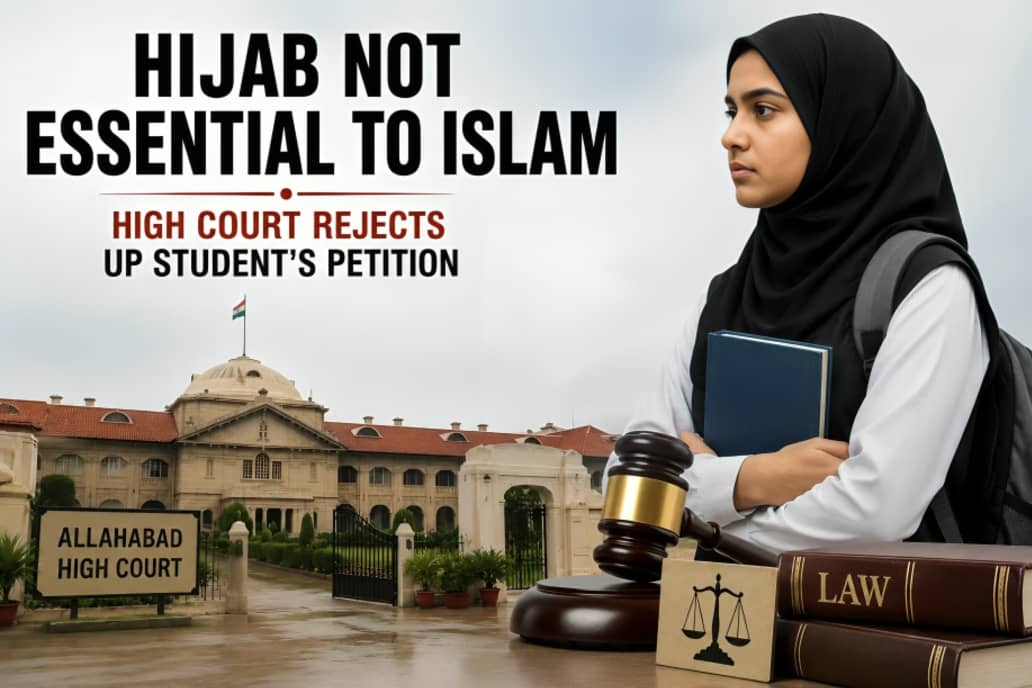
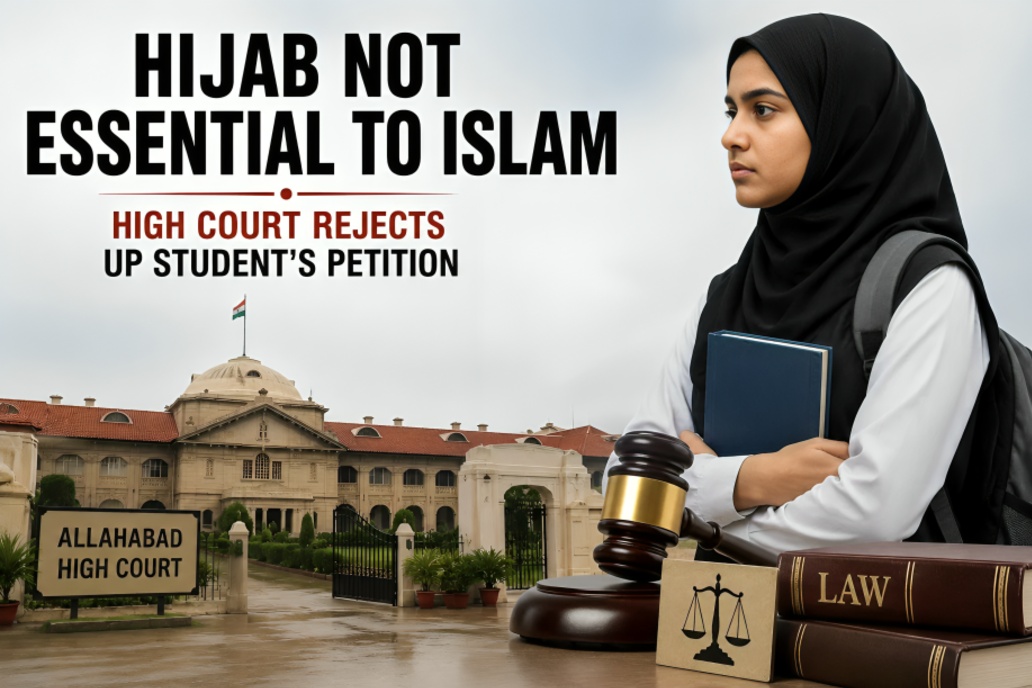
AIMIM president Asaduddin Owaisi has criticised the Allahabad High Court’s recent decision dismissing a minor student’s petition concerning the wearing of a hijab with her prescribed school uniform. Owaisi strongly disagreed with the ruling and described it as an attack on Islam.
The case concerns a student from Prayagraj who had approached the Allahabad High Court after her school reportedly refused to allow her to wear a scarf over the prescribed uniform. The student sought permission to wear the hijab while continuing to comply with the school’s uniform requirements.
A division bench comprising Justices J J Munir and Indrajit Shukla dismissed the student’s petition. The ruling subsequently prompted a political response from Owaisi, who questioned the reasoning behind the court’s decision.
Speaking at a Jalsa e Rahmatul lil Alameen gathering at the AIMIM headquarters in Darussalam, Hyderabad, Owaisi said he did not agree with the Allahabad High Court judgment. He argued that questions concerning religious practices should be considered in the context of constitutional protections and the wider judicial debate over essential religious practices.
Owaisi referred specifically to the ongoing Sabarimala proceedings before the Supreme Court. A nine judge Constitution Bench is examining broader questions concerning the scope of religious freedom and the doctrine of essential religious practices in the Sabarimala matter.
According to Owaisi, the Allahabad High Court’s ruling should not be viewed separately from these larger constitutional questions. He questioned the authority of a court to determine whether a particular practice is essential to Islam.
The AIMIM chief also referred to Articles 25 and 19 of the Indian Constitution. Article 25 broadly protects freedom of conscience and the right to freely profess, practise and propagate religion, subject to constitutional limitations. Article 19 provides several fundamental freedoms to citizens, subject to reasonable restrictions prescribed by law.
Owaisi argued that the court’s decision was inconsistent with these constitutional protections. His comments represent his political and legal interpretation of the judgment and should be distinguished from the findings contained in the court’s order.
The controversy centres on the balance between individual religious expression and institutional rules governing school uniforms. Educational institutions prescribe uniforms to maintain a common dress code among students. At the same time, courts have been called upon in different cases to consider whether students can seek exemptions or accommodations based on religious practices.
The question of whether a particular religious practice receives constitutional protection has been considered by Indian courts in several cases. The essential religious practices doctrine has historically been used by courts when determining whether a claimed religious practice is protected under Article 25.
The Sabarimala proceedings have brought renewed attention to this doctrine. The Supreme Court is considering several legal questions connected with religious practices and the extent to which courts should examine what constitutes an essential religious practice.
Owaisi used this ongoing judicial debate to question the reasoning behind the Allahabad High Court’s decision in the hijab case. He said that if the Supreme Court is examining questions about essential religious practices, similar questions involving other religions and practices should be approached carefully.
The AIMIM leader also defended the right of Muslim girls to wear the hijab. He argued that wearing a hijab does not affect a student’s ability to receive education or participate in school activities.
His remarks have added a political dimension to a case that primarily concerns the relationship between a student’s claimed religious practice and a school’s uniform requirements.
The Allahabad High Court’s decision, however, remains the immediate subject of the dispute. The division bench dismissed the petition filed by the student, meaning that the relief sought through that particular petition was not granted.
The case also raises broader questions about the limits of religious accommodation in educational institutions. Schools operate under regulations concerning uniforms, discipline and administration, while students may have individual religious or cultural practices that they seek to observe within those institutional frameworks.
Courts are therefore required to consider the relevant facts, applicable rules and constitutional provisions when such disputes arise.
Owaisi’s criticism focuses primarily on the constitutional and religious dimensions of the ruling. He has argued that the decision should not effectively allow a court to determine what is essential to Islam.
His comments have also highlighted the distinction between religious belief and the legal determination of whether a particular practice receives constitutional protection. The latter is ultimately a matter for the judiciary under the applicable constitutional and legal framework.
The reference to the Sabarimala case is particularly significant because the Supreme Court’s larger bench is considering questions concerning the scope and application of the essential religious practices doctrine. The proceedings could potentially have implications for how similar questions are approached in future cases.
The Allahabad High Court matter is narrower in scope because it arose from a specific dispute involving a minor student, a school uniform and permission to wear a hijab. The court’s decision therefore needs to be understood based on the facts and legal questions presented before it.
Owaisi’s remarks, meanwhile, reflect the position of the AIMIM and his disagreement with the judgment. His description of the ruling as an attack on Islam is a political criticism and not a finding made by the court.
The debate over hijab and school uniforms has previously generated discussion across India, particularly around the balance between religious freedom, institutional discipline and educational access. Different courts and authorities have considered such issues in different factual contexts.
The latest controversy is therefore likely to keep the broader debate over religious freedom and educational institutions in public discussion.
For students and families involved in similar disputes, the legal position can depend on the specific school rules, state regulations, court orders and constitutional questions involved. A judgment in one case does not automatically determine the outcome of every other dispute involving religious attire.
The Allahabad High Court’s ruling and Owaisi’s subsequent criticism therefore represent two different aspects of the issue. The court has adjudicated the petition before it, while Owaisi has challenged the reasoning from a constitutional and religious freedom perspective.
The matter also demonstrates why the distinction between political criticism and judicial findings is important. Owaisi’s statement represents his disagreement with the judgment, whereas the court’s legal reasoning is contained in its written order.
The wider constitutional questions concerning religious practices remain subject to consideration by the Supreme Court in the Sabarimala proceedings. The outcome of those proceedings could provide further guidance on the scope of judicial scrutiny of religious practices.
For now, the immediate development is the dismissal of the minor student’s petition by the Allahabad High Court and Owaisi’s public criticism of that decision.
The AIMIM president has maintained that Muslim women and girls should be able to observe the hijab as an expression of their faith. He has also argued that constitutional guarantees relating to religious freedom and expression should be taken into account.
The issue is expected to continue generating discussion among legal experts, political parties, educational institutions and civil society groups. The central questions involve the extent of religious accommodation in schools, the authority of educational institutions to prescribe uniforms and the constitutional protection available to religious practices.
Ultimately, any further legal challenge or clarification would depend on the remedies pursued by the parties involved and the decisions of the competent courts.
For publication, the Allahabad High Court judgment should be presented separately from Owaisi’s political criticism. This helps readers clearly distinguish between the court’s findings and the views expressed by a political leader.
Overall, the case has brought the debate over hijab, school uniform rules and religious freedom back into focus. Owaisi has strongly opposed the Allahabad High Court’s decision and questioned the court’s approach to determining religious practices. At the same time, the Supreme Court’s ongoing consideration of broader questions concerning essential religious practices provides an important constitutional backdrop to the debate.
Key Points
A minor student from Prayagraj had sought permission to wear a hijab with her prescribed school uniform.
The Allahabad High Court dismissed her petition.
The case was heard by a division bench comprising Justices J J Munir and Indrajit Shukla.
AIMIM president Asaduddin Owaisi criticised the judgment and said he disagreed with the decision.
Owaisi questioned the role of courts in determining what constitutes an essential religious practice in Islam.
He referred to Articles 25 and 19 of the Constitution while discussing religious freedom and freedom of expression.
Owaisi also referred to the Supreme Court’s ongoing Sabarimala proceedings involving questions concerning essential religious practices.
His remarks represent his political criticism of the judgment and should not be presented as a judicial finding.