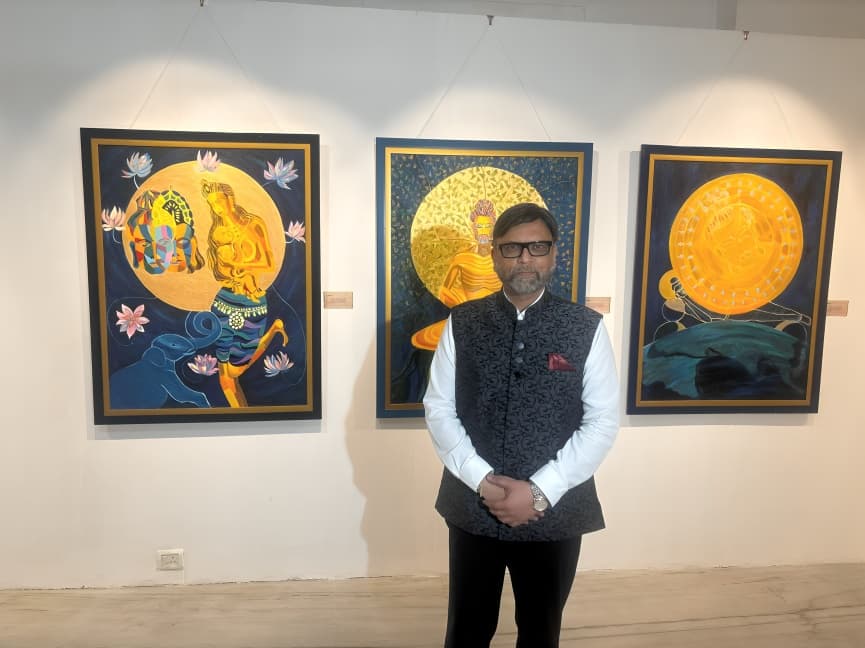
New Delhi, April 11: Renowned Indian diplomat and poet Abhay K has highlighted the historical importance of Nalanda University as a pioneering centre of cultural diplomacy in ancient India. Speaking at a cultural symposium focused on India’s global engagement through knowledge traditions, he stated that Nalanda was not just a university, but a hub of international academic and spiritual exchange.
Abhay K remarked that Nalanda, established in the 5th century CE in present-day Bihar, was among the world’s first residential universities, attracting scholars, monks, and thinkers from regions as diverse as China, Korea, Tibet, Sri Lanka, and Southeast Asia. "Nalanda was an embodiment of India’s early civilizational diplomacy where culture, education, and dialogue formed the basis of global engagement,” he said.
He pointed out that the university’s model of open learning, tolerance, and interdisciplinary studies made it a beacon of enlightenment. "At a time when borders were defined by empires, Nalanda transcended them through the power of knowledge," he added.
The event, attended by academics, cultural diplomats, and heritage experts, reflected on how India can revive its soft power by drawing on its historical legacy. Abhay K emphasized that modern India has much to learn from Nalanda’s ethos, especially as the country seeks to enhance its global presence through initiatives like cultural exchange programs, education diplomacy, and knowledge-based partnerships.
He also highlighted the efforts to revive Nalanda in the 21st century with the establishment of the Nalanda University (2010), which aims to continue the ancient legacy in a modern context. "The new Nalanda must become a global platform where the East meets the West, and ancient wisdom meets contemporary innovation," he said.
Citing ancient texts and travel records of Chinese pilgrim Xuanzang, Abhay K noted that Nalanda was home to over 10,000 students and 2,000 teachers at its peak. These exchanges fostered lasting relationships between India and Asian civilizations, reinforcing the concept of shared knowledge and peaceful coexistence.
Concluding his address, Abhay K called upon academic institutions, cultural bodies, and diplomats to recognize the power of cultural diplomacy rooted in India’s ancient traditions. “Nalanda’s message is timeless—it teaches us that dialogue, learning, and respect for diversity are the most powerful tools of diplomacy,” he said.
The event ended with a collective call to strengthen India’s international outreach by reviving and celebrating its intellectual heritage.