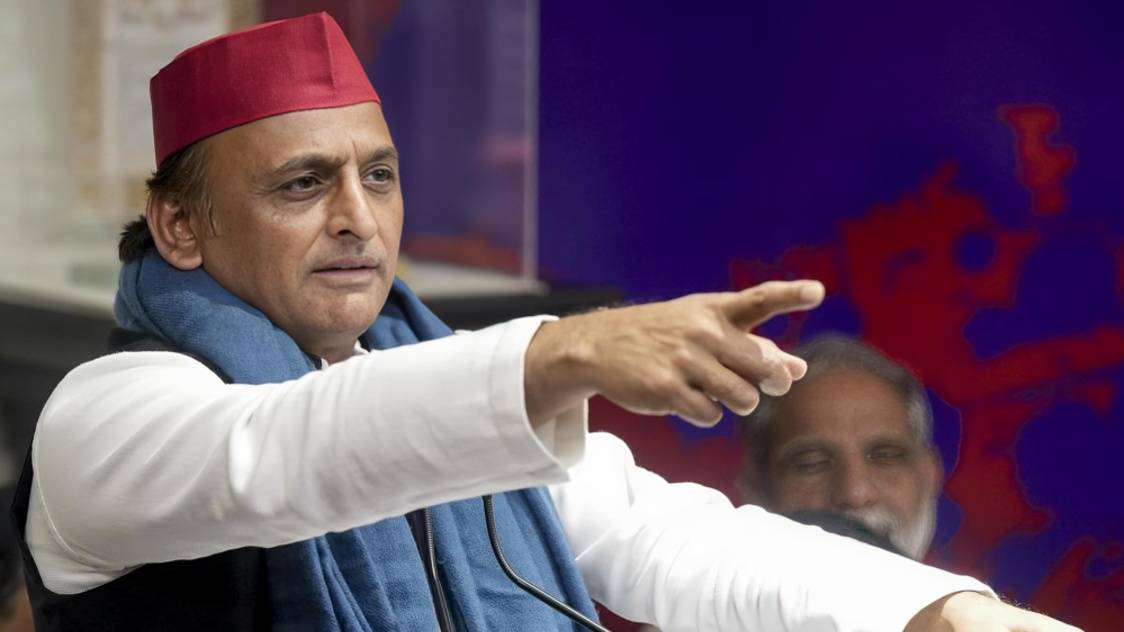
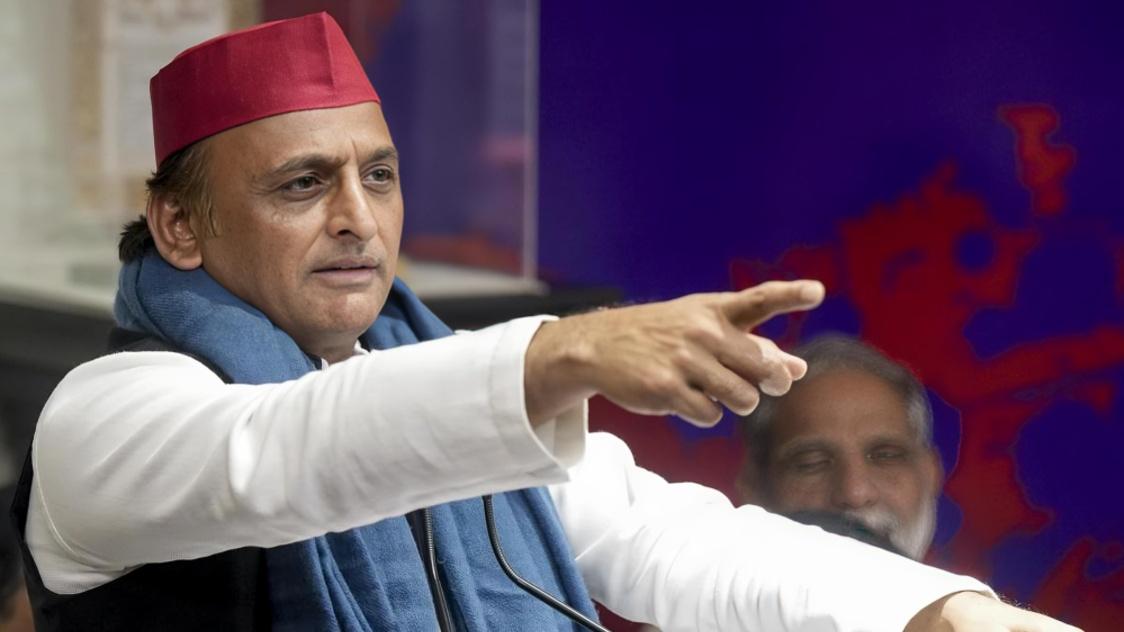
Samajwadi Party president Akhilesh Yadav has intensified his criticism of the Bharatiya Janata Party, claiming that the political contest in Uttar Pradesh has changed from an 80-20 divide to a 95-5 divide. His remarks came during a press conference in Lucknow on November 11, 2026, as political parties began sharpening their strategies ahead of the 2027 Uttar Pradesh Assembly elections.
Yadav said that 95 per cent of the population was facing difficulties, distress and humiliation, while the remaining five per cent were benefiting by exploiting others. He argued that the political battle was increasingly about the interests of ordinary people rather than the division previously highlighted by the BJP.
The Samajwadi Party leader also claimed that the BJP was feeling pressure because of this changing political situation. According to him, the language and behaviour of BJP leaders had changed as the party faced growing public dissatisfaction.
His statement appeared to be a direct response to the political narrative associated with Uttar Pradesh Chief Minister Yogi Adityanath's 80-20 formulation.
What Is Akhilesh Yadav's 95-5 Political Formula?
Akhilesh Yadav used the 95-5 formulation to describe what he considers the economic and social divide in Uttar Pradesh. He portrayed the majority of people as those struggling with financial difficulties and other problems, while accusing a small section of benefiting at their expense.
His remarks were intended to challenge the BJP's political narrative and shift attention towards issues such as public hardship, inequality and governance.
However, the 95-5 division should be understood as Akhilesh Yadav's political characterisation rather than an independently verified statistical assessment of the state's population. He did not present survey data or an official study to establish that precisely 95 per cent of people were suffering or that five per cent were exploiting them.
The statement reflects the Samajwadi Party's attempt to present the upcoming political contest as a struggle between ordinary citizens and those it accuses of benefiting from the existing system.
Yadav also suggested that the BJP was responding to this political pressure through changes in its public statements and conduct.
Why Did Akhilesh Yadav Refer to Yogi Adityanath's 80-20 Formula?
The reference to 80-20 has a political background in Uttar Pradesh. Ahead of the 2022 Assembly elections, Chief Minister Yogi Adityanath used the expression to describe the political division in the state.
The formulation became a prominent part of the political debate during that election period. It was widely discussed by political parties and observers, with interpretations differing over whether it referred to electoral support, ideological positions or religious divisions.
In his more recent remarks, Yadav sought to challenge that narrative by presenting a different interpretation of the state's political situation. Instead of focusing on an 80-20 division, he argued that the contest was now between 95 per cent of people facing difficulties and five per cent whom he described as exploiters.
The exchange illustrates how political leaders are using numerical slogans and contrasting formulations to communicate their messages to voters ahead of the next Assembly election.
While the BJP has used its own political framing, the Samajwadi Party is attempting to focus its campaign on public welfare, economic concerns and allegations of unequal benefits.
2027 Uttar Pradesh Elections Become the Focus of Political Exchanges
The next Uttar Pradesh Assembly elections are expected in 2027, and political activity has already begun to intensify across the state.
The BJP has been in power in Uttar Pradesh since 2017, while the Samajwadi Party remains one of its principal political challengers. Akhilesh Yadav has been working to strengthen his party's position by raising issues relating to governance, public welfare and the interests of different social groups.
The Samajwadi Party's PDA slogan, which stands for Pichhda, Dalit and Alpsankhyak, has been an important part of its political outreach. The party has sought to bring together backward communities, Dalits and minorities under this broader political approach.
Yadav's latest 95-5 statement fits into this wider effort to present the election as a contest centred on the concerns of a large section of society.
The BJP, meanwhile, is expected to defend its record in government and campaign around its development, governance and welfare initiatives. The political competition is likely to involve debates over employment, inflation, law and order, infrastructure, social representation and the implementation of government schemes.
The Election Commission has not announced the detailed schedule for the 2027 Assembly elections.
Akhilesh Yadav Also Raises Demonetisation and Governance Issues
The 95-5 remark was part of a broader press conference in which Akhilesh Yadav criticised the BJP over several issues.
November 2026 marks ten years since the announcement of demonetisation in India on November 8, 2016. Referring to the policy, Yadav criticised its impact on the economy and described it as a major failure of the BJP government.
He argued that farmers, labourers, middle-class families, professionals, salaried employees and small business owners had faced difficulties because of the decision. He also claimed that many sections of society had not fully recovered from its effects.
These statements represent the Samajwadi Party leader's political assessment of demonetisation. The economic impact of the policy has been debated by political parties, economists and financial experts since its implementation.
Yadav also raised allegations concerning corruption and infrastructure contracts in Uttar Pradesh. He questioned the quality of roads and expressways and alleged irregularities in the tendering process. These allegations have not been independently established by the remarks alone.
By raising these issues alongside the 95-5 formulation, Yadav attempted to connect his criticism of the BJP with concerns about economic conditions, public infrastructure and governance.
Religious Visits and Political Outreach
During the same interaction, Akhilesh Yadav also spoke about his possible visits to religious places, including Ayodhya and Vrindavan.
Responding to questions about visiting the Ram temple in Ayodhya, he said that he would also visit the Kedareshwar temple in Etawah and Vrindavan. His remarks attracted attention because religious visits have become an important part of political messaging in Uttar Pradesh.
Yadav also referred to the Samajwadi Party's PDA slogan and gave it a different interpretation during the interaction. His comments were seen as part of an effort to respond to the BJP's political messaging around religion and identity.
The Samajwadi Party has sought to communicate that its political approach includes different communities and social groups. The BJP, on the other hand, has continued to emphasise its own political and ideological positions.
These exchanges show that the upcoming election campaign is likely to include discussions about both development and identity-based political narratives.
Political Competition Likely to Intensify Before the 2027 Polls
Akhilesh Yadav's 95-5 statement has added another dimension to the political debate in Uttar Pradesh. By challenging the BJP's 80-20 formulation, the Samajwadi Party president is attempting to shift the discussion towards economic inequality, public hardship and governance.
The BJP and the Samajwadi Party are likely to continue exchanging criticism as the 2027 Assembly elections approach. While the opposition is expected to highlight problems and question the government's performance, the ruling party will seek to defend its policies and development record.
Whether the 95-5 formulation gains wider support among voters remains to be seen. The actual electoral outcome will depend on public opinion, political alliances, candidate selection, campaign issues and voting patterns across the state.
For now, Yadav's remarks underline the growing political contest between the BJP and the Samajwadi Party as both parties prepare for the next major electoral battle in Uttar Pradesh.