
Congress and National Conference Clash Over Full Rendition of Vande Mataram in Jammu and Kashmir
A political disagreement has emerged between the Congress and the National Conference, which are alliance partners in Jammu and Kashmir, over the full rendition of Vande Mataram at an official event in Srinagar.
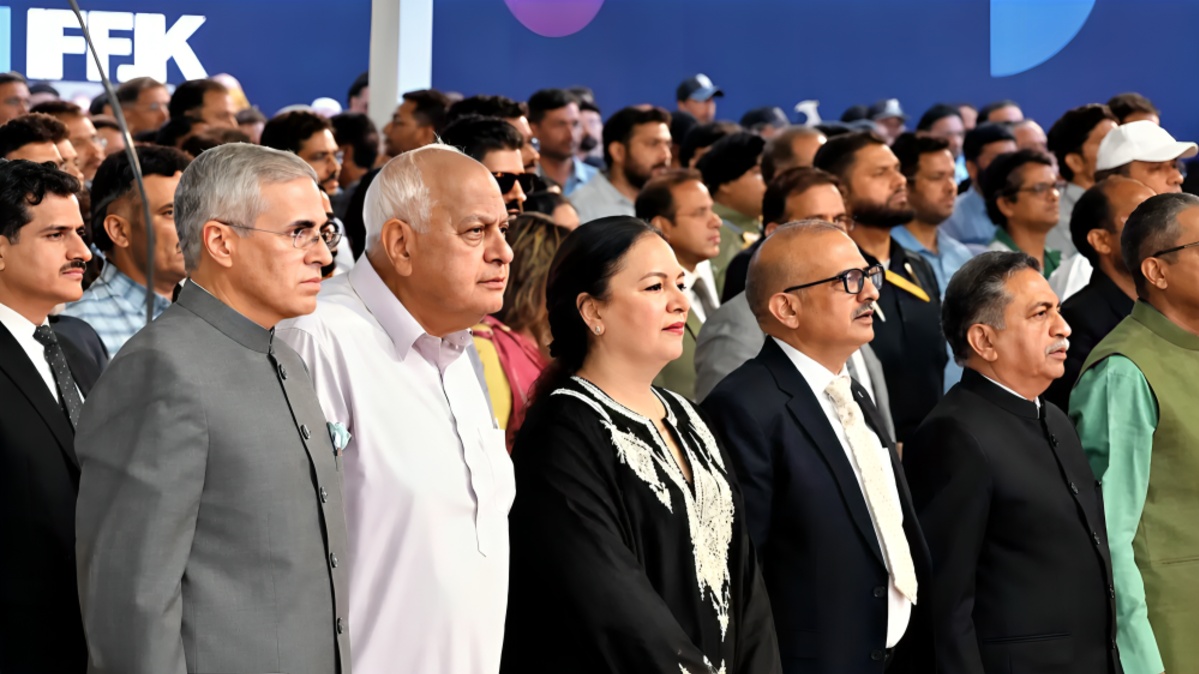
The controversy began after the complete version of Vande Mataram was played during the inaugural ceremony of the International Film Festival of Jammu and Kashmir. The event was attended by Jammu and Kashmir Chief Minister Omar Abdullah, National Conference president Farooq Abdullah and other senior leaders.
The rendition of the complete version of the national song has now triggered a debate between the two alliance partners over the historical significance of the song, its place in public functions and the established practice concerning its rendition.
Jammu and Kashmir Pradesh Congress Committee president Tariq Hameed Karra expressed concern over the decision to play the full version. He argued that national symbols, songs and traditions have an important role in bringing together India's diverse population.
Karra said the significance of national symbols should be understood in the context of India's freedom movement as well as the constitutional journey of the Republic. He questioned the decision of the alliance partner to support the full version and suggested that the evolution of the song's place in national life should also be taken into consideration.
The Congress position has also been supported by senior party leader K C Venugopal, who criticised the decision and called for adherence to what the party considers the established and historically evolved approach to the national song.
The National Conference, however, rejected the criticism and defended the decision taken at the government event.
NC chief spokesperson and MLA Tanvir Sadiq said that government protocol should be kept separate from party ideology. According to him, the National Conference has a clear position on the issue and the government acted in accordance with the applicable official framework.
Sadiq also asked Congress leaders to look at the practices followed by Congress governments in other states. He referred to Telangana and Karnataka, where the complete version of Vande Mataram has also been played at official events.
The disagreement has therefore become more than a debate over the rendition of a national song. It has highlighted differences between two political parties that are currently allies in Jammu and Kashmir.
The Congress and National Conference have worked together politically in Jammu and Kashmir, but differences on issues of national identity, political strategy and public symbolism have occasionally surfaced.
The latest disagreement comes at a time when Vande Mataram has become the subject of renewed national debate. Different political parties have taken different positions on how much of the song should be rendered at official and party events.
Congress has reiterated its historical position favouring the first two stanzas at party and national events. The party has argued that this approach reflects the understanding reached during the freedom movement and takes into account India's plural and diverse character.
The National Conference, on the other hand, has focused on the official nature of the event and the distinction between government protocol and individual or party preferences.
The issue has also drawn attention because of the presence of Omar Abdullah and Farooq Abdullah during the full rendition at the film festival. Their participation has become part of the wider political discussion surrounding the controversy.
The disagreement does not mean that the two parties have ended their political alliance. Instead, it reflects a specific difference over the treatment and rendition of the national song at official functions.
The controversy also illustrates the broader sensitivity surrounding national symbols in Indian politics. Songs, flags and other national symbols often carry historical, cultural and political significance, and different political groups may interpret their public use differently.
For the National Conference, the issue is primarily connected with the conduct of a government function and adherence to official protocol. For the Congress, the concern is linked to the historical and constitutional context in which the national song has evolved.
The debate is also taking place alongside discussions in other states over the complete rendition of Vande Mataram. Recent developments in states such as Gujarat have further brought the issue into the political spotlight.
The dispute between the Congress and National Conference is therefore being closely watched because it involves two parties that are partners in the Jammu and Kashmir political landscape.
For now, both sides have maintained their respective positions. Congress leaders have questioned the decision to play the complete version, while National Conference leaders have defended the government’s approach and pointed to similar practices in other non BJP ruled states.
The episode is expected to remain a topic of political discussion in Jammu and Kashmir, particularly as both alliance partners continue to work together while maintaining differences on certain ideological and national issues.
The latest controversy ultimately highlights the challenge faced by political alliances when their constituent parties have different views on national symbols and public protocol. The Congress and National Conference will have to manage these differences while continuing their broader political engagement in Jammu and Kashmir.