
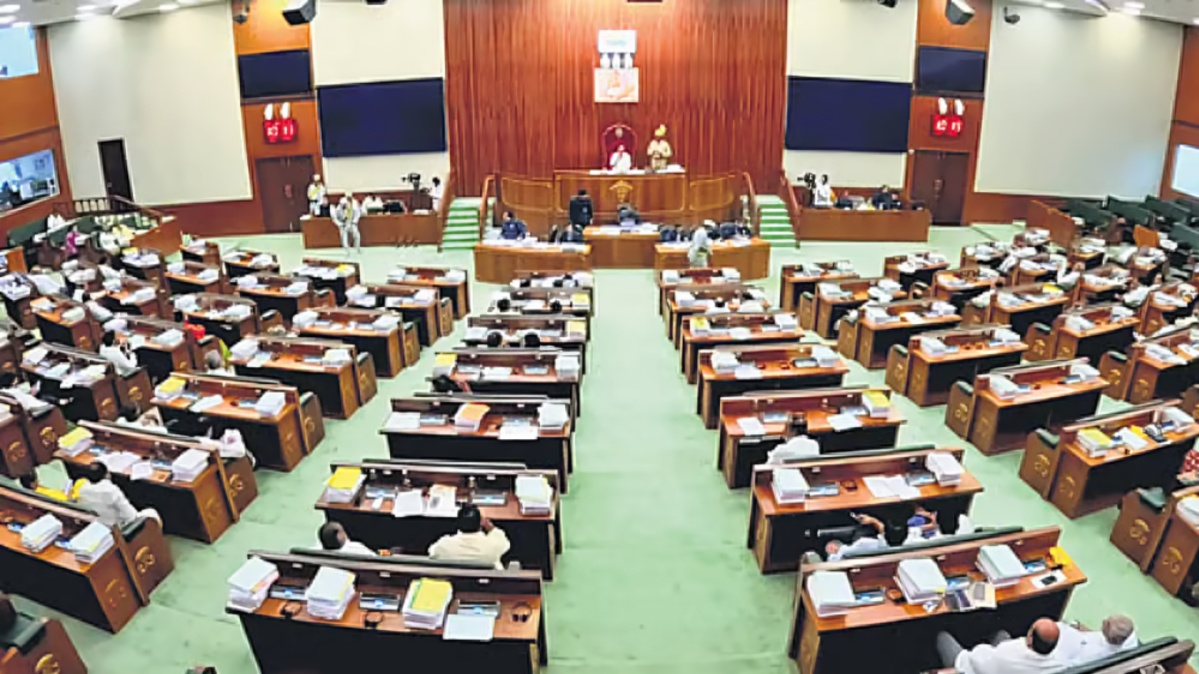
The autumn session of the Jammu and Kashmir Legislative Assembly began on Monday amid protests and heated exchanges between members of the ruling alliance and the Bharatiya Janata Party. The first day of the session witnessed disruptions during Question Hour, with legislators raising issues related to governance, employment, electricity charges, daily wage workers and the restoration of statehood.
The session began with Speaker Abdul Rahim Rather making obituary references to former members of the Assembly who had passed away since the previous Budget session. The proceedings then moved towards Question Hour.
Soon after the obituary references, BJP legislators began raising slogans against the government. Several BJP members, including Leader of Opposition Sunil Sharma, moved towards the Well of the House and protested against what they described as governance failures under the Omar Abdullah-led administration.
The BJP legislators raised several public issues during their protest. These included electricity charges, employment concerns and the regularisation of daily wage workers. BJP members also displayed posters while demanding answers from the government on issues they said were affecting people across Jammu and Kashmir.
The protests disrupted Question Hour, prompting the Speaker to appeal to the BJP members to allow the proceedings to continue. The Speaker also warned that action could be taken if the disruption continued. Despite the appeals, the protests continued for some time, resulting in noisy scenes inside the Assembly.
The ruling National Conference and its alliance partner Congress responded to the BJP protests by raising the issue of restoring statehood to Jammu and Kashmir. Their members argued that the restoration of statehood should be addressed and referred to commitments made by the Centre in Parliament and before the Supreme Court.
CPI(M) legislator Mohammed Yousuf Tarigami and Awami Ittehad Party MLA Sheikh Khursheed also joined the statehood-related protest. Other members of the ruling side raised slogans supporting the demand for restoration of statehood.
The issue of statehood has remained a major political subject in Jammu and Kashmir since the Union government reorganised the former state into the Union territories of Jammu and Kashmir and Ladakh in 2019. The current political debate centres on the demand for restoring Jammu and Kashmir to statehood.
During the Assembly proceedings, Deputy Chief Minister Surinder Choudhary said that the government was prepared to respond to questions raised by opposition members. He said ministers were present in the House to address issues brought up by legislators and urged members to raise their questions one by one so that they could be answered.
Leader of Opposition Sunil Sharma, meanwhile, defended the BJP's protest. Speaking outside the Assembly, he said the BJP was performing its role as the principal opposition by seeking answers from the government on issues concerning the public.
Sharma raised concerns about basic amenities, corruption, daily wage workers and employment. These statements represent the BJP's position and allegations about the performance of the government, rather than findings established by the Assembly or a judicial authority.
Chief Minister Omar Abdullah described the Assembly session as an opportunity for debate and discussion on issues concerning the people of Jammu and Kashmir. The Chief Minister's Office said the session would provide a platform to deliberate on matters related to public welfare and the aspirations of the people.
Another important issue raised during the first day's proceedings concerned reservation policies in Jammu and Kashmir. PDP legislator Waheed Para moved an adjournment motion seeking a discussion on the rationalisation of reservations in the Union Territory.
The PDP said Para sought an urgent debate on the reservation issue and argued that delays in resolving the matter were affecting students and candidates competing under the open merit category. The motion brought the reservation policy into the wider debate taking place during the Assembly session.
The first day's proceedings therefore featured several separate political issues, including governance, employment, electricity charges, daily wage workers, restoration of statehood and reservation policy.
The protests continued amid repeated appeals from the Speaker to maintain order. With the disruption preventing normal proceedings from continuing, the House was eventually adjourned for the day. According to The Indian Express, the Assembly was adjourned at around 11 am following the continued pandemonium.
The developments on the opening day indicate that statehood and governance-related questions are likely to remain important subjects during the autumn session. At the same time, the reservation issue raised by the PDP could receive further attention as legislators discuss policies affecting different sections of the population.
The session also demonstrated the differing priorities of the political parties represented in the Assembly. The BJP focused its opening-day protest on issues it said reflected governance concerns, while the National Conference, Congress and other members highlighted the demand for restoration of statehood. The PDP separately sought discussion on reservation rationalisation.
Further proceedings will determine how these issues are taken up through questions, motions and legislative discussions. The Assembly's discussions are expected to provide an institutional forum for the parties to place their positions on governance and policy matters on record.
For news reporting purposes, claims made by political parties about government performance, public grievances or policy failures should be distinguished from facts established through official records, investigations or judicial findings. The positions of the BJP, ruling alliance and PDP in this session represent their respective political arguments on the issues raised.