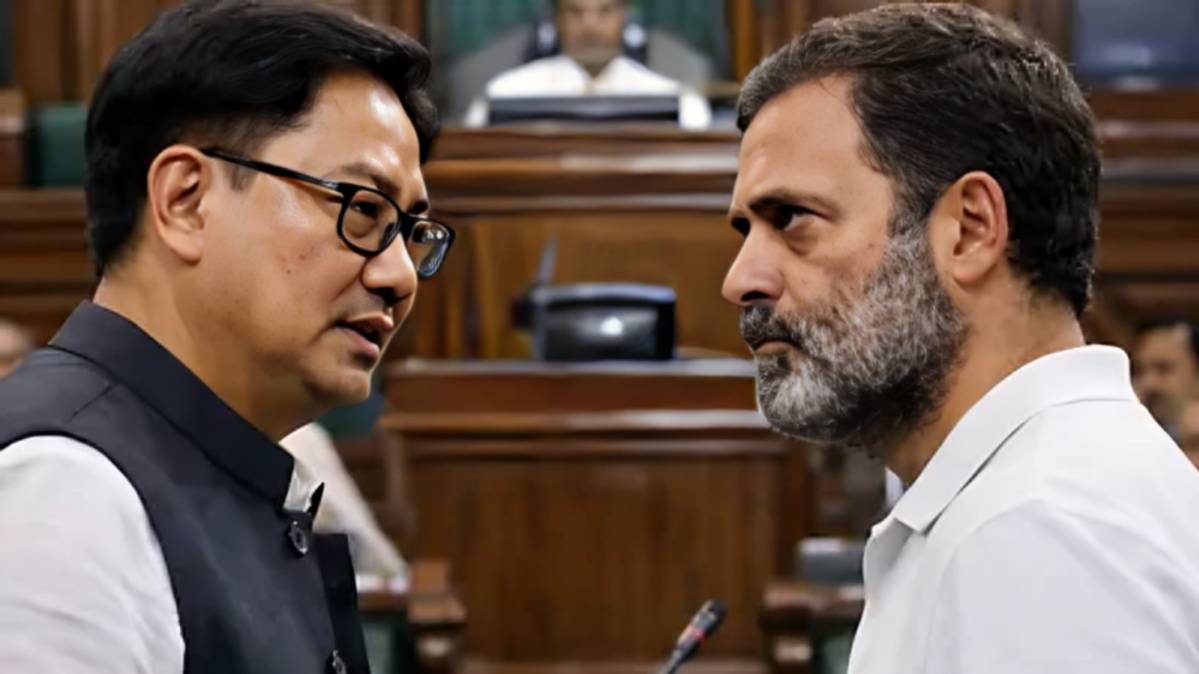
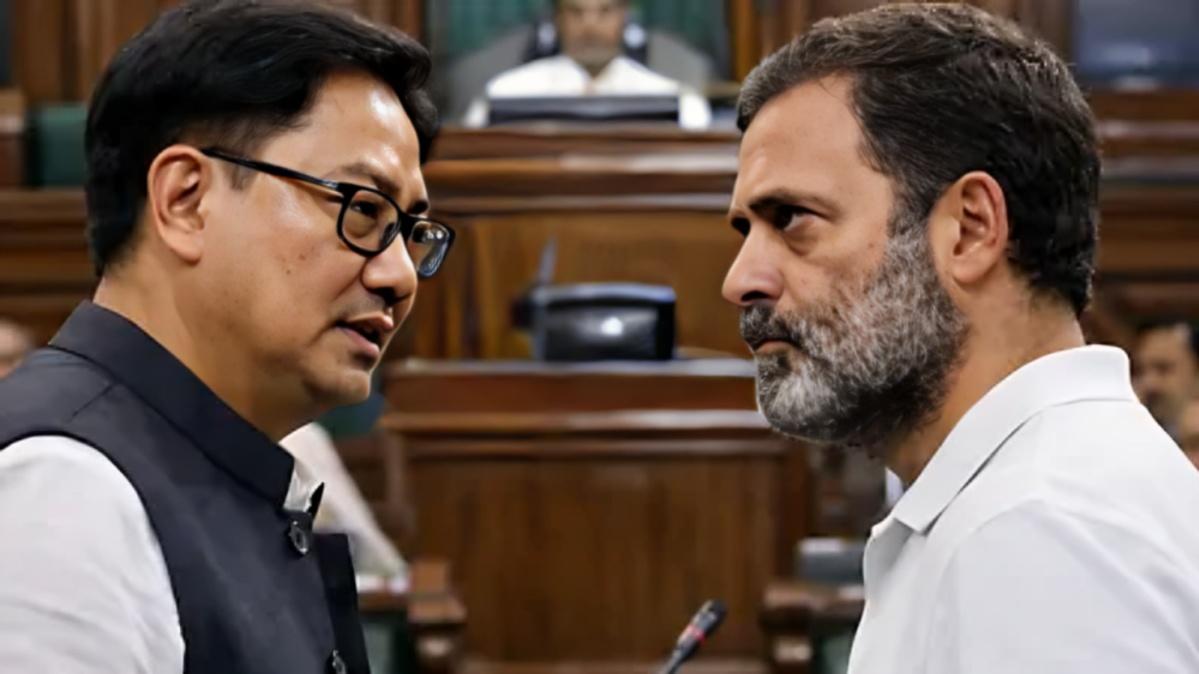
Union Minister Kiren Rijiju has urged Leader of Opposition in the Lok Sabha Rahul Gandhi to avoid making statements against India, whether within the country or overseas. His remarks came after Gandhi questioned India's position in international affairs and described the country as a “side player” in global diplomacy during an interaction at the University of Chicago.
The comments have triggered a political exchange between the ruling Bharatiya Janata Party and the Congress. While the BJP criticised Gandhi's assessment of India's international role, the Congress leader's remarks focused on the country's diplomatic influence and its participation in important global discussions.
Speaking to reporters in New Delhi on Friday, Rijiju responded to questions about Gandhi's comments. The Union minister said he wanted to request the Congress leader not to make statements against the country, regardless of whether he was speaking in India or abroad.
“I would just request him not to make statements against the country, whether inside India or abroad. That is all I want to say,” Rijiju said.
His statement added to the political debate over India's foreign policy, international standing and the role of opposition leaders in discussing the country's diplomatic relationships.
Rahul Gandhi Questions India's Role in Global Diplomacy
The controversy followed Rahul Gandhi's interaction with students at the University of Chicago on Wednesday. During the discussion, Gandhi spoke about India's position in international affairs and questioned whether the country was exercising the level of diplomatic influence expected from its size and global standing.
Gandhi said India had traditionally maintained a sophisticated understanding of geopolitics. However, he argued that the country had increasingly become a “side player” in global affairs.
He also referred to diplomatic discussions involving the United States and Iran. Questioning India's role in the process, Gandhi asked why Pakistan was involved in facilitating negotiations between the two countries while India appeared to be on the sidelines.
His comments raised questions about India's diplomatic engagement with major international powers and its ability to influence discussions involving regional and global security.
Gandhi's remarks were made in the context of a wider discussion about India's foreign policy and its place in the changing international order. His assessment subsequently became the subject of criticism from BJP leaders.
BJP Accuses Rahul Gandhi of Favouring Pakistan
The BJP strongly criticised Gandhi's comments following his interaction at the University of Chicago. Party national spokesperson Pradeep Bhandari accused the Congress leader of repeatedly speaking favourably about Pakistan while questioning India's diplomatic position.
In a series of posts on X, Bhandari questioned Gandhi's remarks and alleged that he was portraying Pakistan as a model for foreign policy engagement.
Bhandari wrote, “Why is Rahul Gandhi so obsessed with Pakistan! At every global stage Rahul acts like Pak Fan Boy!”
He further alleged that Gandhi had once again presented Pakistan as a role model in diplomatic outreach.
The BJP spokesperson also claimed that Gandhi's criticism ignored India's diplomatic efforts in international conflicts, particularly the Russia-Ukraine war. According to Bhandari, both Russia and Ukraine had acknowledged India's peace initiatives.
He also referred to Iran and the issue of restrictions involving the Strait of Hormuz while arguing that India's diplomatic engagement had been overlooked in Gandhi's assessment.
These remarks were part of the BJP's political response to the Congress leader's comments. The allegations made by Bhandari represent the party's position in the ongoing political debate.
BJP Raises Questions About Congress-Era Foreign Policy
Bhandari also linked his criticism of Rahul Gandhi to the foreign policy decisions taken during the Congress-led United Progressive Alliance government.
He alleged that the Congress leadership had compromised India's sovereignty during diplomatic discussions at Sharm el-Sheikh. He also criticised the UPA government's response following the November 2008 Mumbai terror attacks.
Referring to the 26/11 attacks, Bhandari questioned why India did not launch military action against Pakistan after the terrorist incident.
His comments brought earlier foreign policy controversies into the current political debate. The BJP has frequently criticised the Congress over its handling of national security and relations with Pakistan.
However, the remarks about the UPA government's decisions are political allegations made by the BJP spokesperson. They should be understood as part of the party's criticism rather than as independent findings.
Debate Over India's International Standing
The exchange between Rijiju and Gandhi has brought attention to a broader debate about India's position in international diplomacy.
India has maintained diplomatic relationships with several major global powers and has participated in discussions involving regional conflicts, trade, energy security and international cooperation. Its diplomatic approach has included engagement with countries that have competing interests and political differences.
Gandhi's comments focused on whether India is using its international standing effectively and whether it has sufficient influence in important negotiations. His reference to Pakistan's involvement in discussions between the United States and Iran was intended to question India's apparent absence from that diplomatic process.
The BJP, on the other hand, argued that Gandhi's assessment failed to recognise India's diplomatic initiatives and international engagement. Party leaders also maintained that comments made by senior opposition figures on foreign platforms should not undermine the country's image.
The disagreement reflects the continuing political differences between the BJP and Congress over foreign policy, national security and India's global influence.
Political Reactions Continue
Rijiju's statement and Bhandari's criticism have intensified the political discussion surrounding Gandhi's remarks at the University of Chicago. The BJP has questioned the Congress leader's comments, while the issue has also highlighted differences in how the two parties assess India's international role.
As Leader of Opposition in the Lok Sabha, Rahul Gandhi regularly comments on government policies, including foreign affairs and national security. His criticism of India's diplomatic position has now become a subject of political debate beyond the original university interaction.
The central issue remains whether India has sufficient influence in international negotiations and how its diplomatic efforts should be assessed. While Gandhi questioned the country's position in global affairs, the BJP defended India's diplomatic record and criticised his remarks.
The exchange also highlights the political sensitivity surrounding statements made by Indian leaders on international platforms. Discussions about foreign policy often involve differing assessments of diplomatic achievements, strategic relationships and national interests.
For now, Rijiju has made his position clear by urging Gandhi not to make statements against the country. The BJP has also continued its criticism, while Gandhi's comments have renewed the debate over India's role in global diplomacy.