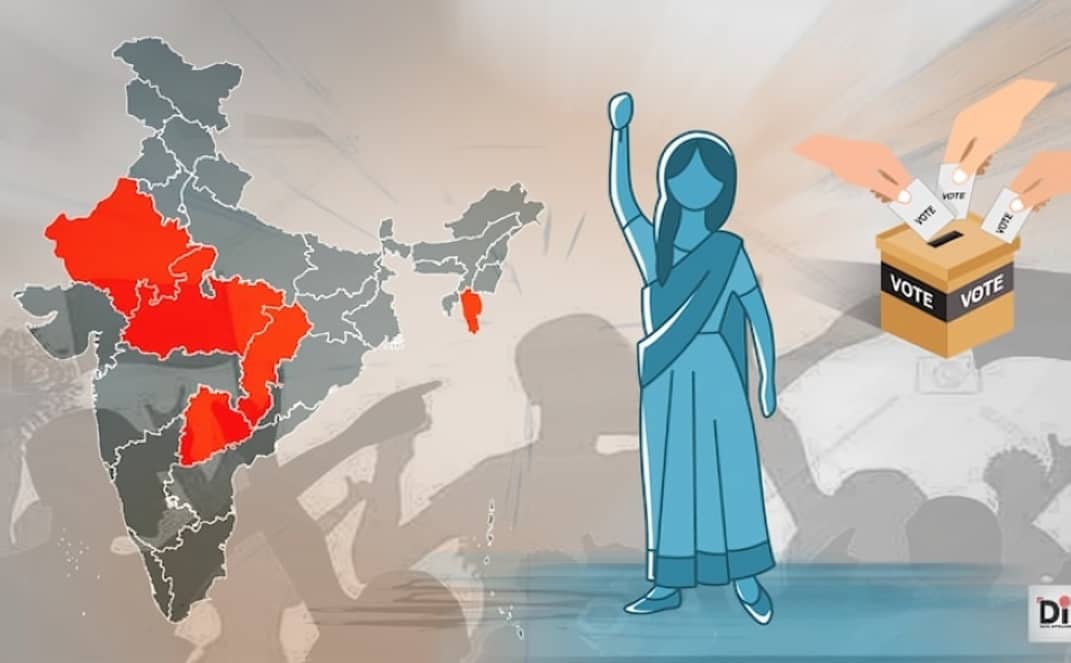
Women voters are emerging as a major political focus in Uttar Pradesh as political parties prepare for the 2027 Assembly election. The state's electoral politics has traditionally been strongly influenced by caste equations, but the increasing participation and political importance of women are encouraging parties to expand their strategies.
The Bharatiya Janata Party and the Samajwadi Party have recently intensified their efforts to reach women voters through welfare-oriented announcements. The competing initiatives indicate that women's issues are becoming an increasingly important component of the political contest in the state.
Uttar Pradesh has one of the largest electorates in India, making every major voter group important for political parties. According to the final electoral roll cited by The Indian Express, the state had about 13.39 crore registered voters, including approximately 6.09 crore women. Women therefore accounted for about 45.46 percent of the electorate.
The growing importance of women voters is not limited to one particular caste or social group. Women voters are spread across different communities and regions, meaning that parties seeking their support can potentially reach beyond traditional caste-based vote calculations.
This has encouraged political parties to combine their existing social and caste-based strategies with policies specifically designed to address women's economic and social concerns. Welfare programmes relating to financial assistance, transportation, education, safety and social security are increasingly becoming part of electoral outreach.
The Bharatiya Janata Party-led government in Uttar Pradesh has recently announced measures aimed at women. One such initiative provides free bus travel for women and one accompanying person during the Raksha Bandhan period. The state government has also approved a scheme under which women aged 60 and above can travel free of charge on Uttar Pradesh State Road Transport Corporation buses.
The Samajwadi Party, meanwhile, has announced a significant financial support proposal for women. Party president Akhilesh Yadav has said that if the Samajwadi Party forms the government after the 2027 Assembly election, women would receive an annual financial benefit of Rs 40,000 under a proposed Samajwadi pension scheme.
The Samajwadi Party has also linked its women-focused promises with education and social infrastructure. Akhilesh Yadav has announced plans to reopen 26,000 schools and has outlined other proposals aimed at supporting women and girls.
The competing announcements demonstrate how women's welfare is becoming an important part of the political narrative in Uttar Pradesh. Rather than focusing only on traditional identity-based politics, parties are increasingly attempting to connect electoral strategies with everyday economic and social concerns.
Women-centric welfare has already become an important feature of electoral politics in several Indian states. Political parties have increasingly used financial assistance, free transportation, social security, education support and other benefits to build connections with women voters.
The trend has also encouraged parties in Uttar Pradesh to study the voting behaviour of women across different social groups. The objective is not necessarily to treat women as a single political bloc, but to understand how welfare policies and governance issues influence women across caste, class, rural and urban divisions.
Recent electoral trends have strengthened the argument that women voters cannot be ignored in major elections. Increased participation by women has made their preferences more relevant to campaign strategies and political calculations. However, it would be inaccurate to assume that all women vote as a single group. Their political preferences can vary depending on region, community, economic circumstances and individual priorities.
For the BJP, the focus on women is part of a broader welfare and governance narrative. The party can point to existing state programmes and new initiatives as evidence of its emphasis on women's welfare and mobility.
For the Samajwadi Party, the proposed annual financial support programme represents an attempt to create a direct economic connection with women voters. The party is also seeking to combine its traditional social coalition strategy with additional welfare commitments.
The political competition is therefore developing on two levels. One involves established caste and community equations, while the other increasingly involves welfare, economic support and issues that directly affect women.
The BJP and Samajwadi Party are not the only political players interested in women voters. Other parties are also expected to develop their own strategies as the 2027 election approaches. The Congress has previously attempted to build a dedicated women-focused political narrative in Uttar Pradesh, indicating that women's issues could become a broader area of competition.
Another important factor is the difference between announcing a welfare measure and implementing it. Voters may assess not only the value of a proposed benefit but also its accessibility, eligibility requirements and actual delivery. This could make implementation records an important part of the election campaign.
The debate over women-focused welfare is also likely to include questions about employment, education, public safety, transportation and household economic pressures. Political parties may seek to present their programmes as measures of empowerment rather than simply electoral benefits.
For voters, the increasing attention from political parties could bring greater focus to issues that directly affect their daily lives. At the same time, the competing announcements are likely to face scrutiny regarding funding, implementation and long-term sustainability.
With the 2027 Uttar Pradesh Assembly election approaching, the political contest is gradually expanding beyond traditional caste calculations. Women voters are emerging as a major constituency that political parties believe could influence electoral outcomes.
The BJP's welfare initiatives and the Samajwadi Party's financial support proposal show that both sides are actively attempting to build a stronger connection with women. Their strategies differ, but the underlying political message is similar: women voters are becoming too significant to overlook.
The coming months are likely to see more announcements and policy proposals targeting women as parties intensify their preparations for the election. The extent to which these measures influence voter preferences will depend on how women assess the competing promises, existing government performance and their own local concerns.
Overall, the growing focus on women voters marks an important shift in Uttar Pradesh's electoral politics. Caste and community calculations will remain significant, but women-centric welfare and governance are increasingly becoming another major dimension of the political contest.