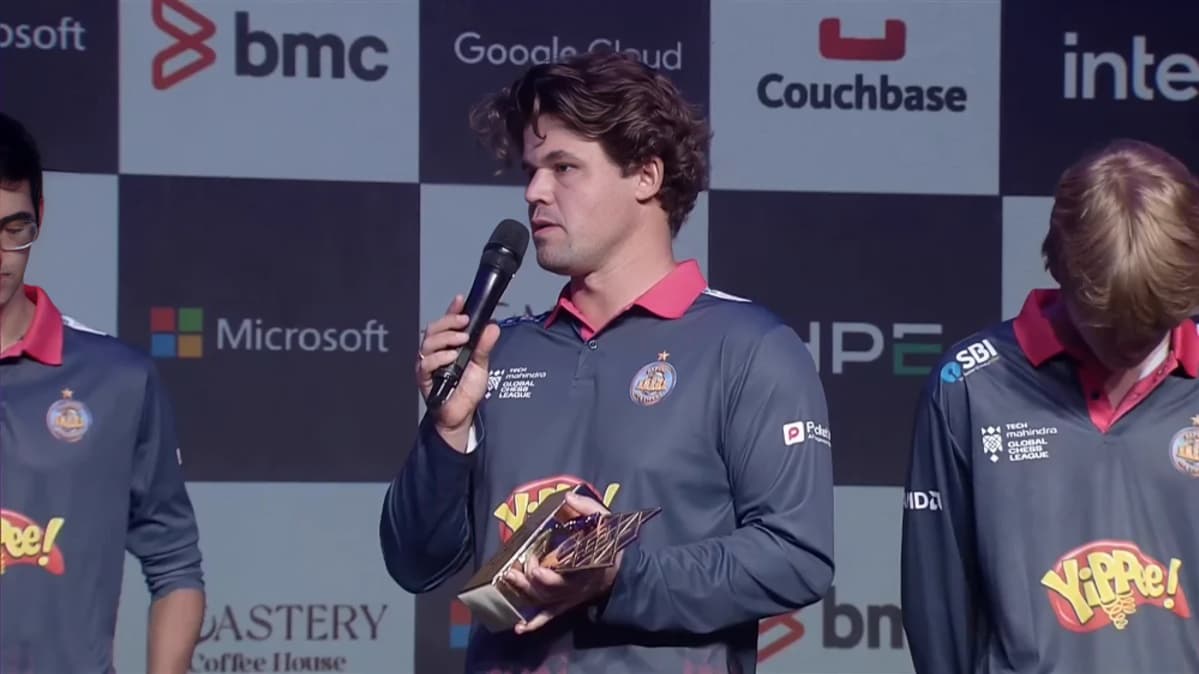
The ongoing saga involving Magnus Carlsen and the International Chess Federation (FIDE) has taken another dramatic turn, as the Norwegian chess grandmaster has publicly criticized Indian chess legend Viswanathan Anand’s role as Deputy President of FIDE. The controversy erupted after Carlsen's controversial disqualification from the 2023 World Rapid Chess Championship in New York, where he was banned from competing for wearing jeans. Carlsen has described this decision as "draconian" and voiced his dissatisfaction with how FIDE handled the situation, particularly the lack of flexibility in the enforcement of the dress code.
In an interview with an online platform, Carlsen expressed his frustration with the way the incident was handled, highlighting his discussions with Anand and other officials. He revealed that despite numerous conversations, the outcome remained unchanged, with no clear resolution. "We had long conversations with Anand yesterday and others, which generally didn't lead anywhere," Carlsen said. "It was generally the same answers — that arbiters are basically robots who cannot think on their own, who have no way to even deviate slightly from... I don't even know if I broke any rules. I still haven't gotten a clear answer on that," Carlsen added.
The crux of Carlsen’s criticism was directed at Anand, who, as Deputy President of FIDE, holds a leadership role within the organization. Carlsen was disappointed by Anand’s response, claiming that the chess legend appeared passive and unable to challenge the arbiters' decision. According to Carlsen, Anand told him that he didn’t realize he had any power to alter the situation beyond agreeing with the arbiters’ decision. "Anand said very clearly that he didn't know that he had any opportunity to do anything past, you know, go with the arbiters' honestly draconian decision of not pairing me. And that means that he was, for all his good qualities, not ready for this job," Carlsen remarked. This comment underscores Carlsen's belief that Anand was ill-prepared for such a pivotal role, despite his longstanding contributions to the chess world.
The incident, which has now become a topic of widespread debate, has sparked a conversation within the chess community about the rigidity of FIDE's rules and the need for greater flexibility. Many players and analysts have questioned whether the enforcement of a strict dress code is appropriate in modern chess tournaments, especially given the growing global prominence of the sport. FIDE’s dress code, which led to Carlsen’s disqualification, has been scrutinized for being too inflexible, with critics arguing that it failed to accommodate minor deviations such as jeans, as long as they are paired with appropriate attire like a jacket.
Following the backlash and Carlsen’s criticism, FIDE announced that it would update its dress code policy. The revised rules will now allow "elegant minor deviations," including jeans, as long as they are paired with jackets, which is seen as a more flexible and modern approach to attire in professional chess events. This change, while minor, is significant as it acknowledges the evolving norms in sports and the increasing acceptance of casual yet stylish attire in formal settings.
For his part, Carlsen’s remarks on Anand and FIDE have resonated with many in the chess world, especially those who have long admired Anand for his leadership and diplomatic skills. However, the criticism highlights the growing frustration with FIDE's decision-making processes, particularly when it comes to enforcing rules that seem outdated or unnecessarily rigid. Many believe that FIDE, under Anand's leadership, needs to adapt to the changing landscape of chess, where professionalism, talent, and the global nature of the game require a more nuanced approach to governance.
This episode has also brought Carlsen's relationship with FIDE into the spotlight. Carlsen, who has been one of the most dominant figures in chess for over a decade, has had a somewhat tense relationship with the organization in recent years. His critique of Anand and FIDE, while scathing, is not the first time Carlsen has expressed dissatisfaction with the federation’s policies. The disqualification incident in New York, coupled with his public comments, underscores the growing tension between one of the game’s greatest players and the governing body of the sport.
Ultimately, this saga raises important questions about leadership, governance, and the evolution of the chess world. As FIDE moves forward with its revised policies, it will need to address not only the practicalities of dress codes but also broader issues regarding player rights, flexibility, and the organization’s ability to adapt to the times. Carlsen’s comments are a reminder that even the most respected figures in the chess world are not immune to criticism, and that the sport’s future requires a thoughtful balance between tradition and modernity. Only time will tell how these debates shape the direction of chess, but for now, the tension between Magnus Carlsen, Viswanathan Anand, and FIDE remains a compelling storyline in the world of competitive chess.