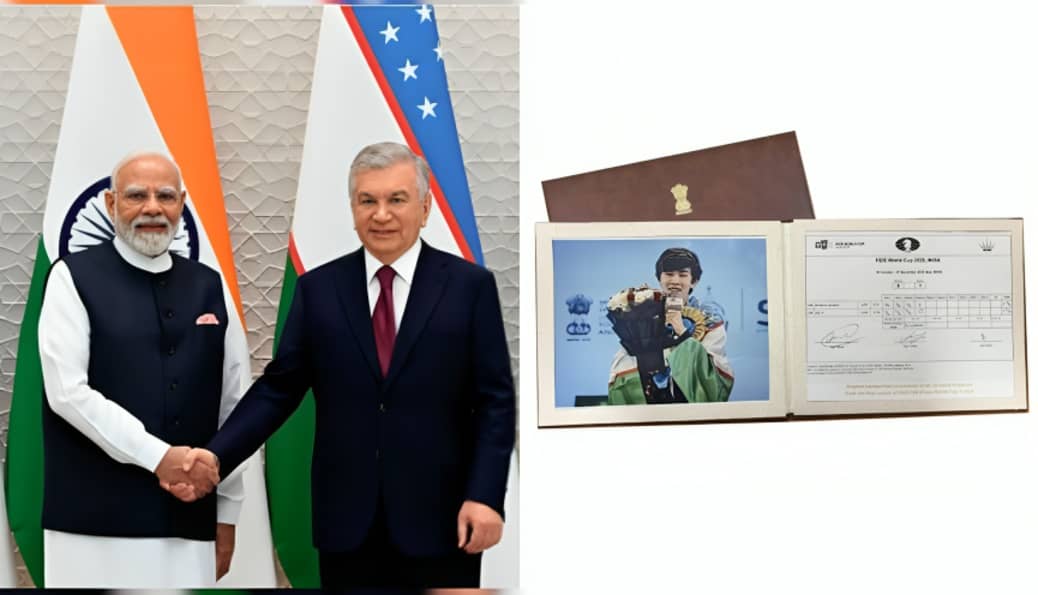
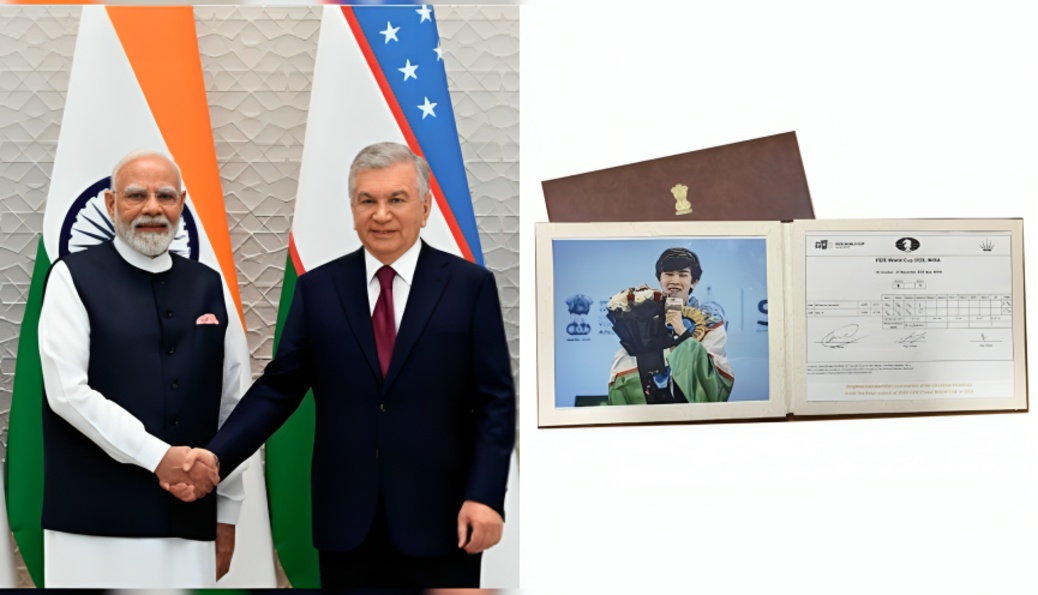
Prime Minister Narendra Modi presented Uzbekistan President Shavkat Mirziyoyev with a unique chess memento during his visit to Uzbekistan, gifting him the original handwritten scoresheet from Grandmaster Javokhir Sindarov’s historic victory in the 2025 FIDE World Cup final.
The gift was connected to one of the most significant moments in Uzbekistan’s recent chess history. Sindarov won the 2025 FIDE World Cup in Goa after defeating China’s Wei Yi in the final tiebreak. The victory made Sindarov the youngest player to win the FIDE World Cup and the first Uzbek chess player to claim the prestigious title.
The handwritten scoresheet records the moves from Sindarov’s decisive final tiebreak game. Rather than presenting a conventional sporting trophy or souvenir, Modi chose an item directly connected to the historic achievement. The scoresheet was reportedly placed in a leatherette cover along with a photograph of Sindarov holding the World Cup trophy and displaying the Uzbek flag.
The presentation gave a sporting dimension to the diplomatic engagement between India and Uzbekistan. Chess has developed into an important area of sporting interaction between the two countries, with both nations producing several leading young grandmasters and maintaining strong performances in international team competitions.
Sindarov’s World Cup victory in Goa was particularly significant for Uzbekistan. He defeated Wei Yi after the two classical games of the final ended in draws. The Uzbek grandmaster then won the decisive tiebreak, securing the title with a 1.5 to 0.5 result in the tiebreak stage. His overall final score was 2.5 to 1.5.
The World Cup victory also secured Sindarov qualification for the 2026 Candidates Tournament, providing him with a route toward the World Chess Championship. He subsequently won the Candidates event, setting up a world championship match against India’s reigning world champion D Gukesh later in 2026. This development has added another important link between the chess communities of India and Uzbekistan.
The choice of the scoresheet as a diplomatic gift was also notable because it represents the exact record of a historic sporting achievement. A chess scoresheet normally serves as a technical record of a game, documenting the moves played by both competitors. In this case, the document has acquired wider significance because it is associated with Uzbekistan’s first FIDE World Cup title.
All India Chess Federation chief Nitin Narang described the gesture as an example of chess diplomacy. He highlighted how a record of moves from a chess game had become part of the wider India Uzbekistan relationship.
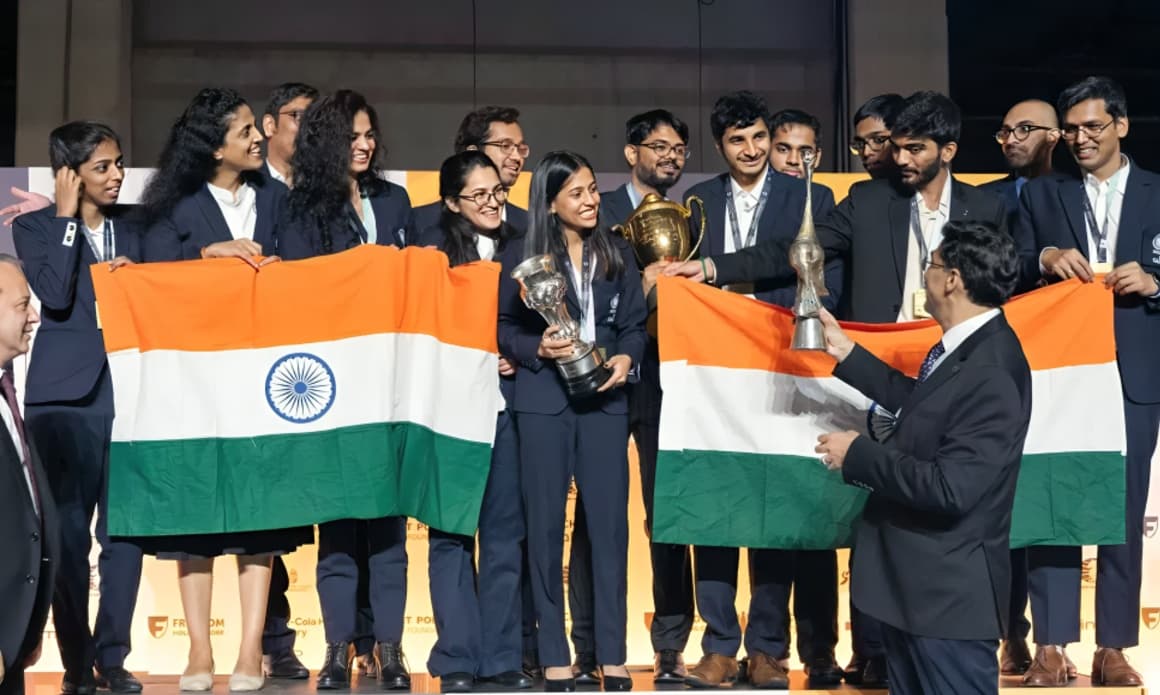
The sporting connection between India and Uzbekistan has strengthened in recent years. India has produced several leading young players, including Gukesh, R Praggnanandhaa, Arjun Erigaisi, Vaishali Rameshbabu and Divya Deshmukh. Uzbekistan has also developed a strong generation of players, with Sindarov and Nodirbek Abdusattorov among the country’s prominent grandmasters.
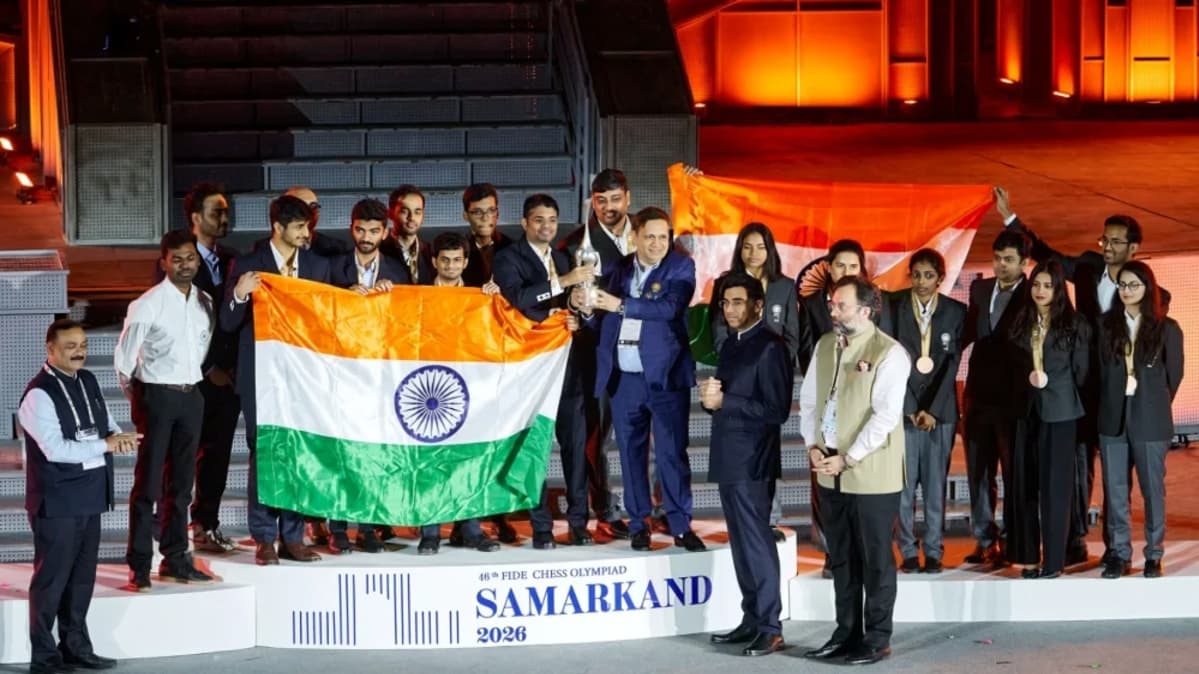
The two countries are also expected to compete closely at major international chess events. Uzbekistan is scheduled to host the 46th Chess Olympiad in Samarkand from September 15 to 27, 2026. India’s teams are expected to defend their gold medals, while Uzbekistan is regarded as one of the major competitors.
Modi’s gift to Mirziyoyev was part of a wider exchange of culturally significant items during the visit. Other gifts presented to the Uzbek leadership included traditional Indian handicrafts, premium Kangra tea and a sandalwood Shata Tantri Veena, also known as the Santoor. These gifts were intended to showcase different aspects of India’s cultural and artistic heritage.
The chess scoresheet, however, stood apart because it was linked specifically to Uzbekistan’s sporting achievement on Indian soil. Sindarov’s victory took place in Goa in November 2025, making the memento a direct reminder of an event that connected the sporting histories of the two countries.
For India, the gesture also reflects the growing importance of chess as a form of cultural and sporting diplomacy. The sport has gained considerable international attention following the rise of young Indian players and the success of the Indian teams at the Chess Olympiad. Uzbekistan has similarly established itself as a major chess nation, making sporting exchanges between the two countries increasingly significant.
The gift also carries additional relevance because Sindarov and Gukesh are now linked through the world championship cycle. Sindarov’s success at the World Cup and Candidates Tournament eventually placed him on the path to challenge Gukesh for the world title. Their upcoming championship contest is expected to add another chapter to the growing chess relationship between India and Uzbekistan.
Modi’s presentation of the original scoresheet therefore served several purposes. It recognised Sindarov’s achievement, acknowledged Uzbekistan’s chess tradition and provided a personal diplomatic gift to President Mirziyoyev. The choice of an actual game record instead of a conventional commemorative object also gave the exchange a direct connection to the history of international chess.
The episode demonstrates how sporting achievements can become part of diplomatic engagement. In this case, a chess game played in Goa has produced a memento that travelled to Tashkent and was presented at the highest level of government.
With Sindarov preparing to face Gukesh in the world championship match and the Chess Olympiad scheduled to take place in Samarkand, chess is likely to remain an important part of the sporting relationship between India and Uzbekistan. The handwritten scoresheet from the 2025 World Cup final has consequently become more than a record of moves. It now represents a shared sporting connection between two countries with strong and growing chess traditions.