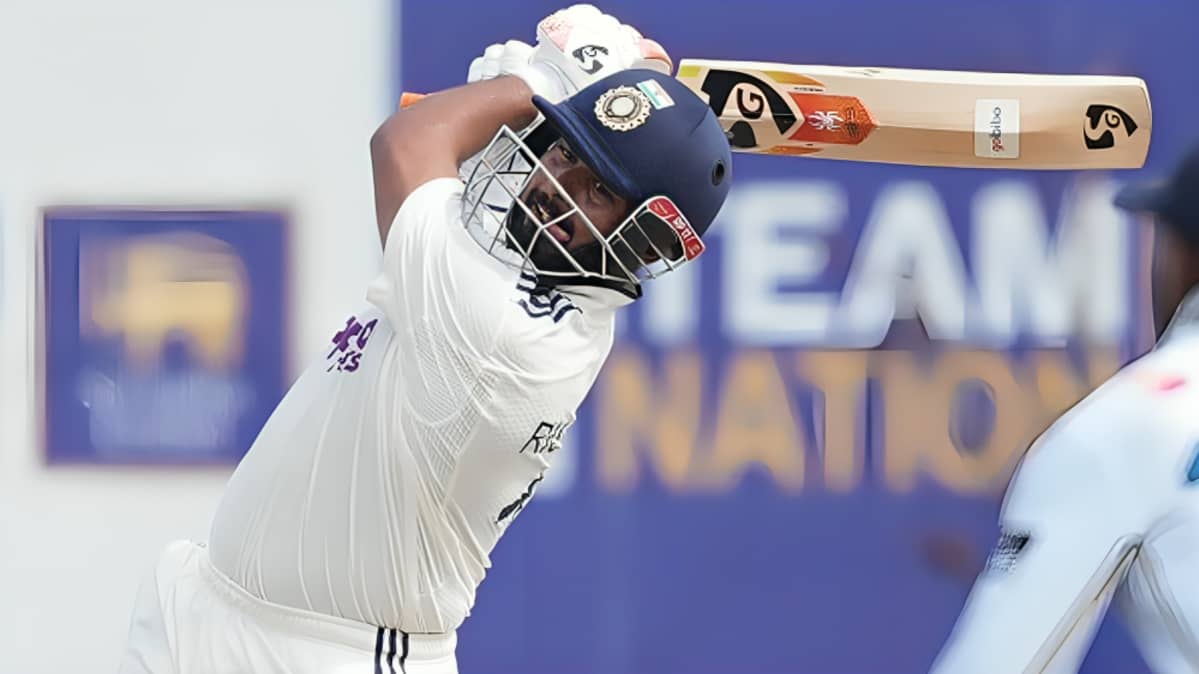
Rishabh Pant's dismissal during India's first Test against Sri Lanka in Galle has become a major talking point after former India cricketer Mohammad Kaif questioned the wicketkeeper batter's decision making.
Pant scored 39 runs from 62 deliveries before his innings came to an end on the second day of the Test. He was dismissed by Sri Lankan debutant Keshara Nuwantha, with Sonal Dinusha completing the catch at wide long on.
Pant's dismissal came at an important stage of India's innings. The Indian team had already established a strong position after impressive contributions from Devdutt Padikkal and KL Rahul. Padikkal went on to score 167, while Rahul made 82, giving India a solid platform.
Pant entered the crease with expectations of continuing the attacking approach that has become closely associated with his Test batting. He scored quickly and looked capable of converting his start into a substantial innings. However, his attempt to attack the bowling ultimately resulted in his dismissal.
According to Kaif, the situation required greater awareness because Sri Lanka had just taken the new ball. The former India batter argued that a batter should assess the conditions and give himself time to understand how the new ball behaves before attempting an aggressive shot.
Kaif's comments have focused specifically on what he described as the importance of common sense and match awareness. His criticism was not necessarily directed at Pant's natural attacking style but at the timing of the particular shot.
Pant has built his reputation as one of India's most aggressive Test batters. His ability to change the course of a match quickly has made him an important member of the Indian side. On numerous occasions, his attacking approach has put opposition bowlers under pressure.
At the same time, that aggressive style can carry risks. Test cricket requires players to adapt to changing conditions, and shot selection becomes particularly important when a new ball is in operation.
The Galle Test provided an example of this challenge. India had accumulated a substantial total, but Sri Lanka's bowlers were able to take wickets during the later stages of India's innings. Nuwantha eventually finished with three wickets, while experienced spinner Prabath Jayasuriya claimed four wickets.
Despite Pant's dismissal, India remained in a commanding position. The visitors eventually reached 460 for nine at the end of the second day's play, with Kuldeep Yadav and Prasidh Krishna unbeaten. Devdutt Padikkal's maiden Test century was the major highlight of India's batting performance.
Pant's 39 was therefore not enough to overshadow India's overall batting effort, but the manner of his dismissal attracted attention because of his importance to the team.
Kaif's criticism has also reignited the broader debate surrounding Pant's batting philosophy in Test cricket. Supporters of Pant's approach believe his ability to attack can unsettle bowlers and change the momentum of a match. Critics, however, argue that he needs to balance aggression with greater awareness of match conditions.
The situation becomes even more significant when Pant is playing in a Test match where the opposition has quality spin options. Galle is traditionally regarded as a venue where spinners can have a significant influence as the match progresses.
India's strong first innings total gave the bowlers a considerable advantage. On the third day, Sri Lanka struggled early in their reply and reached 99 for five at lunch. India's bowlers maintained pressure, with Manav Suthar, Kuldeep Yadav and other bowlers contributing to the early wickets.
This context also underlines why the dismissal of Pant was viewed differently from an ordinary batting error. When a team is already in a strong position, a batter can potentially adopt a more measured approach and attempt to build a longer partnership.
However, Pant's attacking instincts remain one of his biggest strengths. Indian cricket has benefited from his willingness to take risks, particularly in Test matches where he has produced several memorable innings.
The challenge for Pant is therefore not necessarily to abandon his aggressive style but to identify the right moments to attack. Kaif's comments reflect the view that experienced international batters must calculate the risks involved before attempting high-impact shots.
The criticism has generated discussion among cricket followers, particularly because Pant has repeatedly shown the ability to make significant contributions with the bat. A strong performance in the remainder of the series could quickly shift the focus back to his match-winning abilities.
India's Test series against Sri Lanka is also important as the team continues to develop under captain Shubman Gill. With several young players making significant contributions, the team will be looking for consistency from its established players as well.
For Pant, the immediate focus will be on the next opportunity with the bat. His ability to learn from the Galle dismissal and adapt his approach could become an important part of India's campaign.
The first Test has already produced several notable performances. Padikkal's 167 gave India a strong foundation, while Rahul and Dhruv Jurel also made valuable contributions. Sri Lanka's spinners fought back strongly during the closing stages of India's innings before the hosts faced pressure from the Indian bowling attack.
Ultimately, Mohammad Kaif's comments have placed the spotlight on an issue that has followed Pant throughout his career: the balance between aggression and responsibility. Pant's attacking style has brought India major rewards, but Test cricket often demands patience and situational awareness.
His dismissal in Galle will therefore be remembered not only for the runs he scored but also for the debate surrounding his shot selection. As the Test series continues, Pant will have an opportunity to respond through his performances and demonstrate that his aggressive approach can be combined with the judgement required at the highest level.
For now, Kaif's criticism has added another layer to the ongoing discussion about Pant's role in India's Test batting line-up and the importance of adapting one's approach according to the match situation.