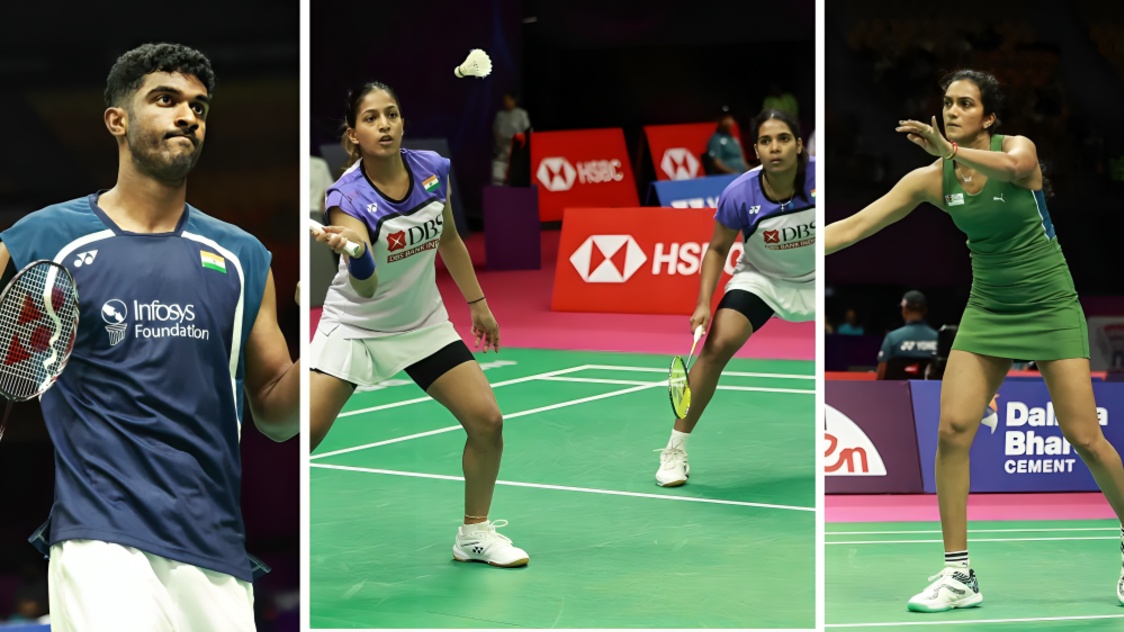
The 2026 BWF World Championships in New Delhi have produced intense competition on court, but one factor beyond the players’ control has also attracted considerable attention. The drift inside the Indira Gandhi Indoor Stadium has emerged as an important talking point, with players having to adjust their tactics and shot execution to the conditions.
In badminton, drift refers to the movement of the shuttle caused by air currents inside an indoor venue. Even though badminton is played indoors, factors such as air conditioning, ventilation, humidity and temperature can influence how the shuttle travels. A change in air movement can make attacking shots, defensive lifts and delicate net play more difficult to judge.
The issue has been particularly noticeable because the tournament features many of the world's leading players. At this level, small differences in shuttle movement can affect timing and decision making. Players who normally rely on precise attacking strokes may have to adjust their pace, trajectory and positioning depending on which side of the court they occupy.
The Delhi championships are especially significant for Indian badminton because the World Championships have returned to India after 17 years. The tournament is being held at the Indira Gandhi Indoor Stadium from August 17 to August 23, bringing many of the world's leading players to the capital.
The venue had undergone extensive preparation before the tournament. Organisers reportedly carried out upgrades after concerns were raised about conditions during the India Open earlier in the year. Players from China and other leading teams subsequently gave positive feedback about the improved venue conditions during their preparations.
Despite the preparations, the drift has remained an important competitive factor. Players have needed to adapt quickly during matches rather than simply relying on their normal game plans.
India's campaign has already produced contrasting results. Youngster Ayush Shetty created one of the biggest early surprises when he defeated defending champion and world number one Shi Yuqi in the opening round. The victory immediately established Shetty as one of the players to watch during the tournament.
PV Sindhu has also progressed to the pre quarterfinal stage. The two time Olympic medallist remains one of India's biggest hopes for a medal in women's singles. Her experience at major tournaments could be particularly valuable in conditions where players need to make frequent tactical adjustments.
However, not every Indian contender has been able to overcome the challenges. Lakshya Sen suffered a surprise second round defeat against USA's Garret Tan. Sen lost the three game contest 19 21, 21 19, 17 21. The result ended his campaign earlier than expected.
The playing conditions were also discussed in relation to Sen's earlier match. Reports noted that he initially struggled with the drift before adapting and recovering to win his contest against Austria's Collins Filimon.
For Sindhu, the next challenge is particularly demanding. She is set to face China's Wang Zhi Yi, currently ranked among the world's leading women's singles players. Wang has previously spoken about the psychological challenge of facing Sindhu and the importance of concentrating on her own strategy rather than thinking too far ahead about a potential matchup.
The Sindhu Wang contest therefore brings together experience, current form and tactical adaptability. Both players will need to manage not only their opponent but also the conditions inside the stadium.
The drift can influence the way players attack from the rear court. A shuttle that travels differently from expectations can affect smash placement and defensive returns. Players may therefore choose safer shots, alter their attacking angles or attempt to control rallies through longer exchanges.
For spectators, these technical details may not always be immediately visible. However, for elite badminton players, the conditions can have a significant impact on every rally.
The Delhi World Championships have already demonstrated the unpredictability of the tournament. A world number one was eliminated early, several Indian players have advanced, and experienced competitors have had to make rapid adjustments to the venue.
The tournament also represents an important opportunity for India to showcase its growing badminton strength. Sindhu remains one of the country's most decorated players, while Shetty represents the emerging generation. Their progress could provide an important contrast between established experience and young talent.
With the competition entering the knockout stages, every match becomes increasingly significant. There is little room for players to lose concentration or fail to adapt to the court environment.
For Sindhu, the upcoming meeting with Wang Zhi Yi will be closely watched by Indian fans. A victory would take her into the quarterfinals and strengthen her hopes of adding another World Championships medal to her already impressive record.
For Shetty, the tournament has already become a major breakthrough after his victory over Shi Yuqi. His continued progress would further underline the emergence of a new generation of Indian men's singles players.
Ultimately, the Delhi drift is another variable that the world's best players must manage. Skill, fitness and strategy remain fundamental to success, but the ability to adapt to the conditions could prove equally important as the tournament approaches its decisive stages.
The BWF World Championships continue in New Delhi through August 23, with India's remaining players looking to make the most of home conditions and challenge for medals