
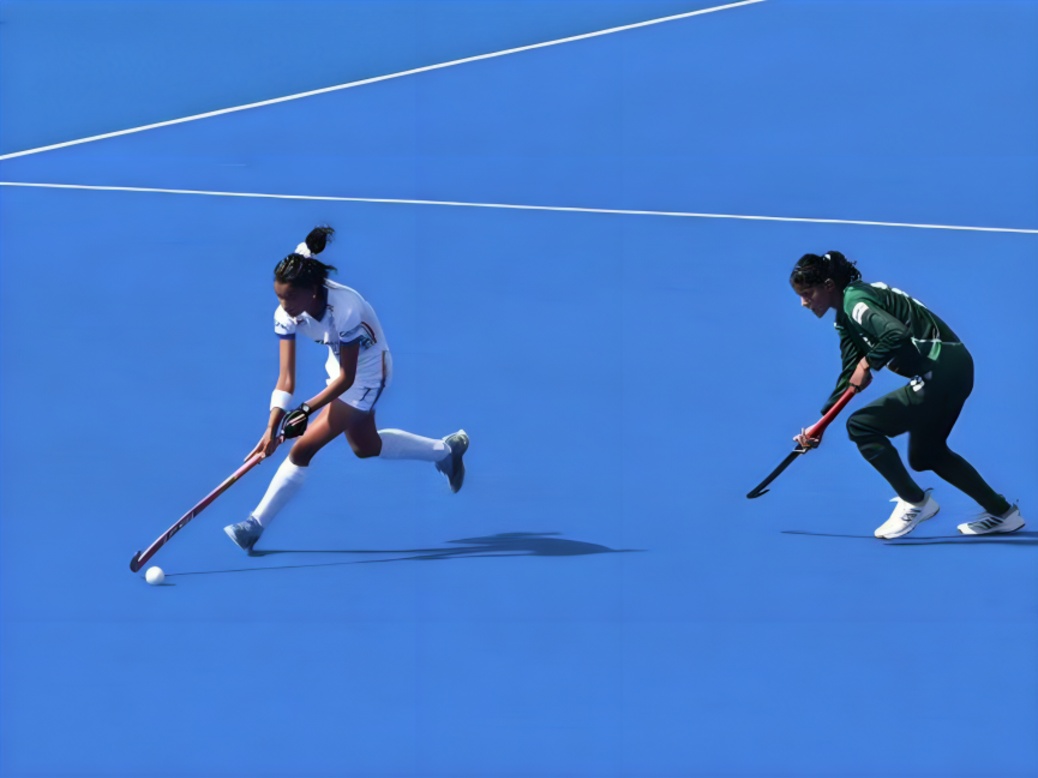
India delivered a commanding performance at the 2026 Women’s Junior Asia Cup in Moqi, China, defeating Pakistan 19-0 in the quarterfinals and advancing to the semifinals of the tournament. The result underlined India’s strong campaign and kept the team on course for another title. The official FIH match centre confirms the 19-0 scoreline in the quarterfinal between India and Pakistan.
India entered the knockout stage after finishing at the top of the elite pool. The team had recorded victories against South Korea, Malaysia and Japan before playing out a goalless draw against hosts China. India and China both finished the pool phase with 10 points, but India secured the top position on goal difference.
The quarterfinal against Pakistan was a completely one sided contest. India took control early and continued to apply pressure throughout the match. The Indian attack repeatedly breached the Pakistani defence, while the team also maintained a strong defensive structure to prevent Pakistan from finding the net.
India had already demonstrated its attacking strength during the pool stage. The team scored four goals against South Korea, 11 against Malaysia and seven against Japan. The goalless draw against China was the only match in the pool phase in which India failed to score. The 19 goal performance against Pakistan showed the team’s ability to quickly regain its attacking momentum in the knockout stage.
Puja Malik was among the standout performers for India, scoring three goals during the quarterfinal. A total of 13 different Indian players found the net, highlighting the depth of the team’s attacking options. Several players contributed multiple goals, allowing India to maintain pressure across the match rather than depending on one individual scorer.
India had already established itself as one of the leading teams in the tournament before the quarterfinal. The side entered the competition with the confidence of having won the previous two editions in 2023 and 2024. The current campaign has given the team an opportunity to continue that successful run and challenge for another championship.
The 19-0 victory also strengthened India’s position as one of the leading contenders for the 2026 title. However, the knockout stage presents a different challenge because every match carries greater significance. India will now have to prepare for the semifinal against the winner of the quarterfinal between South Korea and Malaysia.
The result is also significant in the context of the tournament’s wider importance. The Women’s Junior Asia Cup is an under-21 international hockey competition organised under the Asian Hockey Federation. The tournament provides young players with high-level international experience and is also linked to qualification for the Junior World Cup.
For India’s junior players, performances at this level can provide valuable experience before they move into senior international hockey. The tournament gives the players an opportunity to compete against strong Asian teams while adapting to the pressure of knockout matches.
India’s defensive performance was equally important in the 19-0 victory. While the large scoreline naturally draws attention to the attacking display, keeping a clean sheet in a quarterfinal also demonstrates the team’s ability to maintain concentration and defensive organisation. Pakistan were unable to score during the match as India controlled the contest from both ends of the field.
The scale of the victory also reflects the difference in attacking efficiency on the day. India converted its opportunities consistently, while Pakistan struggled to create enough chances to challenge the Indian defence. By the end of the match, India had scored 19 goals without conceding.
The victory comes after India’s goalless draw against China in the final elite pool match. That result had ensured that India remained unbeaten, but the team’s inability to score in that match meant that the quarterfinal became an opportunity to respond strongly. India did exactly that by producing its highest scoring performance of the knockout stage so far.
The semifinal will now become the next major test for India. The team cannot afford to rely on the quarterfinal scoreline because the remaining opponents are also among the stronger teams in Asian junior hockey. South Korea and Malaysia will contest the other quarterfinal, with the winner earning a place in the semifinal against India.
India’s objective will be to maintain the consistency that has characterised its campaign so far. The team has combined attacking depth with defensive discipline, and the coaching staff will now look to prepare the players for a more competitive semifinal.
The tournament is particularly important for India because of its recent success in the competition. Having won the 2023 and 2024 editions, the team is attempting to continue its dominance at the junior level. Another title would further strengthen India’s position in women’s junior hockey in Asia.
For now, the 19-0 victory over Pakistan stands as one of the biggest talking points of the tournament. India’s attacking depth, with 13 different goal scorers, was one of the clearest features of the performance. Puja Malik’s three goals further highlighted the individual contributions within a collective team effort.
The semifinal will provide a much stronger test of India’s title credentials. While the quarterfinal result demonstrated India’s attacking power, the next match will require the team to maintain the same level of concentration against a potentially tougher opponent.
With an unbeaten record intact, India will enter the semifinal with considerable confidence. The team will now look to convert its strong tournament start into another appearance in the final and continue its pursuit of a third consecutive Women’s Junior Asia Cup title