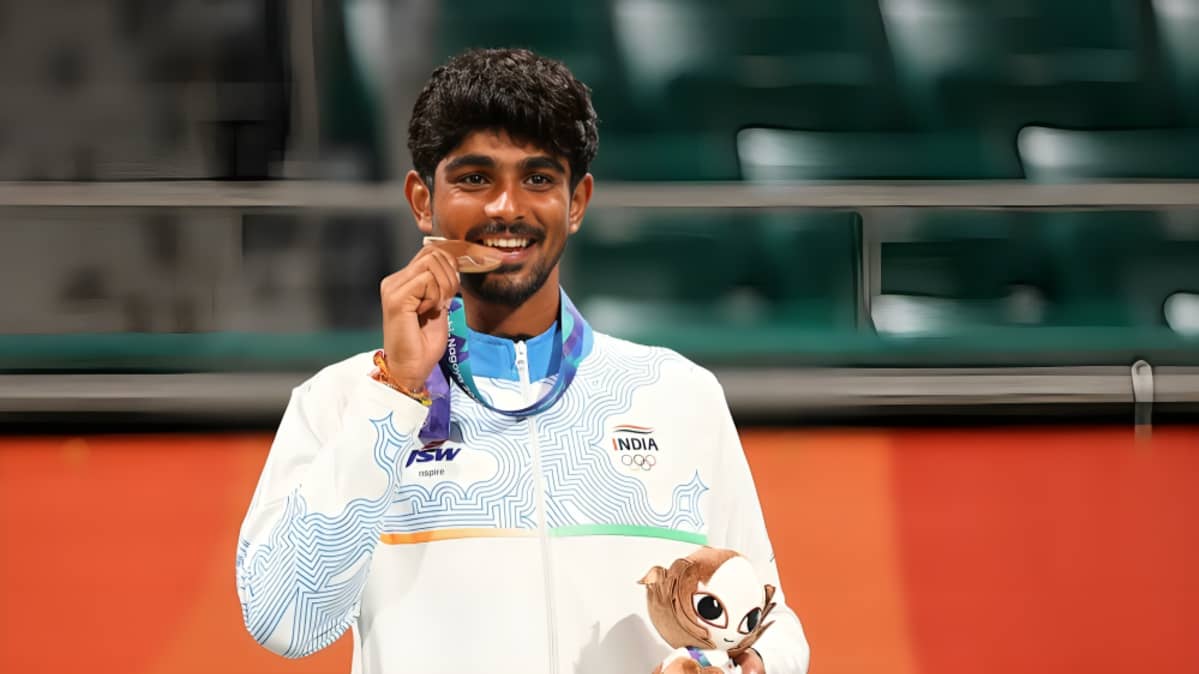

Jay Meena’s historic bronze medal at the 2026 Asian Games came after one of the most difficult periods of his sporting career. Weeks before the competition in Aichi Nagoya, the Indian soft tennis player was bedridden with typhoid and a severe infection. He lost around eight kilograms and was forced to leave the Asian Games training camp in Srinagar and return to his home in Dewas, Madhya Pradesh.
The illness came at a particularly difficult stage of Meena’s preparation. With the Asian Games approaching, he had spent months training with the goal of competing for India. According to his account to Times of India, he was out of action for around 15 days. During the worst phase of his illness, his parents had to feed him by hand for nearly a week because of his condition.
Recovery was not immediate. After returning home, Meena said that even walking a few steps could leave him feeling dizzy for about a week. He also struggled with an unsettled stomach while attempting to regain his strength. The combination of illness, weight loss and reduced physical condition made his return to competitive training particularly challenging.
Despite the setback, Meena decided that he could not remain away from training for long. He gradually began with light warm ups before increasing his workload. He told Times of India that he started training again because he did not want to sit at home with the Asian Games approaching. His priority was to recover sufficiently to join the Indian contingent and compete in Nagoya.
The comeback eventually took Meena to the podium and into Indian sporting history.
At the Asian Games, Meena competed in the men’s singles soft tennis event. He progressed through the competition and reached the quarterfinal, where he faced the Philippines’ Sherwin Nuguit in a closely fought contest. Meena won the match 4 3 to reach the semifinals and, in doing so, guaranteed India a medal because the four semifinalists were assured of podium finishes.
The semifinal brought another major challenge. Meena faced Japan’s Takuya Kurosaka, one of the home competitors. The Indian struggled at the beginning of the match and fell three games behind. However, he refused to give up and produced a strong response.
Meena won the fourth and fifth games to reduce the deficit to 2 3 and briefly put himself in contention for a place in the final. The Japanese player eventually recovered and closed out the semifinal, winning 4 2. The reported game scores were 3 5, 1 4, 1 4, 4 1, 6 4 and 1 4. The semifinal defeat ended Meena’s hopes of reaching the gold medal match, but his place on the podium was already guaranteed.
Meena’s performance also came despite physical discomfort during the semifinal. Sports reports noted that he was dealing with pain in his hip, particularly while attempting backhand shots. He took a medical timeout during the match but continued playing and completed the contest.
The bronze medal was therefore much more than a result on the scoreboard. It represented India’s first ever Asian Games medal in soft tennis. Meena became the first Indian athlete to win a medal in the sport at the continental Games.
The achievement is also significant because soft tennis remains a relatively less familiar sport among Indian audiences. Although the sport shares similarities with lawn tennis, it uses lighter equipment and has different scoring and playing characteristics. Meena has previously spoken about the need for greater awareness, infrastructure and investment in the sport in India.
Meena’s journey in soft tennis began when he was young. He had initially been interested in cricket, like many children in India, but was introduced to soft tennis at Pioneer Public School in Dewas. According to The Indian Express, his father encouraged him to spend time on the soft tennis court, and what began as an activity gradually developed into a serious sporting career.
His performances eventually established him as one of India’s leading soft tennis players. Meena won gold at the 2022 National Games in Gujarat and also became India’s first medallist at the World Soft Tennis Championships when he won bronze in mixed doubles at the 2024 edition. He has also collected medals at the Asian Soft Tennis Championships.
The Asian Games medal was nevertheless a different milestone because it represented India’s first podium finish in soft tennis at the continental multi sport event. Meena had previously competed at the 2018 and 2022 Asian Games. At the 2023 Hangzhou Asian Games, he reached the quarterfinal stage but missed out on a medal.
His bronze in Nagoya therefore also marked a personal progression at the Asian Games. After earlier disappointment, Meena returned to the competition and successfully secured a place on the podium.
The medal was also significant for the Indian soft tennis team. Meena has credited his coaches, teammates, family, the Amateur Soft Tennis Federation of India and the Sports Authority of India for supporting his preparation. After winning the medal, he dedicated the achievement to the people and organisations that had supported his career.
Coach Sudesh Sangate described the medal as the result of many years of work. He said the achievement could help create greater interest in soft tennis and encourage more young athletes to take up the sport.
The historic result also received recognition from the highest levels of Indian sport. Prime Minister Narendra Modi congratulated Meena for becoming India’s first Asian Games medallist in soft tennis. The Prime Minister’s Office described the achievement as a new chapter for Indian soft tennis and expressed hope that the medal would encourage more youngsters to take up the sport.
For Meena, however, the road to that historic podium had involved considerable uncertainty. His illness had interrupted his preparation at a crucial moment, while the recovery process meant that he had to rebuild his physical condition within a limited period. The additional hip problem during the semifinal created another challenge once he reached Nagoya.
Yet he managed to compete, reach the semifinal and secure the medal.
His celebration after the decisive point reflected the significance of the achievement. After his opponent’s final shot went long, Meena fell to the baseline in celebration before getting back up and acknowledging the Indian bench. The moment captured the relief and emotion surrounding a medal that had come after a difficult period.
Meena’s story also highlights the challenges faced by athletes competing in sports that receive less public attention. In an interview with The Indian Express, he said India has talent and infrastructure in soft tennis but needs greater investment and visibility. He also expressed hope that his Asian Games medal would bring more attention to the sport.
The bronze medal does not change the fact that Meena lost his semifinal against Kurosaka. However, because the semifinal stage guaranteed a medal, the result still secured a historic bronze for India. His comeback during the match, after falling three games behind, also demonstrated his determination to compete until the final point.
For Indian soft tennis, the significance of the result extends beyond one athlete. Meena’s medal provides a major Asian Games milestone for the sport and could increase attention among young players, coaches and sporting administrators.
For Meena personally, the medal completed an extraordinary turnaround. Just weeks earlier, he had been at home recovering from typhoid, a severe infection and significant weight loss. He had then returned to training, travelled to Japan and competed at the Asian Games despite another physical challenge during the semifinal.
His bronze medal is now recorded as India’s first Asian Games medal in soft tennis. It is the result of a comeback that involved illness, interrupted preparation, physical pain and the pressure of competing at one of Asia’s biggest sporting events.