
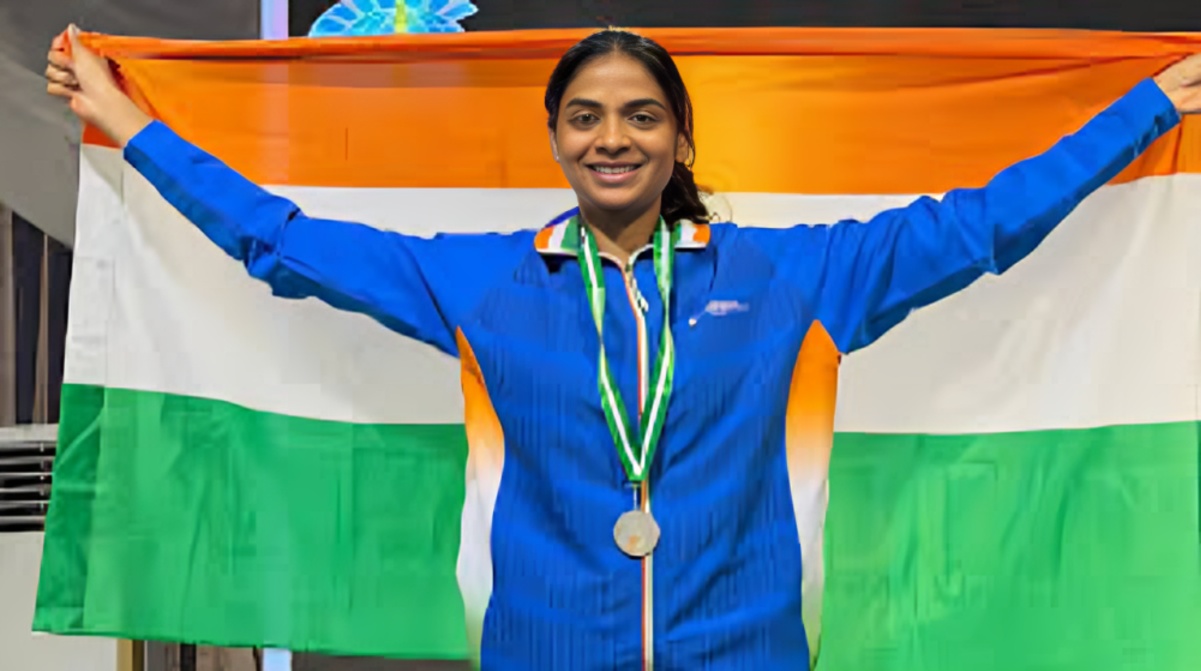
Indian Teqball player Quimcy Dsouza has moved one step closer to a historic medal at the Aichi-Nagoya Asian Games after reaching the women’s singles semifinals on her Asian Games debut.
The 24-year-old Indian produced two important victories on Friday, September 18, to finish at the top of her group and secure a direct place in the semifinal. Her campaign began with a major challenge against Japan’s top-seeded Yuina Sakamoto, followed by a second group-stage match against Cambodia’s Koemyean Dy.
Dsouza’s opening match against Sakamoto proved to be a closely contested encounter. The Indian lost the first game 10-12 but responded strongly in the second game, winning 12-11. She maintained her composure in the deciding game and secured a 13-11 victory to complete a 2-1 comeback win.
The victory was significant because Sakamoto entered the competition as the top seed and was also competing on home territory for Japan. Dsouza’s ability to recover after losing the opening game helped her begin her Asian Games campaign with an important victory.
Dsouza then continued her winning run against Cambodia’s Koemyean Dy. She won the first game 12-9 and followed it with a 12-7 victory in the second to complete a 2-0 result. The two victories enabled her to finish at the top of her group and earn a direct berth in the women’s singles semifinals.
The semifinal represents an important moment for Indian Teqball. The sport is making its debut at the Asian Games in Aichi-Nagoya, giving athletes an opportunity to establish the country's first continental medal record in the discipline.
Dsouza will face Indonesia’s Ima Sumaya in the women’s singles semifinal on Saturday. A victory in that match would guarantee her a place on the podium and secure India’s first Asian Games medal in Teqball. If she loses the semifinal, she will still have another opportunity to compete for a bronze medal in the subsequent medal match.
The Indian player’s performance has attracted attention because of the way she handled the pressure of her opening match. Recovering from a first-game defeat against a top-seeded opponent before winning the next two games required her to maintain control during a closely fought contest.
Her second victory was comparatively more straightforward. Against Koemyean Dy, Dsouza won both games and completed the match without dropping a game. The result ensured that she did not have to go through an additional qualification round before entering the semifinal stage.
Teqball combines elements of football and table tennis and is played on a specially designed curved table. The sport originated in Hungary and includes singles, doubles and mixed doubles formats. Its inclusion in the Asian Games provides another platform for the sport to expand its presence across Asia.
Dsouza is also competing in the mixed doubles competition at the Asian Games. She is partnering fellow Indian player Mohamed Anas Imran Beg. The Indian pair began their mixed doubles campaign with a victory against the Philippines’ Jhoana Abulencia and Prince Agustin. Their group-stage campaign also includes matches against Cambodia, Thailand and Kuwait.
India has additional representation in Teqball at the Asian Games. Mohamed Anas Imran Beg and Declan Marshall Gonsalves are competing in the men’s doubles event. According to The Times of India, the pair had previously won a bronze medal at the 2024 Teqball World Championships, which was India’s first medal in the sport at that world event.
Dsouza’s sporting background also includes football. The Indian Express reported that she is a Mumbai-born athlete who played football at the under-19 level before pursuing Teqball. She currently works as a test engineer for Decathlon. Her transition into Teqball has now taken her to the semifinal stage of the sport’s Asian Games debut.
The semifinal against Sumaya will therefore determine whether Dsouza can convert her strong opening campaign into a guaranteed medal. Regardless of the result, her qualification for the last four has already placed her among the leading performers in the inaugural Asian Games Teqball competition.
For India, the result also provides an opportunity to establish a medal record in a sport being introduced to the continental Games programme. A semifinal victory would guarantee a podium finish, while a defeat would leave Dsouza with a bronze-medal opportunity.
With two victories already secured, Dsouza enters the semifinal with momentum after defeating a top seed and then producing another straight-games win. Her next match against Indonesia’s Ima Sumaya will decide whether she advances to the medal stage in the women’s singles competition.
The outcome will be closely watched as India looks for its first Asian Games medal in Teqball.