
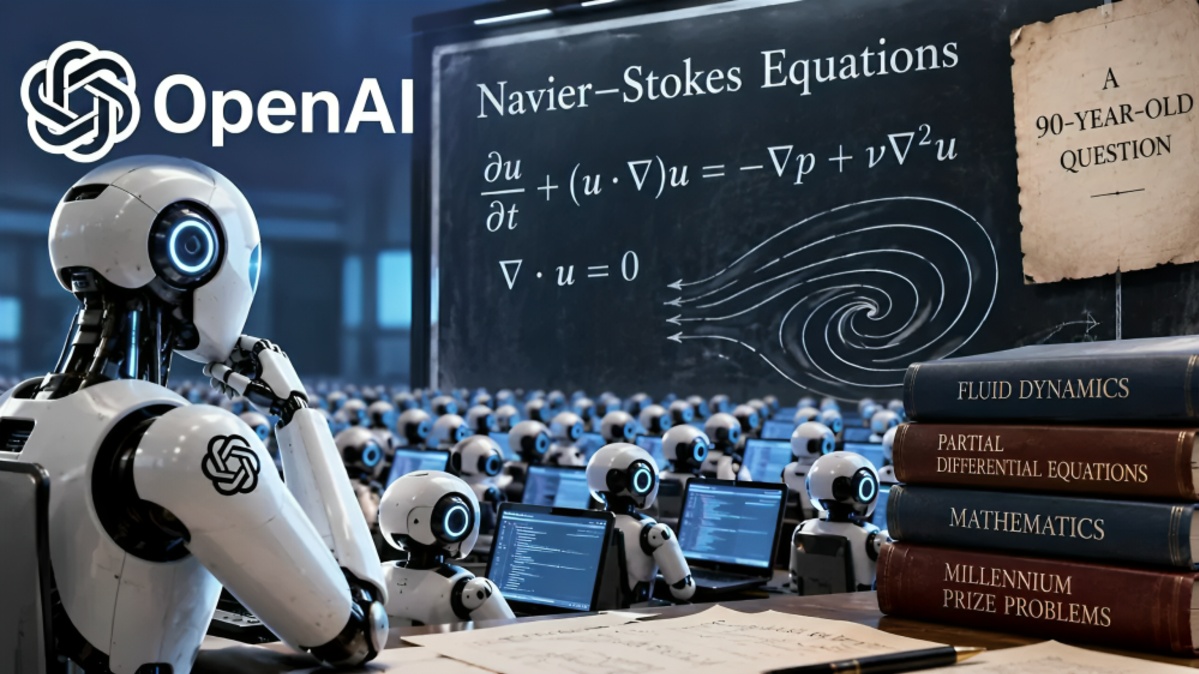
OpenAI has announced the formation of an independent Advisory Group on Mathematics and Artificial Intelligence as the company expands its work on AI powered mathematical research.
The announcement comes after OpenAI said that a new internal AI model has resolved more than 100 long standing open problems across most areas of mathematics. The company also said the same model produced a solution to the Navier Stokes existence and smoothness problem, one of the seven Millennium Prize Problems.
OpenAI said the new internal model began training on August 28, 2026. The company said the pace of its mathematical progress surprised mathematicians working within OpenAI and led to internal discussions about how the wider mathematical community should be informed about the rapid development.
The company has now established the independent mathematics advisory group to create a channel between OpenAI, mathematicians and the wider public. The group is hosted at the Institute for Advanced Study in Princeton, New Jersey.
According to OpenAI, the advisory group will help review emerging mathematical results produced with AI systems and assess their significance. It will also provide advice on how such results should be communicated and disseminated to the academic community.
The group will further advise on academic and professional standards related to mathematical research and consider ways in which AI tools can support mathematicians in research and learning.
OpenAI has said that the advisory group is intended to give mathematicians a voice as AI systems become increasingly capable of working on difficult mathematical questions. The company described the group as a bridge between the mathematical community and the broader public.
The development follows OpenAI's earlier announcement concerning its internal model and the Navier Stokes problem. On September 8, OpenAI published a paper describing what it called a solution to the Navier Stokes existence and smoothness problem.
The Navier Stokes equations are fundamental equations used to describe the motion of fluids. The associated existence and smoothness question has remained unresolved for decades and is one of the Millennium Prize Problems identified by the Clay Mathematics Institute. OpenAI said its internal system generated a proof and that the work was also formalised in Lean for verification.
OpenAI explained that its work on the Navier Stokes problem involved a large multi agent system. According to the company, approximately 10,000 concurrent agents were involved in the group that produced the reported resolution.
The company said the agents explored different approaches to the problem and that useful insights from different groups were later consolidated. OpenAI reported that the agents arrived at their resolution on September 5, approximately 88 hours after the first agents were launched for the effort.
The company also said Lean formalisation and verification required an additional 17 hours. OpenAI reported that the broader project involved millions of messages and hundreds of billions of output tokens.
The latest announcement goes beyond the Navier Stokes problem. OpenAI now says the same internal model has resolved more than 100 long standing open problems across most areas of mathematics.
However, the company has not publicly presented detailed solutions to all of those problems. The exact nature of each result, the mathematical methods used and the extent of independent verification remain important questions for researchers.
OpenAI's announcement comes amid wider discussion within the mathematics community about the role of artificial intelligence in mathematical research. Some mathematicians have raised concerns about AI systems rapidly producing solutions to major mathematical questions before researchers have enough time to examine, verify and understand the results.
An open letter titled A Severe Misalignment of AI in Mathematics has also raised concerns about using famous open mathematical problems as benchmarks for AI systems. The discussion has focused on whether the rapid production of solutions could affect traditional mathematical research and the development of deeper conceptual understanding.
The new advisory group is intended to provide a formal connection between OpenAI and the mathematical community as these issues develop. Its members include prominent mathematicians such as Timothy Gowers, Martin Hairer, Edward Witten, Camillo De Lellis, Nikhil Srivastava, Ulrike Tillmann, Ravi Vakil, François Charles and Melanie Matchett Wood.
The advisory group will examine the significance of emerging results and advise on their communication. It will also provide input on academic and professional standards for mathematical research involving AI.
The Institute for Advanced Study has emphasised that the group is advisory in nature. It does not have decision making authority over AI companies or direct control over the pace or direction of OpenAI's mathematical research. Responsibility for decisions remains with the respective companies.
OpenAI has also said that the responsible development of mathematical AI is important because advances in mathematics can have applications beyond the field itself. The company views AI assisted mathematical research as an area that could contribute to scientific and technological development.
The company wants mathematicians to have access to increasingly capable AI tools so that researchers can use them to investigate questions that they understand best and potentially develop new ideas.
At the same time, OpenAI has acknowledged that there are difficult questions surrounding the use of AI in mathematical research. These include how results should be evaluated, how discoveries should be communicated and how AI generated research can be incorporated into established academic practices.
The announcement therefore represents two developments at the same time. OpenAI is reporting rapid progress by its internal AI systems in mathematics, while also creating an external advisory structure to engage with mathematicians about the implications of that progress.
The claim that the model has solved more than 100 long standing problems remains an OpenAI-reported result and should be understood in that context. Independent mathematical scrutiny and verification will be important in determining the significance and validity of individual results.
For now, OpenAI's new mathematics advisory group will focus on reviewing emerging results, assessing their importance, advising on communication and helping establish responsible practices for AI supported mathematical research.
The development highlights the growing role of artificial intelligence in advanced mathematical research and the increasing need for collaboration between AI companies and academic mathematicians.