
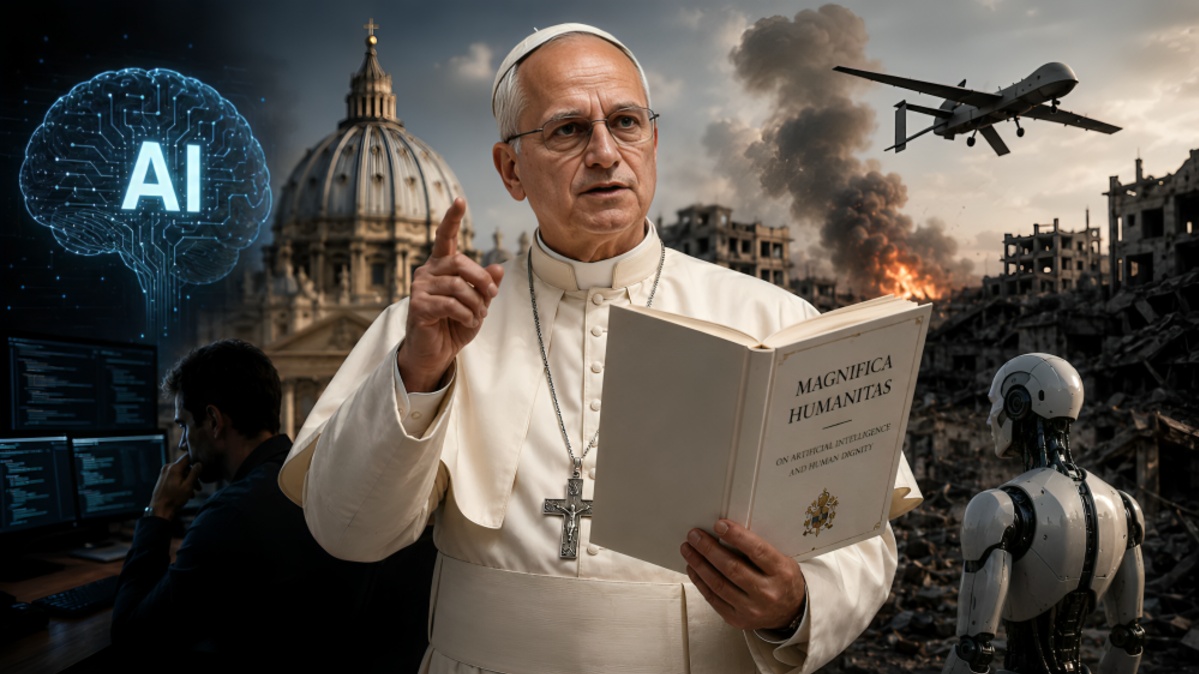
Pope Leo XIV has renewed his warnings about the potential risks of artificial intelligence, particularly its impact on conflict, social divisions, human dignity and international security. His latest comments came as governments, technology companies and researchers continue to debate how increasingly capable AI systems should be developed, regulated and used.
On September 21, 2026, Pope Leo sent a message to participants at the AI4Peace Global Biennial Symposium and International Conference in Rome. The conference focused on the opportunities and challenges presented by artificial intelligence in areas including conflict prevention, peacebuilding, human rights and global governance. The Pope's message was read by Father Andrea Ciucci, Chancellor of the Pontifical Academy for Life.
In his message, Pope Leo said that AI development should be guided by wisdom and charity in a world affected by conflict and division. He called for technological progress that serves the dignity of every person and strengthens relationships between people. He also encouraged researchers and policymakers to explore ways AI could support dialogue, reconciliation and solidarity rather than contribute to division.
The latest statement builds on concerns that Pope Leo has expressed throughout his papacy. In May 2026, he issued his first encyclical, titled Magnifica Humanitas, which addresses the implications of artificial intelligence for humanity, work, social life, governance and warfare.
In that document, the Pope argued that human intelligence, conscience and freedom should remain responsible for guiding technological innovation and determining its appropriate limits. He also noted that AI systems are developing rapidly and that understanding their operation remains limited even among their developers.
Pope Leo also addressed the use of AI in military systems. In the encyclical, he warned that the increasing availability of autonomous weapons could make armed conflict easier to initiate and less subject to human control. He called for the development and use of AI in warfare to be subject to strict ethical constraints, with the objective of protecting human dignity and preventing an arms race involving such technologies.
A particularly important part of his argument concerns decisions involving life and death. Pope Leo stated that moral judgment cannot simply be reduced to calculations and argued that lethal or irreversible decisions should not be entrusted to artificial systems. His position places human responsibility and ethical judgment at the centre of discussions about autonomous weapons and military AI.
The Pope has also called for stronger international oversight of artificial intelligence. In May, he urged governments to slow down and closely regulate AI development, warning that the technology could contribute to misinformation and conflict if its development is not accompanied by appropriate safeguards. Reuters reported that he called for international regulation and stronger legal frameworks surrounding AI.
The Vatican's position does not focus only on the potential dangers of AI. Pope Leo's September message also highlighted possible positive uses of the technology. At the AI4Peace conference, he encouraged participants to consider how AI could be used to support peacebuilding, dialogue and reconciliation. The Vatican said the objective should be to transform technological innovation into an instrument that benefits society and supports peaceful relations between communities.
The debate over AI and warfare has become increasingly important as governments and technology companies develop systems capable of analysing large quantities of information, supporting military planning and potentially operating with varying levels of autonomy. The use of AI in security and defence therefore raises questions about accountability, human oversight and the circumstances under which automated systems should be permitted to operate.
Pope Leo's concerns extend beyond military applications. His broader argument is that AI should not become a substitute for human responsibility. In his May encyclical, he discussed the possibility that excessive reliance on technological systems could affect human relationships, work and social structures. He argued that technological progress should remain connected to human dignity and the common good.
The Pope has continued this theme in recent public remarks. During his September 16 general audience, he warned about the growing dependence on technology and the possibility of people delegating to algorithms decisions that should remain matters of human conscience. The comments came amid wider discussions about how AI is changing relationships and social interaction.
The question of AI regulation is now being discussed internationally by governments, technology companies, researchers and civil society organisations. Different jurisdictions are considering approaches involving transparency requirements, safety testing, accountability mechanisms, data protection and restrictions on particular high-risk applications.
Pope Leo's intervention adds a religious and ethical perspective to that global debate. His statements do not constitute international law or a regulatory framework, but they contribute to discussions about how governments and technology companies should approach the development of increasingly powerful AI systems.
His warning about the possibility of AI contributing to prolonged conflict should therefore be understood within his broader argument for human oversight and ethical governance. He has not said that artificial intelligence will inevitably cause war. Rather, his statements have focused on the risks associated with allowing technological development, particularly military AI, to advance without sufficient ethical and political safeguards.
The Vatican has also emphasised that AI can be used constructively. At the AI4Peace conference, the focus was on examining how artificial intelligence could contribute to preventing conflicts, protecting human rights and supporting peace initiatives. Pope Leo encouraged participants to explore these possibilities while keeping human dignity at the centre of technological development.
As AI capabilities continue to expand, the debate is likely to involve increasingly difficult questions about who should control these systems, how responsibility should be assigned when automated decisions cause harm and what limits should apply to military applications.
Pope Leo's recent comments underline the Vatican's position that technological progress should remain accountable to human values. His call for international regulation and his warnings about AI in warfare reflect a broader demand for human oversight, ethical safeguards and responsible development as artificial intelligence becomes more deeply integrated into society.