
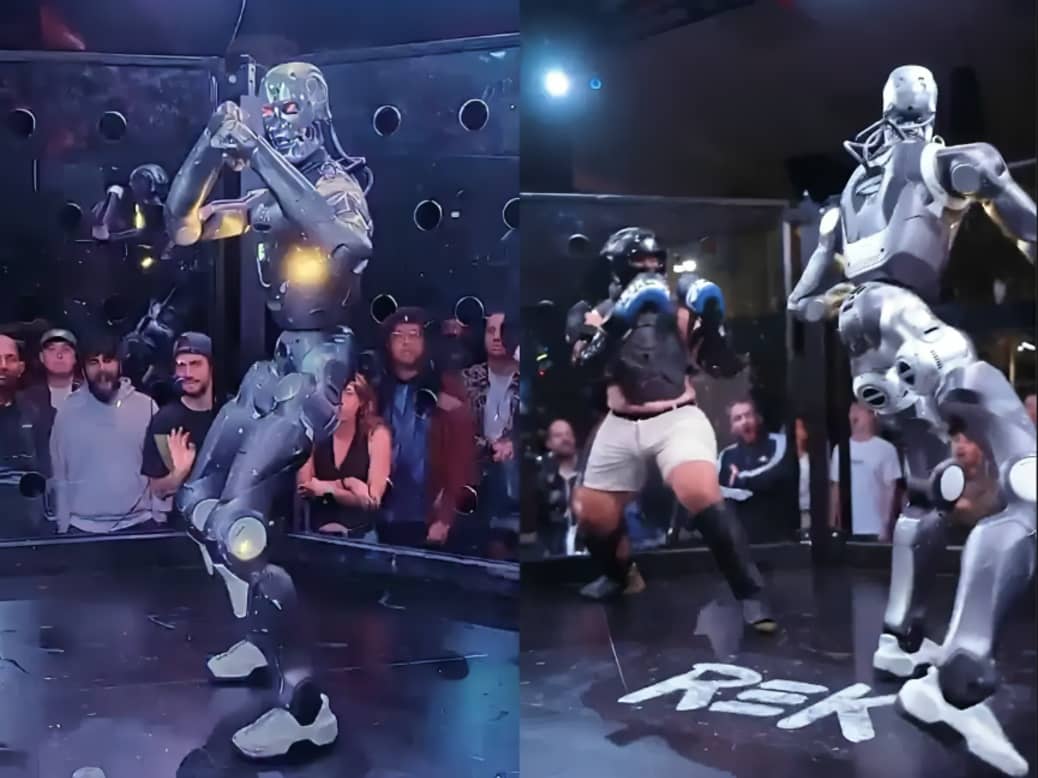
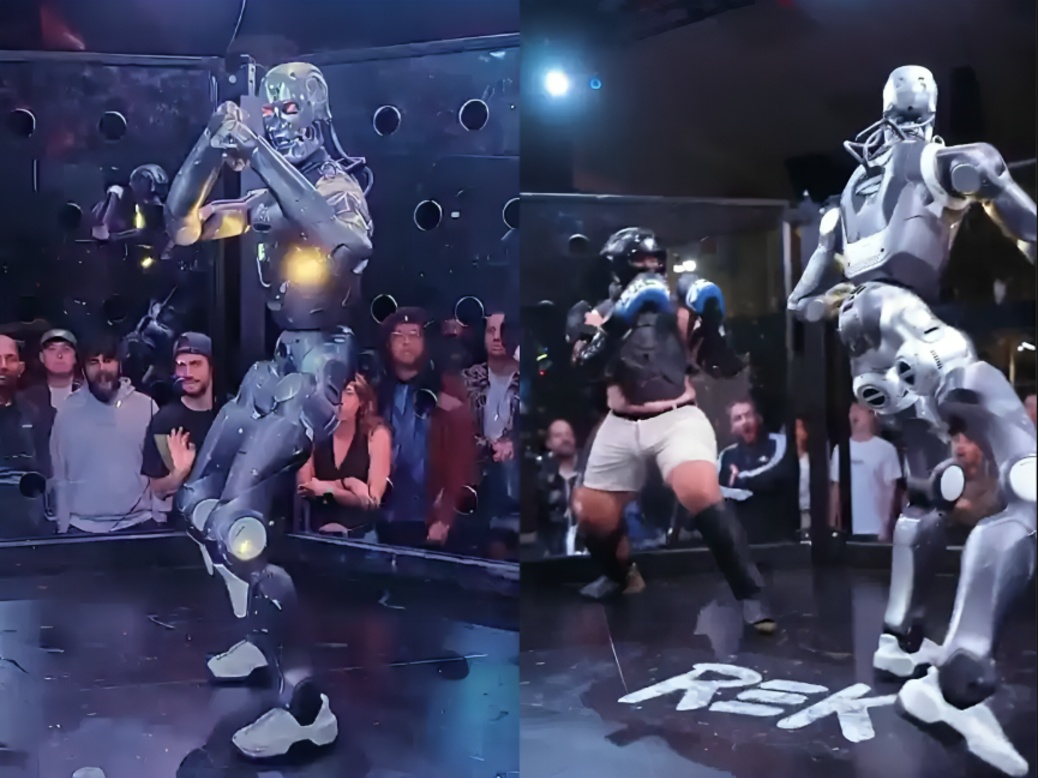
A bizarre human versus humanoid robot fight in San Francisco has attracted widespread attention online after footage showed a six foot robot exchanging blows with content creator Frankie LaPenna inside a fighting cage. The unusual event was organised by US robotics company REK and was presented as a demonstration connected to the company's virtual reality combat concept.
The video has attracted comparisons with science fiction films such as The Terminator because of the robot's appearance and the way it moved inside the cage. However, the real technology behind the demonstration is different from the autonomous machines often portrayed in science fiction.
The humanoid robot was remotely controlled by a human operator. This means that the machine was not independently deciding when to punch or kick its opponent. Instead, a person controlled its movements remotely, while robotic systems helped the machine maintain balance and perform physical movements.
The fight took place in San Francisco on September 18, 2026. REK described the event as its first human versus Terminator robot fight. The company has been developing a combat entertainment concept in which people can remotely operate humanoid robots and use them in fighting competitions.
The viral footage shows LaPenna entering the cage wearing protective equipment. The approximately six foot humanoid robot stands opposite him with a design intended to resemble a futuristic combat machine. Its appearance was further enhanced with a Terminator inspired head, adding to the science fiction look of the event.
At the beginning of the short video, LaPenna appears to approach the robot and throw several punches. The humanoid machine absorbs the attacks and begins responding with its own movements. The robot is then shown delivering several kicks.
One of the most widely shared moments in the video occurs when the robot delivers a powerful kick that sends LaPenna backwards across the cage. Another sequence shows the humanoid continuing to attack while LaPenna struggles to remain in the fight. The footage ends before the complete event can be assessed from the publicly available clip.
The appearance of the robot has been another major reason for the video's popularity. Reports identify the machine as an EngineAI T800 humanoid platform. Its design resembles the fictional T 800 associated with The Terminator franchise, although the real machine is a remotely operated robot rather than an artificial intelligence system similar to the one depicted in the films.
The distinction between remote control and autonomous operation is important when considering what the demonstration actually shows. The robot's physical capabilities are being demonstrated through a human operator. The event therefore provides an example of teleoperated humanoid robotics rather than evidence that an independent AI system has learned to fight a human without human control.
REK's broader concept involves humans controlling humanoid robots remotely, including through virtual reality technology. The company has used robot versus robot combat as part of its entertainment and gaming concept. The LaPenna event takes that idea a step further by placing a human participant directly against one of the machines.
The event has also raised questions about the future use of humanoid robots in entertainment. Humanoid robotics has advanced considerably in recent years, with companies developing machines capable of walking, maintaining balance, carrying objects and performing increasingly complex movements. Demonstrations involving physical interaction can provide a way to showcase these capabilities to a wider audience.
At the same time, a short viral video does not provide enough information to determine how powerful, autonomous or reliable a humanoid robot is in real-world conditions. The fight was an organised demonstration, and the robot was operated by a person. The footage also does not provide complete information about the rules, duration or final result of the entire event.
There is some uncertainty surrounding the outcome of the bout. The widely circulated footage ends with LaPenna appearing to be knocked down by the robot. However, REK later indicated that LaPenna continued and claimed that he eventually defeated the robot. Other reports have noted that the publicly available footage does not show enough of the complete event to independently establish a conventional winner or final result.
This has added another layer of interest to the viral video. While viewers have focused on the robot's powerful kicks, the larger technological significance lies in the ability of a full sized humanoid platform to be remotely operated in a dynamic physical environment.
The demonstration also highlights the challenges involved in controlling humanoid robots. Unlike wheeled machines, humanoid robots need to maintain balance while moving their arms and legs. During a fight style demonstration, the robot must also respond to movement, maintain its position and execute rapid physical actions without losing stability.
For robotics companies, these capabilities can have applications beyond entertainment. Teleoperated humanoid machines could potentially be explored for situations where humans need to control machines remotely, although the technology shown in a staged combat event should not automatically be considered proof of readiness for such applications.
The viral video has also renewed public discussion about how human like robots could become part of everyday life. Humanoid machines are increasingly being developed for industrial, research and service applications. Their ability to move through environments designed for humans is one of the reasons researchers and companies continue to explore the technology.
However, the REK demonstration should be viewed in its proper context. It was an entertainment focused event involving a remotely controlled robot rather than an autonomous machine independently choosing to fight. The Terminator comparisons are largely based on the robot's appearance and the dramatic nature of the footage rather than its actual level of artificial intelligence.
The event nevertheless demonstrates how quickly humanoid robotics is becoming a subject of mainstream public attention. A few years ago, a full sized robot physically interacting with a human inside a fighting cage would have seemed largely fictional. Today, companies are using such demonstrations to explore new forms of entertainment and remote interaction.
As humanoid robots become more capable, similar demonstrations are likely to generate further discussion about safety, human control and the possible uses of the technology. For now, the San Francisco event offers a striking visual example of remotely controlled robotics rather than evidence of an autonomous Terminator style machine.