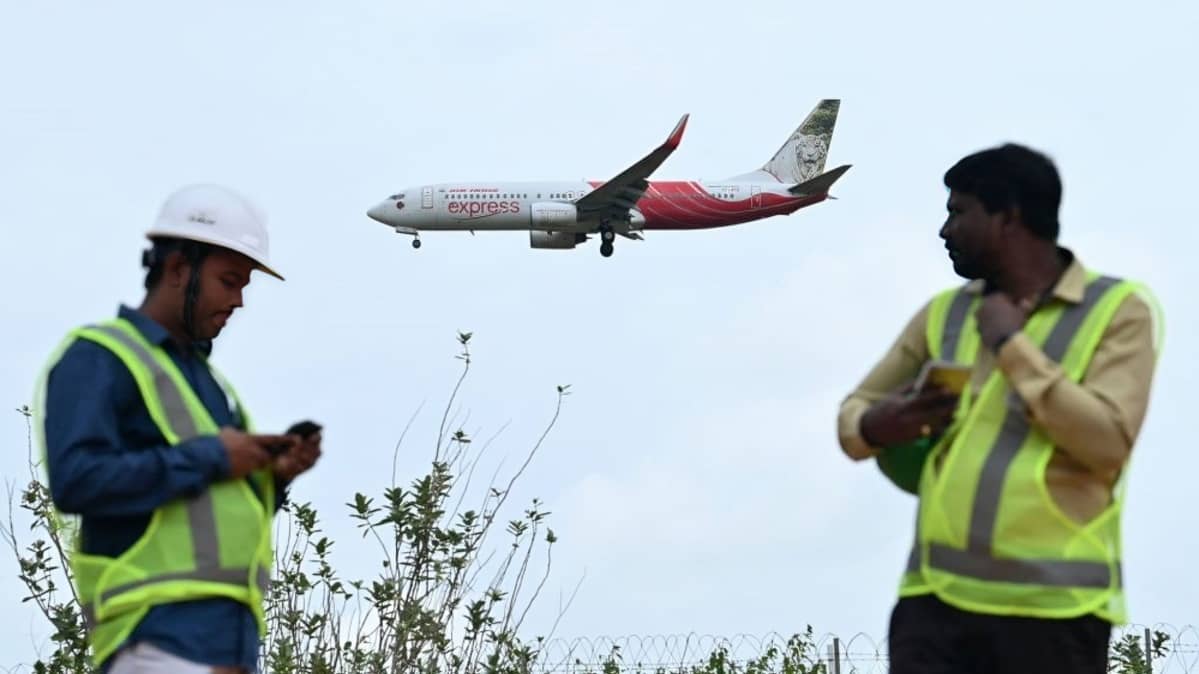
The investigation into a bomb threat involving an Air India Express flight from Dammam to Delhi has intensified after investigators compared handwriting samples collected from everyone who was on board the aircraft.
The flight, operating as Air India Express IX 170, was diverted to Ahmedabad on August 31 after a threatening message was discovered on a tissue paper inside one of the aircraft's lavatories. The message reportedly contained the words bomb red 430 along with a drawing of a box, both written in black ink.
The discovery prompted the aircraft to be diverted from its scheduled route to Delhi and land at Ahmedabad as a precautionary security measure. The Bomb Threat Assessment Committee was alerted, and established security procedures were initiated after the aircraft landed.
According to reports, investigators collected handwriting samples from all 40 people on board. This included 32 passengers, four cabin crew members and four pilots. The samples were obtained to determine whether the handwriting on the tissue matched that of anyone who had travelled on the flight.
The handwriting comparison has reportedly brought one crew member under scrutiny. Investigators are also examining the possible involvement of a passenger. However, authorities have not conclusively identified either person as the individual responsible for writing the threatening message.
The investigation therefore remains ongoing, and the reported focus on a crew member should not be interpreted as confirmation of guilt.
The aircraft was carrying 32 passengers along with eight crew members. After landing at Ahmedabad airport, the passengers were safely taken off the aircraft while security agencies carried out detailed checks.
The aircraft and baggage were searched as part of the security response. No explosive device or other suspicious material was reportedly found during the checks.
Air India Express subsequently arranged another aircraft with a new crew to transport the passengers to Delhi. The passengers were flown onward after the necessary security procedures had been completed.
The crew members from the diverted aircraft remained in Ahmedabad while investigators conducted questioning and collected evidence. Reports said that several crew members were later permitted to leave the city, while one crew member continued to remain under examination.
The investigation is focused on establishing who wrote the threat message and how the tissue paper was placed inside the aircraft lavatory.
The handwriting examination was an additional investigative step following the standard security response to the threat. Investigators sought to compare the writing on the recovered tissue with samples produced by people who had access to the aircraft during the flight.
Reports said investigators asked the airline to provide the original tissue paper containing the message so that it could be compared with handwriting samples. Passengers were reportedly asked to provide multiple samples using the same type and colour of writing instrument.
The use of handwriting comparison highlights the effort by investigators to determine whether the threat originated from someone travelling on the aircraft or from another source.
The incident began when a crew member discovered the tissue paper inside an aircraft lavatory during the Dammam to Delhi flight. The message was treated as a specific bomb threat, resulting in the aircraft being diverted to Ahmedabad.
Air India Express said that the Bomb Threat Assessment Committee was alerted immediately after the threat was received. The airline also said that all necessary security procedures were initiated and that passengers were safely disembarked after the aircraft reached Ahmedabad.
Security agencies subsequently conducted checks of the aircraft, passenger belongings and baggage. The aircraft was kept away from normal operations until the required security clearance procedures were completed.
Bomb threats against aircraft are treated as serious security matters even when they later turn out to be hoaxes. Such incidents can lead to flight diversions, delays, additional security checks and significant operational disruption.
For airlines, a bomb threat can require an aircraft to be diverted to another airport where specialised security procedures are carried out. Passengers may have to leave the aircraft, while security personnel inspect the cabin, baggage and other areas before the aircraft can return to service.
In this case, the diversion to Ahmedabad allowed authorities to carry out the required security checks. The passengers were eventually provided with an alternative aircraft to continue their journey to Delhi.
The investigation now appears to be moving beyond the initial security response and towards identifying the person responsible for the handwritten message.
Investigators are expected to examine several factors, including the handwriting comparison, movements of passengers and crew, access to the lavatory and other available evidence. The objective is to establish whether the message was deliberately placed as a hoax threat and, if so, who was responsible.
The reported involvement of a crew member has attracted attention because crew members have access to different parts of an aircraft during a flight. However, investigators have not publicly confirmed that the crew member under scrutiny wrote the note.
A passenger is also reportedly being examined as part of the investigation. This indicates that authorities are continuing to consider multiple possibilities rather than limiting the inquiry to one individual.
The distinction between being questioned or coming under investigation and being found responsible is important. At this stage, there has been no conclusive public confirmation identifying the author of the threat note.
Air India Express has said that it is cooperating fully with law enforcement agencies investigating the incident. The airline has also condemned conduct that compromises or has the potential to compromise the safety of passengers, crew members and flight operations.
The airline indicated that appropriate action would be taken based on the findings of the investigation.
The incident also comes amid wider concerns over false or hoax bomb threats affecting aviation operations in India. Security agencies and airlines have been working to strengthen responses to such threats while ensuring that genuine security risks are identified quickly.
The Ahmedabad incident demonstrates the multiple stages involved in responding to a reported aircraft threat. The initial priority is to protect passengers and crew, divert or land the aircraft safely when required, secure the aircraft and conduct a comprehensive search.
Once the immediate threat is addressed, investigators can focus on determining the origin of the message and identifying the person responsible.
In the Air India Express case, the handwriting examination involving all 40 people on board was conducted as part of that wider investigation. The reported identification of similarities has provided investigators with additional leads, but further verification is required before any conclusion can be reached.
The investigation will ultimately determine whether the message was written by a passenger, a crew member or another person who had access to the aircraft.
For now, the aircraft's diversion and the subsequent security checks ensured that all passengers and crew members were safely removed from the potentially affected situation. The absence of an explosive device means the immediate physical threat was not confirmed, but the act of placing a bomb warning on an aircraft remains a serious security concern.
Authorities are continuing to examine the available evidence, while Air India Express is cooperating with the investigation.
The case underlines the importance of aviation security procedures and the need to treat every specific threat seriously. It also highlights the challenge faced by investigators in distinguishing genuine threats from hoaxes and identifying those responsible without reaching conclusions before the investigation is complete.
The next stage of the probe will focus on establishing whether the handwriting evidence can be conclusively linked to an individual and whether other evidence supports that finding.