Chief Justice of India Surya Kant has drawn attention to the enormous scale of the global money laundering problem, saying that authorities recover less than one rupee for every Rs 100 involved in illicit financial activity.
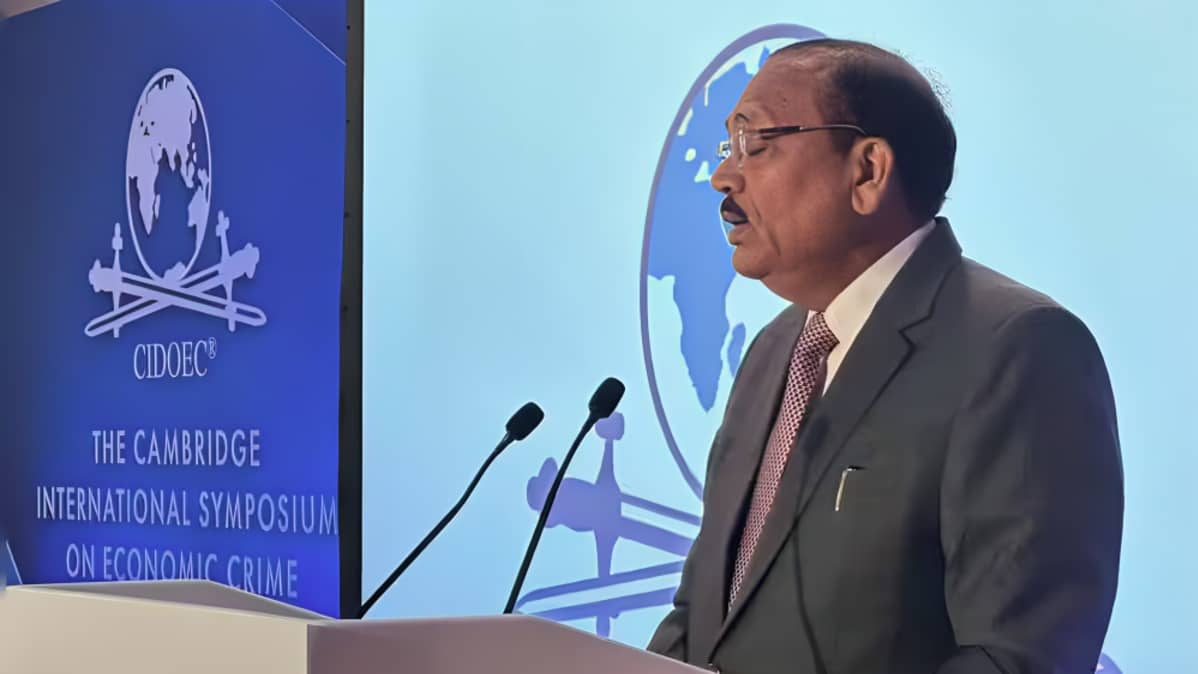
CJI Surya Kant made the remarks while addressing the 43rd International Symposium on Economic Crime in Cambridge. His address focused on the challenges faced by law enforcement agencies and courts in tracing, confiscating and recovering assets generated through economic offences.
According to the Chief Justice, the recovery rate of illicit wealth remains extremely low despite the existence of extensive legal and regulatory systems in many countries. He said that sophisticated methods used by economic offenders, combined with difficulties in international cooperation, make it difficult for authorities to trace and recover illegally acquired assets.)
The CJI used the comparison of one rupee being recovered for every Rs 100 laundered to highlight the scale of the problem. He said that a significant portion of illicit wealth remains beyond the reach of enforcement agencies because criminals frequently move money through complex financial structures and across multiple jurisdictions.
Money laundering generally involves concealing the illegal origin of funds by moving them through financial transactions or assets in an attempt to make the money appear legitimate. Because such activity frequently crosses national borders, authorities often depend on cooperation between different countries to obtain records, identify suspects and recover assets.
International cooperation is therefore a critical part of financial crime investigations. However, CJI Surya Kant highlighted the difficulties that arise when economic offenders move to jurisdictions outside the country where the alleged offence was committed.
Extradition is another major challenge. When an accused economic offender is located abroad, the country seeking prosecution must generally rely on legal procedures and cooperation from the country where the individual is staying. Differences in laws, lengthy court proceedings and diplomatic or administrative procedures can delay the process.
The Chief Justice also pointed to the difficulties involved in recovering assets located overseas. Even when an investigation establishes that assets are connected to alleged economic offences, bringing those assets back can require complex legal proceedings and cooperation between agencies in different countries.
In his address, CJI Surya Kant referred to India's long history of dealing with economic offences and financial misconduct. He cited Kautilya's Arthashastra to illustrate that concerns about misuse of public money and illicit enrichment are not new. According to the CJI, the ancient text recognised the importance of audits, checks and confiscation in preventing corruption and misuse of state resources.
The reference to the Arthashastra was used to underline the continuing importance of accountability in financial administration. Although financial crimes have become more technologically sophisticated, the fundamental challenge of preventing the misuse of public and private wealth remains.
Modern money laundering networks can involve multiple bank accounts, shell companies, cross-border transactions, digital platforms, real estate and other assets. These arrangements can make it difficult for investigators to establish the complete flow of funds.
CJI Surya Kant stressed that legal frameworks alone cannot solve the problem. Effective enforcement also requires timely exchange of information, cooperation between investigating agencies, efficient judicial processes and greater coordination between countries.
India has established various legal and institutional mechanisms to combat money laundering and economic offences. However, cases involving assets and accused persons located overseas can present additional legal and practical challenges.
The Chief Justice's remarks come amid a broader international effort to strengthen action against financial crime. Governments and international organisations have increasingly focused on transparency in financial transactions, beneficial ownership, cross-border asset recovery and information sharing.
Asset recovery is particularly important because financial penalties and criminal convictions may have limited deterrent value if illegally acquired wealth remains outside the reach of authorities. Recovering the proceeds of crime can also help restore public resources and strengthen confidence in the rule of law.
CJI Surya Kant's comments therefore emphasised the gap between the scale of illicit financial activity and the amount of money actually recovered by authorities. The comparison of one rupee recovered for every Rs 100 involved in money laundering was intended to demonstrate the magnitude of that gap.
The Chief Justice also highlighted the need to address the problem collectively rather than through isolated national efforts. Since illicit funds can move rapidly across borders, effective action often depends on countries sharing information and assisting each other in investigations, prosecutions and asset recovery.
The Cambridge symposium brought together experts and legal professionals working on economic crime and related issues. The discussions focused on how legal systems can respond more effectively to increasingly complex forms of financial misconduct.
For India, the remarks are significant because economic offences often involve both domestic and international dimensions. Strengthening cooperation with foreign jurisdictions can help Indian authorities track assets, obtain evidence and pursue economic fugitives facing allegations.
At the same time, due process remains essential in financial crime cases. Allegations must be investigated thoroughly, evidence must be tested through legal procedures and the rights of accused persons must be protected throughout the judicial process.
CJI Surya Kant's speech ultimately highlighted a central challenge facing governments around the world. While money laundering networks have become increasingly sophisticated and international, asset recovery mechanisms remain comparatively limited.
His call for stronger international cooperation, better enforcement and more effective asset recovery reflects the wider global effort to ensure that financial crime does not allow illegally acquired wealth to remain beyond the reach of law enforcement agencies.