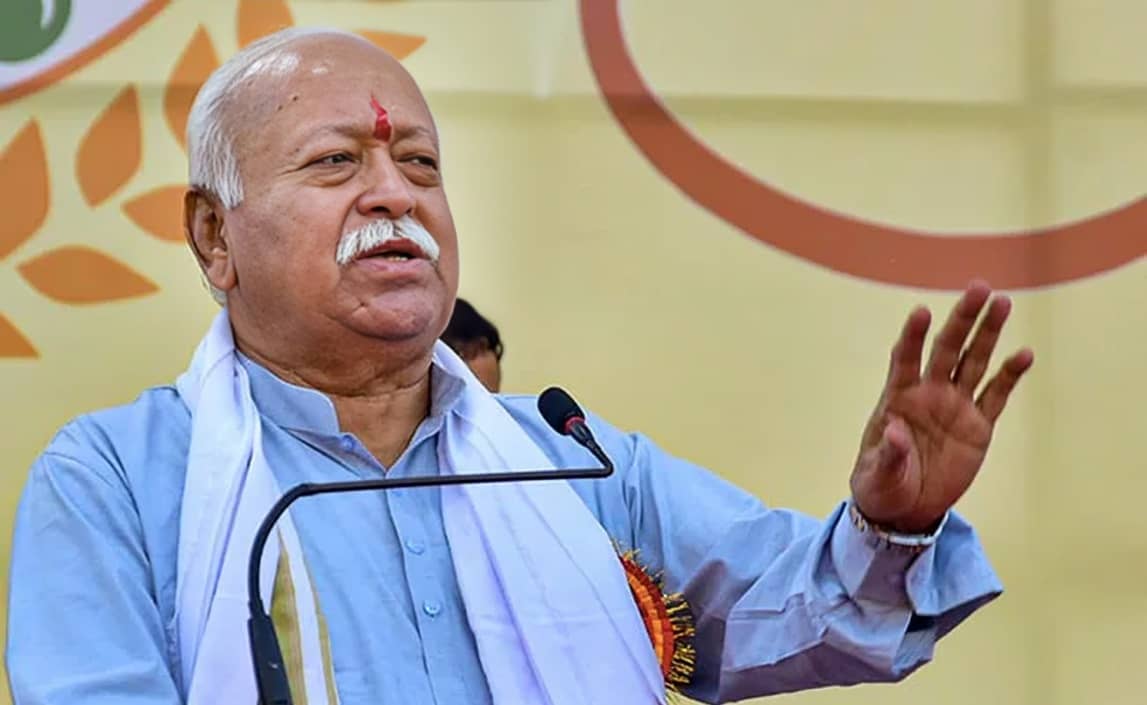
RSS chief Mohan Bhagwat has said that India became a Vishwaguru through selfless service to humanity rather than through the pursuit of superpower status. He made the remarks while addressing the Hindu Vishwa Bandhu, Embrace the World in Friendship gathering in Toronto, Canada.
Bhagwat said India’s historical influence did not come from territorial expansion or the desire to dominate other countries. Instead, he attributed the country’s civilisational standing to its tradition of sharing knowledge, helping others and serving humanity. He argued that India’s character and values made it a Vishwaguru rather than a Mahashakti.
The RSS chief placed particular emphasis on the idea that India has historically welcomed people facing persecution, conflict and difficult circumstances. According to Bhagwat, the country’s civilisational traditions include providing refuge and extending support to people in need.
He also spoke about diversity and the importance of respecting different traditions and ways of life. Bhagwat presented India’s approach as one in which different communities can retain their distinct identities while remaining part of a broader sense of unity.
A key theme of his address was the principle of Vasudhaiva Kutumbakam, commonly understood as the idea that the world is one family. Bhagwat linked this philosophy to India’s historical outlook and argued that the country’s global role should continue to be shaped by friendship, cooperation and service.
The remarks were made during Bhagwat’s ongoing international outreach programme in North America. His recent engagements in the United States and Canada have focused on Indian civilisation, social harmony, diversity and the role of the Indian diaspora.
In Toronto, the RSS chief sought to explain how he believes India’s global influence developed over centuries. He distinguished the concept of Vishwaguru from that of a conventional superpower. A superpower is generally associated with economic, military and geopolitical strength, whereas Bhagwat presented Vishwaguru as a position earned through knowledge, moral values and service to others.
Bhagwat said that India had historically influenced the world by sharing its knowledge and contributing to humanity. His comments therefore placed greater emphasis on cultural and civilisational influence than on military or political power.
He also referred to India’s tradition of accepting people who sought safety from persecution and conflict. This was presented as evidence of what he described as the country’s long-standing culture of openness and humanitarian support.
The Toronto gathering also focused on friendship and engagement among communities. The programme was organised under the theme Hindu Vishwa Bandhu, Embrace the World in Friendship, reflecting its emphasis on dialogue and global outreach.
Bhagwat’s comments come during the RSS centenary period and as the organisation increases its engagement with Indian communities living outside the country. The RSS has sought to present its activities internationally through discussions on Indian culture, social unity and community participation.
His remarks have also attracted attention because they address the question of how India should understand its role in the changing international order. India is increasingly described in geopolitical discussions in terms of its economic growth, military capabilities and diplomatic influence. Bhagwat, however, stressed that national strength should not be measured only through conventional indicators of power.
According to his view, the more important measure is the contribution a country makes to humanity. He argued that service and compassion can provide a more lasting form of influence than the pursuit of dominance.
Bhagwat’s emphasis on diversity was another significant part of the address. He highlighted the coexistence of different communities and traditions as part of India’s civilisational experience. The message was that unity does not necessarily require uniformity and that diversity can coexist with a shared sense of belonging.
His statements also reflected themes he has discussed during his recent international engagements, including social harmony, human unity and the acceptance of different faiths and communities.
The speech comes amid wider international attention on the RSS and its ideology. The organisation has faced criticism from some groups over its political and ideological positions, while the RSS has consistently described itself as a cultural organisation working for social unity. Bhagwat’s international speeches have therefore been closely followed by supporters and critics alike.
The Toronto address focused primarily on India’s civilisational identity and its relationship with the wider world. Bhagwat presented India’s historical role as one based on helping others, sharing knowledge and maintaining a spirit of friendship.
The idea of Vishwaguru remains a subject of political and cultural debate in India. Supporters of the concept view it as a reference to India’s historical contributions to philosophy, knowledge, science and culture. Critics may interpret it differently depending on their views of India’s contemporary political and social direction.
Bhagwat’s remarks in Toronto therefore offered a particular perspective on India's global role. Rather than describing national greatness in terms of military or economic dominance, he argued that India’s influence should be rooted in service, humanity, knowledge and respect for diversity.
The speech also underlined the importance Bhagwat places on the Indian diaspora in communicating India’s civilisational ideas abroad. As Indian communities continue to grow across North America, such events provide platforms for discussions about culture, identity, heritage and India’s role in the global community.
Overall, Bhagwat’s Toronto message centred on the view that India’s greatest strength lies not simply in becoming a powerful nation, but in contributing positively to humanity. His emphasis on service, friendship, refuge and diversity formed the central theme of his argument that India’s civilisational identity is what gives it the potential to act as a Vishwaguru.