
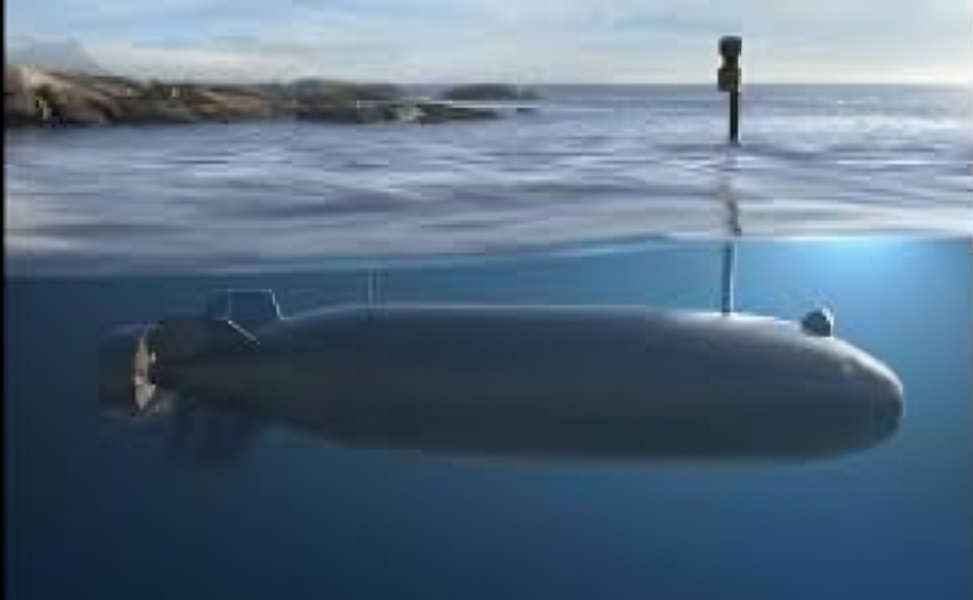
China appears to be developing a large surface vessel that could serve as a dedicated mothership for extra-extra-large uncrewed underwater vehicles, according to recent satellite imagery and assessments by naval analysts.
The vessel has been observed under construction at the Hudong-Zhonghua shipyard in Shanghai. Naval News, which first reported the development, assessed the ship as a likely purpose-built platform for launching, recovering and supporting large uncrewed submarines. Other reports based on commercial satellite imagery have reached similar conclusions about the vessel's possible role.
The ship is estimated to be approximately 205 metres long, equivalent to about 673 feet, and around 27 metres wide. Its unusual design has attracted attention because several features appear to be suited to handling large underwater vehicles rather than conventional surface-ship operations.
One of the most notable features is a large well deck at the stern. According to the available imagery assessments, the area includes a cradle that can be lowered into the water. The reported system uses multiple vertical lifting arms to position the cradle for launching and recovering underwater vehicles.
The vessel also appears to have a large enclosed hangar located forward of the well deck. Naval News estimates that the hangar could potentially accommodate up to four of China's largest known uncrewed underwater vehicles, although the exact capacity and final configuration cannot be confirmed while the vessel remains under construction.
The suspected mothership is significant because China has already been associated with the development and testing of unusually large uncrewed underwater vehicles. These systems are generally described as extra-extra-large uncrewed underwater vehicles, or XXLUUVs.
Two large Chinese underwater vehicles have been observed during testing in the Hainan area. Naval News estimates their lengths at approximately 35 and 45 metres. These systems are considerably larger than many existing military unmanned underwater vehicles and are part of China's expanding work on autonomous maritime platforms.
The large size of such vehicles can provide space for additional sensors, energy storage and mission equipment. However, their exact operational capabilities remain uncertain because China has not publicly released comprehensive specifications for the systems.
The potential mothership could address an important logistical challenge associated with large autonomous underwater vehicles. Very large underwater drones require specialised facilities for transportation, launch, recovery, maintenance and storage. A dedicated surface ship could combine several of these functions into a single mobile platform.
At present, the large Chinese underwater vehicles have reportedly been associated with specialised floating docks during testing. Those facilities can support launch and recovery operations but are less flexible than a purpose-built vessel capable of moving between different operating areas.
A mobile mothership could potentially transport the underwater vehicles to locations farther from their normal testing facilities. It could also provide maintenance and support services while the vehicles are deployed.
The possible missions of the XXLUUVs remain uncertain. Defence analysts have discussed roles such as intelligence, surveillance and reconnaissance, seabed monitoring, mine-related operations and other long-duration underwater missions. These possibilities are assessments rather than confirmed operational assignments.
The size of the vehicles could allow them to carry sophisticated sensors and other modular equipment. However, there is currently no public confirmation that the suspected Chinese systems are equipped with particular weapons or that the vessel itself is intended for a specific combat mission.
The suspected mothership is also notable because of its overall design. It reportedly resembles an amphibious transport vessel in some respects, but its stern arrangement and internal hangar appear to have been configured around underwater vehicle operations.
The vessel's estimated dimensions make it substantially larger than many conventional support ships used for smaller unmanned underwater systems. Its approximately 205-metre length would provide considerable internal and deck space for equipment, personnel and maintenance activities.
Naval News has described the vessel as potentially the world's first purpose-built mothership specifically designed around the deployment of submarine-sized uncrewed vehicles. That assessment is based on observed design features and available satellite imagery rather than an official Chinese announcement.
China's broader investment in autonomous underwater technology has also been documented by defence and naval analysts. The United States Naval Institute reported in March 2026 that China was testing two massive XXLUUVs measuring more than 40 metres and was developing a wider range of autonomous underwater systems.
These developments form part of a wider expansion of China's unmanned maritime capabilities. Autonomous underwater vehicles can remain underwater for extended periods and can potentially conduct missions that would otherwise require crewed submarines or specialised research vessels.
The suspected mothership could therefore become an important support element if the XXLUUV programme develops into an operational capability. Instead of requiring the large underwater vehicles to operate only from fixed coastal facilities, a mobile support ship could provide greater flexibility.
However, several details about the vessel remain unknown. Satellite imagery cannot establish its final propulsion system, onboard sensors, communications architecture, command systems or operational mission. Its final configuration could also change before construction is completed.
China has not publicly confirmed that the vessel is a military mothership for XXLUUVs. Consequently, descriptions of its intended purpose should currently be treated as assessments based on observable design characteristics and satellite imagery.
The development nevertheless highlights the growing importance of unmanned underwater technology in modern naval planning. Large autonomous underwater vehicles are being examined by several countries for long-duration maritime missions, while advances in batteries, sensors, communications and autonomous navigation are expanding their potential applications.
For China, a dedicated support platform could provide a way to integrate these large underwater systems into a broader maritime operating structure. It could potentially transport, launch, recover and maintain multiple underwater vehicles without relying entirely on shore-based facilities.
The reported vessel remains under construction, meaning its final capabilities and operational status are not yet known. Further satellite imagery and official information may provide additional details as construction progresses.
For now, the available evidence indicates that China is building an unusually large surface vessel at the Hudong-Zhonghua shipyard in Shanghai. Its approximately 205-metre length, stern well deck, recovery cradle and large internal hangar have led naval analysts to assess that it could be designed as a mothership for China's large uncrewed underwater vehicles.
The development is being closely watched because it could represent another step in China's efforts to expand autonomous maritime capabilities. However, the vessel's exact role and the future missions of the underwater drones it may support remain unconfirmed.