
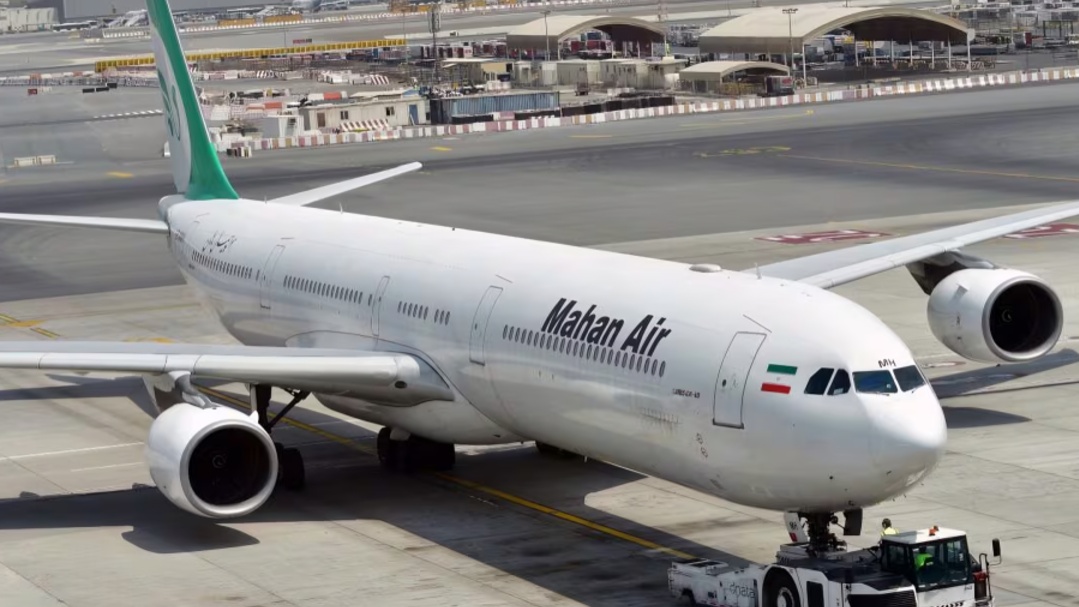
Iran’s international aviation sector is facing increasing pressure as new US sanctions begin to affect airlines, airports and companies that provide essential services to Iranian carriers. Flights connecting Iran with Baghdad and Muscat have been cancelled or suspended, while authorities in Iran are discussing alternative arrangements for some routes.
The latest developments follow a warning from US Treasury Secretary Scott Bessent that companies providing services to Iranian airlines could face secondary sanctions. Washington has expanded its sanctions campaign against Iran’s aviation industry as part of a broader effort to restrict the country’s access to international financial and commercial networks.
The United States Treasury Department announced on September 8 that it had sanctioned 36 targets connected with Iran’s aviation sector. The department said the targeted networks supported Iran’s ability to move weapons, personnel and other cargo and helped the country obtain aircraft and sensitive aviation technology. The action included sanctions against 27 Iranian airlines.
Bessent subsequently warned that the restrictions could effectively prevent Iranian airlines from receiving essential services at airports around the world. He said companies that provide fuel, landing services or ticketing assistance to Iranian carriers could face consequences under the US financial system.
The warning has already begun affecting international flight operations.
According to reports, flights from Iran to Baghdad and Muscat were cancelled from Wednesday, September 23. Iran’s Civil Aviation Organization said discussions were taking place with Iraq to find an alternative arrangement for flights originally scheduled to land in Baghdad.
One proposal involves redirecting some Baghdad-bound flights to Najaf International Airport in Iraq. Najaf is an important destination for Iranian travellers, particularly religious pilgrims visiting major Shia Muslim holy sites.
Iraq’s decision is significant because the country is one of the most important international destinations for Iranian airlines. Iranian carriers regularly transport passengers between Iran and Iraq, including pilgrims travelling to religious sites.
Reuters reported that Iraq had ordered its civil aviation authority to suspend Iranian flights to Baghdad following the US threat to sanction airports and service providers that support Iranian carriers. Two sources familiar with the matter said the suspension was expected to begin from midnight on September 23.
Iranian aviation officials have also been in discussions with Oman. Reports said Iranian passengers were not being accepted at the affected Omani airport, while consultations continued between the two countries regarding aviation arrangements.
The restrictions do not currently mean that every Iranian international flight has stopped. Iranian aviation officials said other international services, including flights to Istanbul, were continuing according to schedule. This distinction is important because reports describing the situation as a complete global shutdown of Iranian aviation would be broader than the currently confirmed developments.
The US measures are designed to make it more difficult for Iranian airlines to operate internationally by targeting the support services they need. An airline requires fuel, airport handling, maintenance, ticketing arrangements and other services to operate flights outside its home country.
If companies providing these services fear losing access to the US financial system, they may choose to stop dealing with Iranian airlines even when they are located outside the United States. This is the mechanism behind secondary sanctions and could significantly reduce the number of airports willing to accept Iranian carriers.
The Wall Street Journal reported that Iranian airlines were already experiencing cancellations and restrictions in several countries, including Azerbaijan, Iraq, Georgia, Turkey and Oman. The report said foreign service providers were becoming increasingly cautious about providing assistance to Iranian carriers because of the potential consequences of US sanctions.
Iran’s aviation industry has faced international sanctions for many years. The country has also experienced difficulties obtaining new aircraft, spare parts and aviation technology because of restrictions affecting trade with Western companies.
The latest sanctions could therefore create additional operational problems for Iranian carriers. Airlines may have difficulty finding airports where they can refuel and obtain ground-handling services. They could also face problems arranging ticket sales, maintenance and other commercial activities.
Mahan Air, one of Iran’s major private airlines, has already suspended several international services amid the increasing pressure. The Financial Times reported that the airline suspended flights to Istanbul, Ankara and Muscat as US sanctions expanded to companies supporting Iran’s aviation sector.
The restrictions could also have an impact on ordinary passengers. Iranian citizens who travel for business, education, medical treatment or family reasons may find fewer direct flight options. Passengers travelling between Iran and Iraq for religious purposes could be particularly affected because of the importance of air connections between the two countries.
Travel agencies in Iraq have expressed concern about the potential consequences. Reports said agencies in Najaf were receiving calls from customers seeking information about cancelled flights and were considering alternative land routes. Such routes could require significantly longer travel times.
The situation is also connected to the broader confrontation between Iran and the United States. Washington has increased economic pressure on Tehran while Iran has faced continuing military and diplomatic tensions in the region.
The US Treasury has said its aviation sanctions are intended to target networks that Washington believes support Iran’s military and strategic activities. The Treasury Department specifically accused Iran’s aviation sector of being used to transport weapons, personnel and illicit cargo. These are US government allegations and represent the stated basis for the sanctions.
Iran and its partners have criticised the US sanctions. China, a major economic partner of Iran, has opposed what it described as unilateral sanctions that lack a basis in international law or authorisation from the United Nations Security Council.
The latest aviation restrictions are occurring alongside wider disruptions to transportation in the region. Shipping through the Strait of Hormuz has also been heavily affected by the broader conflict and security situation.
Iran has indicated that it is prepared to discuss reopening the Strait of Hormuz if the United States reduces military pressure and lifts its blockade on Iranian ports. A senior Iranian official told Reuters that Tehran could reopen the strategic waterway within seven days if Washington met those conditions.
These developments show how the current tensions are affecting both maritime and aviation transportation. Restrictions on Iranian airlines could reduce the country’s international connectivity, while disruption in the Strait of Hormuz is affecting commercial shipping and energy transportation.
For passengers, the immediate issue is the availability of flights. Travellers booked on Iranian airlines or flights between Iran, Iraq and Oman may need to check their airline and airport status before travelling. The situation remains subject to further decisions by governments and aviation authorities.
For Iranian airlines, the key challenge is access to international airport services. Even where foreign governments do not formally ban Iranian aircraft, the threat of US secondary sanctions may encourage airports, banks, fuel suppliers and other companies to avoid providing services.
The US measures therefore have the potential to reduce Iranian airlines’ international operations without Washington directly controlling foreign airspace. This is why the current restrictions could have a broader effect than a conventional flight ban.
At present, however, it would be inaccurate to describe Iran’s entire international aviation network as completely shut down. Flights to Baghdad and Muscat have been affected, while several other routes remain operational. The scale of future disruption will depend on how airports, service providers and governments respond to the US sanctions.
The latest developments mark another major challenge for Iran’s aviation sector. With sanctions affecting airlines and their international service networks, Tehran may have to rely more heavily on a smaller number of countries willing to continue providing aviation services.
The situation remains closely linked to the wider diplomatic and security confrontation between Iran and the United States. Any progress in negotiations could influence future sanctions and aviation restrictions, while further escalation could lead to additional cancellations and international travel disruptions.