
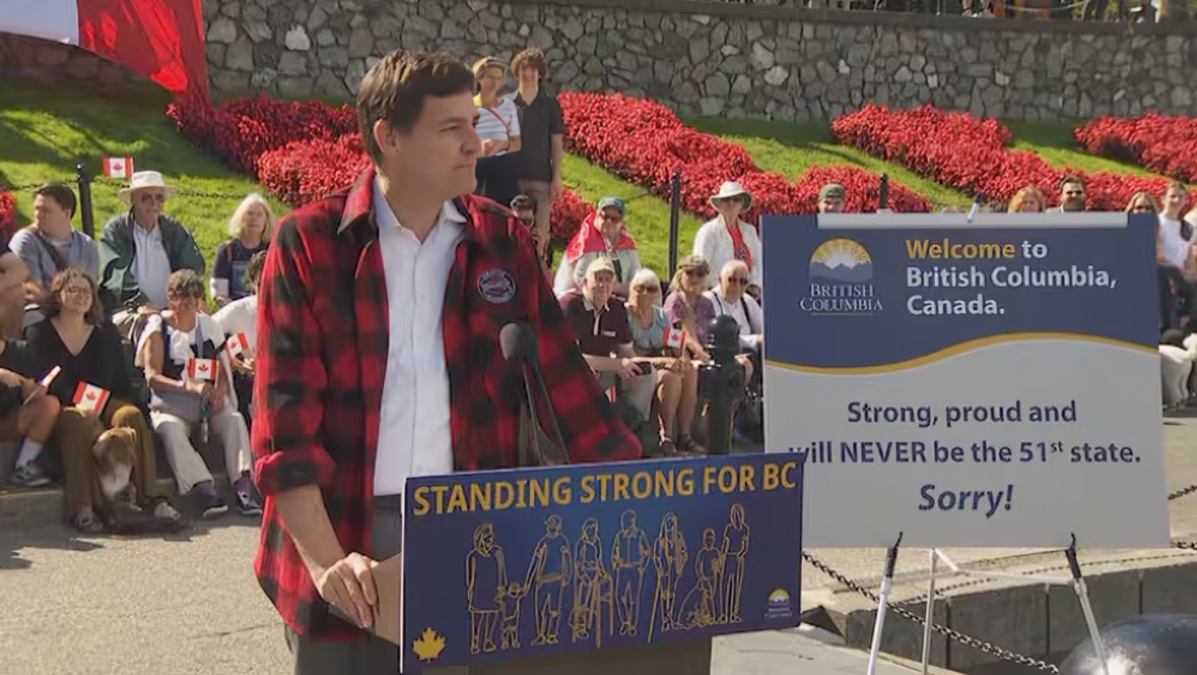
British Columbia has introduced a new political message at its border crossings with the United States, making it clear that the province considers its future firmly within Canada. The new signs carry the message, Welcome to British Columbia, Canada. Strong, proud, and will NEVER be the 51st state. Sorry. The signs were unveiled by British Columbia Premier David Eby as tensions between Canada and the United States continue over trade, tariffs and political relations.
The message is widely viewed as a response to US President Donald Trump’s repeated comments about Canada becoming the 51st state of the United States. Trump has raised the idea several times, including during discussions about trade and the economic relationship between the two countries. His remarks have generated strong reactions from Canadian political leaders and the public.
British Columbia’s new signs use a combination of national pride and humour to reject the idea. The wording emphasizes that the province is part of Canada and that its residents do not want to become part of the United States. The signs are expected to be displayed at border crossings in areas where large numbers of people travel between British Columbia and the United States.
Premier David Eby presented the signs as a confident response rather than a hostile message toward Americans. He emphasized that British Columbia values its relationship with the United States while also making clear that Canadian sovereignty is not negotiable. The province shares a long border with several US states, including Washington, Idaho and Montana, making cross border relations particularly important for residents and businesses.
The signs come at a time when Canada and the United States are dealing with significant trade tensions. Canada has introduced retaliatory measures in response to US tariffs, while Washington has imposed additional restrictions and tariffs on a range of Canadian products. The continuing dispute has created uncertainty for businesses on both sides of the border.
The political disagreement is also affecting public sentiment. Canadian leaders have increasingly emphasized the importance of protecting national sovereignty and reducing economic dependence on the United States. Prime Minister Mark Carney has said Canada needs to strengthen its economic independence and expand trade relationships with other countries.
The issue of Canada becoming the 51st US state has been particularly sensitive. Although Trump has repeatedly discussed the idea, Canadian political leaders have consistently rejected it. The proposal has also been widely criticized across Canada, with sovereignty and national identity becoming central themes in the country’s response to US political pressure.
The British Columbia signs therefore serve both as a local message for people crossing the border and as a broader political statement. Their wording reflects the province’s position that strong relations with the United States can continue without compromising Canadian identity or sovereignty.
The move also highlights the close but complicated relationship between British Columbia and neighbouring US states. The region has extensive economic links, including tourism, transportation, energy, agriculture and cross border business activity. Thousands of people regularly travel between the two countries, and many businesses depend on smooth border operations.
Despite the political disagreements, officials on both sides have continued to acknowledge the importance of Canada US cooperation. However, the latest signs demonstrate that Canadian provinces are willing to publicly respond when they believe their national identity or sovereignty is being challenged.
The phrase Never the 51st state has quickly become a symbolic expression of Canadian opposition to the idea of annexation. In British Columbia, the province has now placed that message directly at the international border, ensuring that visitors arriving from the United States see the province’s position immediately.
The new signs are therefore more than a tourism or welcome message. They represent British Columbia’s political response to a continuing dispute with its largest neighbouring country. While the wording is deliberately humorous, the underlying message is serious: British Columbia identifies itself as part of Canada and does not support becoming a US state.