
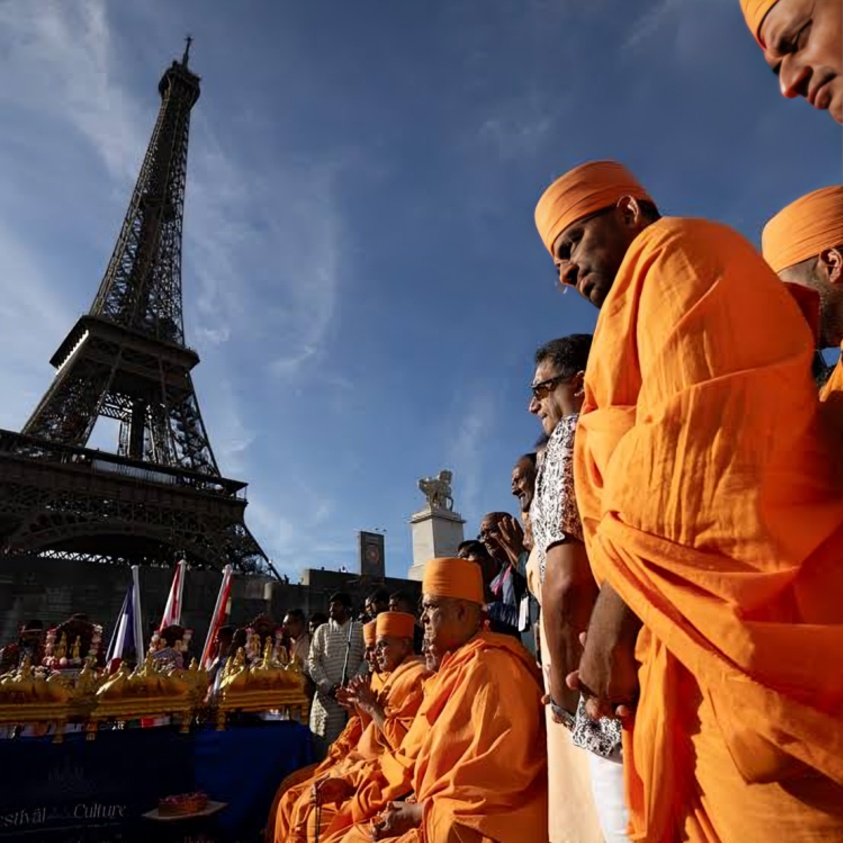
The Eiffel Tower in Paris was temporarily closed following a staff protest over allegations concerning the treatment of female employees during a private visit by a Hindu religious delegation. The incident has triggered a wider debate in France over workplace equality, religious accommodation and the treatment of women in public institutions.
The controversy relates to a visit by a delegation associated with the Bochasanwasi Akshar Purushottam Swaminarayan Sanstha, commonly known as BAPS. Reports said that approximately 100 people linked to the organisation visited the Eiffel Tower during a private event. The visit took place shortly after the inauguration of a major BAPS Hindu temple near Paris.
According to reports, female employees working at the Eiffel Tower were allegedly asked to leave certain workstations or areas during the delegation’s visit. Workers said they were upset by the instructions and regarded the incident as unacceptable treatment of female staff.
The Eiffel Tower’s operating company acknowledged that the visiting group had requested that interactions with women be limited during the private visit. The company has indicated that accepting such a request was inappropriate. The incident subsequently led to an employee protest, with staff members walking out and the landmark being temporarily closed to visitors.
The controversy has also prompted an investigation by Paris authorities. Paris officials said the allegations needed to be examined to establish what happened and why the instructions concerning female employees were issued. The investigation is expected to consider the circumstances surrounding the private visit and the decisions made by management.
Reuters reported that Paris authorities were investigating claims that female employees had been asked to vacate their workstations during the visit. A union representative said staff members were angered by the incident and wanted assurances that similar treatment would not occur again. Paris officials also expressed support for the concerns raised by employees.
The incident has attracted political attention because France places strong emphasis on equality between men and women in public life and workplaces. Several French political figures criticised the reported treatment of female employees and stressed the importance of equal treatment.
At the same time, the religious organisation involved in the visit has offered a different perspective. BAPS said that the visit was planned as a private early-hour event intended to minimise disruption to other visitors. The organisation apologised for any pain or inconvenience caused and said it took the concerns seriously. It also reaffirmed its commitment to mutual respect.
The organisation’s response is significant because the controversy does not establish that the delegation itself directly ordered Eiffel Tower employees to leave their posts. Reports indicate that the request concerning interactions with women was communicated in connection with the private visit, while the exact circumstances and responsibility for implementing the arrangement remain subject to investigation.
The dispute therefore involves several separate questions. One concerns what request was made by the visiting delegation. Another concerns how Eiffel Tower management responded to that request. A third concerns whether female employees were treated differently from male employees as a result of the arrangements.
Employees said they were particularly concerned about the principle involved rather than only the temporary disruption. Their protest reflected concerns that workplace policies should apply equally to male and female employees regardless of the religious or cultural background of visitors.
The temporary closure had an immediate effect on tourists. The Eiffel Tower is one of Paris’s most prominent tourist attractions, and an unexpected closure can affect thousands of visitors, particularly during busy travel periods. The landmark was expected to reopen after the staff dispute and discussions with management.
The controversy has also generated discussion about how major public attractions should accommodate religious groups while maintaining workplace policies and equality standards. Private visits by religious or cultural organisations can involve special security, privacy and operational arrangements. However, such arrangements can become controversial if employees believe they are being treated differently because of their gender.
French authorities are now expected to examine the incident in greater detail. The investigation could help clarify whether management acted outside established workplace policies and whether any changes are required in the way private delegations are handled.
The incident comes at a time when BAPS has received significant attention in France following the inauguration of its first major traditional Hindu temple near Paris. The temple opening was viewed by the organisation as an important milestone for the Hindu community in France. The subsequent controversy at the Eiffel Tower has therefore attracted considerable public interest.
It is important to distinguish between verified developments and allegations while reporting the incident. The closure of the Eiffel Tower following an employee protest is established. The allegations regarding female employees being sidelined have also been reported by multiple news organisations. However, the precise sequence of instructions and the responsibility for those instructions are matters being examined by authorities.
BAPS has not accepted the characterisation that the incident represented deliberate discrimination. Instead, the organisation expressed regret over the distress caused and said it respected the concerns raised. The Eiffel Tower operating company, meanwhile, has acknowledged that accepting a request to limit interactions with women was inappropriate.
The dispute highlights the challenges that can arise when religious practices, private-event arrangements and workplace equality intersect. For employees, the central concern is equal treatment at work. For religious organisations, accommodating the needs of visitors can involve cultural and religious considerations. For public institutions, however, such arrangements must operate within applicable workplace and equality standards.
As the investigation continues, further information could clarify how the decision was made, who approved the arrangements and whether any internal policies were breached. The outcome may also influence how private religious and cultural delegations are accommodated at major public attractions in Paris.
The Eiffel Tower staff protest has consequently developed from a workplace dispute into a broader public debate over equality, religious accommodation and institutional responsibility. The incident also demonstrates why allegations involving religious communities and gender discrimination require careful reporting, clear attribution and an evidence-based approach.
For now, authorities are examining the circumstances, the Eiffel Tower has resumed or is expected to resume normal operations, and the organisation involved has expressed regret over the controversy. Further developments are likely to depend on the findings of the Paris investigation and any subsequent response from the tower’s management and employee representatives.