
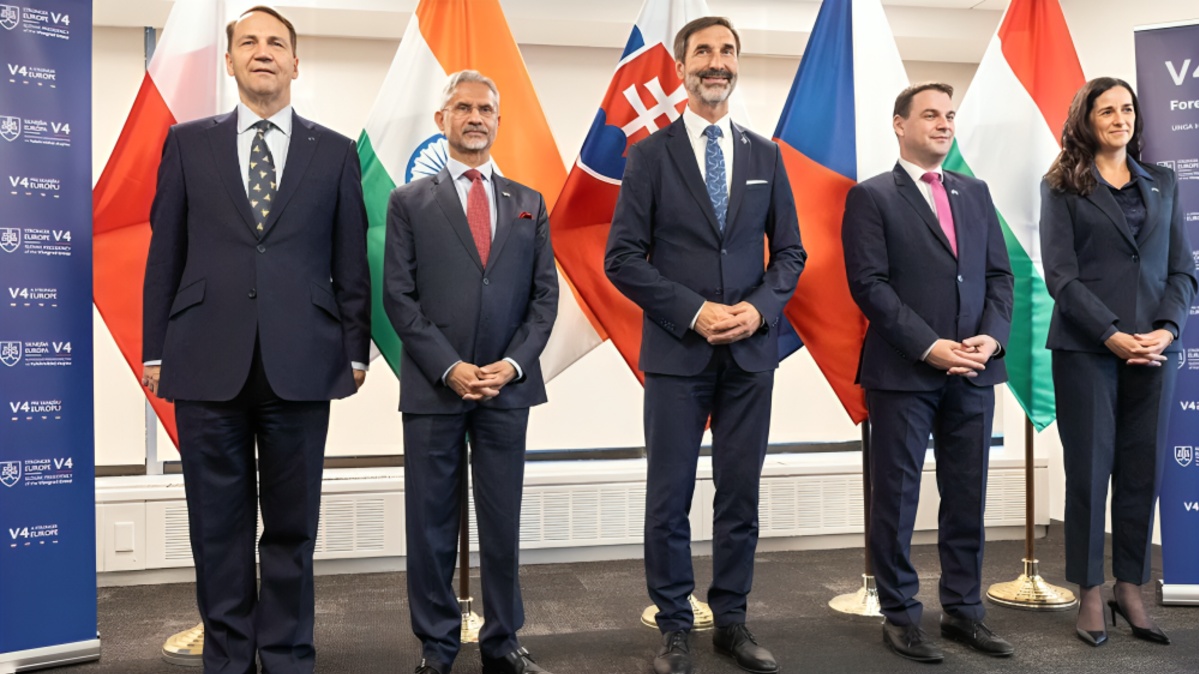
India’s long-standing campaign for a permanent seat on the United Nations Security Council received fresh support from four Central European countries during a high-level diplomatic meeting in New York.
Poland, Hungary, Slovakia and the Czech Republic, which together form the Visegrad Group, expressed support for India’s bid for permanent membership of the United Nations Security Council. The endorsement came during the first Visegrad Group India Foreign Ministers Meeting held on the sidelines of the 81st session of the United Nations General Assembly.
External Affairs Minister S Jaishankar participated in the meeting along with foreign ministers from the four Visegrad countries. The meeting brought together representatives of India, Poland, Hungary, Slovakia and the Czech Republic for discussions on international affairs and bilateral and multilateral cooperation.
Slovak Foreign Minister Juraj Blanar said after the meeting that all four Visegrad countries supported India’s inclusion as a permanent member of the UN Security Council. He referred to India’s role in the Global South and its growing importance in the Indo Pacific region while explaining the position of the four countries.
The development adds another group of European countries to the list of nations that have expressed support for India’s campaign for permanent membership of the Security Council. However, the endorsement does not itself change the composition of the Security Council. Any expansion of permanent membership requires agreement through the United Nations reform process and the procedures required for amendments to the UN Charter.
The UN Security Council currently has 15 members. Five countries hold permanent seats, namely China, France, Russia, the United Kingdom and the United States. The remaining 10 members are elected for two year terms. India has previously served several terms as an elected non permanent member of the Security Council and has continued to call for reform of the council.
India has argued that the composition of the Security Council should better reflect contemporary global realities. New Delhi has particularly highlighted the representation of developing countries and the Global South in discussions on reform of the United Nations.
The latest Visegrad Group support came as India and the four Central European countries also discussed ways to expand their overall cooperation. Jaishankar described the first V4 India meeting as an important development in relations between the countries.
The participating countries agreed to strengthen political engagement through regular meetings of foreign ministers. They also discussed the creation of an annual business forum aimed at expanding economic cooperation. Technology, innovation, research, education, defence, space, connectivity and people to people relations were among the other areas discussed during the meeting.
The discussions also covered major international developments, including the conflict in Ukraine and developments in the Gulf region. The participating ministers exchanged views on global security and other international issues in addition to discussing bilateral and regional cooperation.
The Visegrad Group consists of Poland, Hungary, Slovakia and the Czech Republic. The four countries have maintained a regional cooperation framework covering areas such as political coordination, economic relations, security, culture and other areas of common interest.
The first V4 India Foreign Ministers Meeting therefore provided a new platform for India to engage collectively with the four Central European countries. The participating governments agreed to continue the format and strengthen cooperation across several sectors.
India’s permanent membership campaign has received support from several individual countries over the years. France, the United Kingdom, the United States and Russia have also expressed support for India’s permanent membership in an expanded Security Council, although the broader reform process involves questions about the number of additional permanent members, regional representation and the future role of the veto.
The latest support from Poland, Hungary, Slovakia and the Czech Republic should therefore be understood as a diplomatic endorsement of India’s candidature rather than as a completed reform of the Security Council. The four countries are members of the Visegrad Group and their position does not represent a formal decision by the European Union as a whole.
The issue of Security Council reform remains part of wider discussions at the United Nations. Any change to the permanent membership structure would require the necessary UN Charter amendment process. Under Article 108 of the UN Charter, amendments require adoption by a two thirds majority of the General Assembly and ratification by two thirds of UN member states, including all five permanent members of the Security Council.
For India, the latest endorsement provides another diplomatic statement of support as New Delhi continues to advocate for reform of the United Nations system. The discussions in New York also indicate that India’s engagement with the four Central European countries extends beyond the Security Council issue to economic, technological, defence and educational cooperation.
The next stages of India’s campaign will depend on the broader intergovernmental negotiations on Security Council reform and the positions taken by UN member states. The support announced by the four Visegrad countries is one part of that continuing diplomatic process.